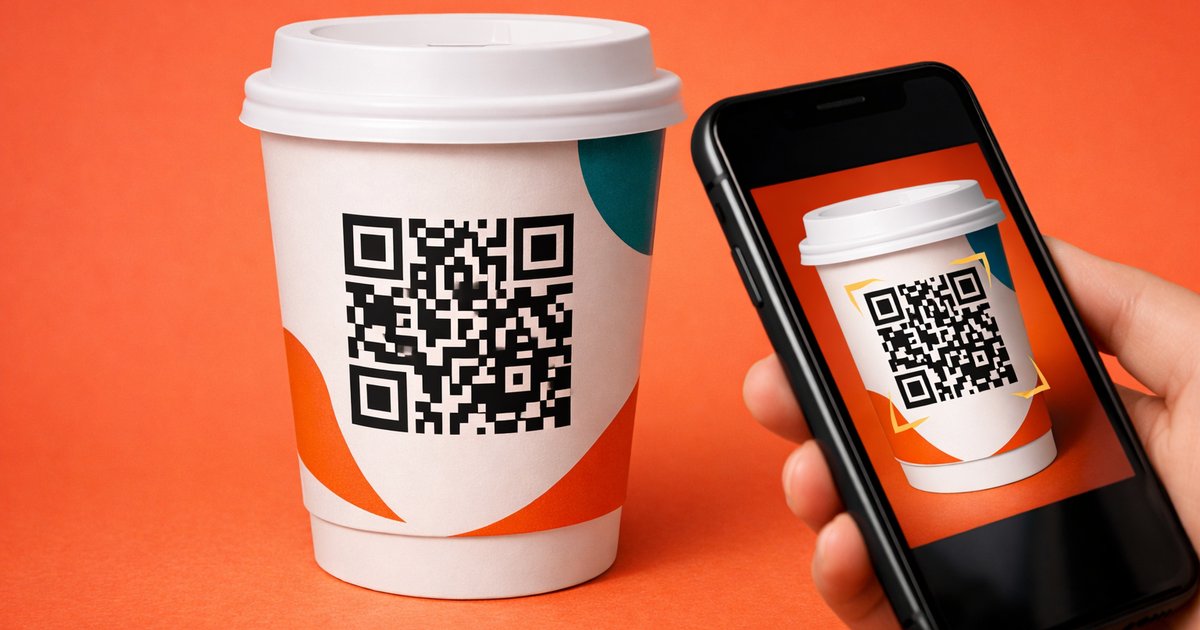
Yes — QR codes on coffee cups can work, but only when they’re visible, scannable and offer immediate value. This guide explains practical design, printing and tracking steps so your QR codes deliver measurable results.
Quick summary
- Print recommendations: minimum 20 mm × 20 mm, preferred 30–40 mm, 2–3 mm quiet zone, high contrast and flat placement.
- Track with UTM parameters or unique promo codes and test using a sample pack before a full run.
Do QR codes on coffee cups get scanned?
Short answer: sometimes. In most café settings you’ll see low single-digit scan rates unless the code is obvious, the reward is immediate and staff encourage customers to scan. Use a fast, mobile-optimised landing page and a clear value-led CTA to increase engagement.
Why QR codes succeed or fail
Common reasons they fail
- Poor size, placement or printing over seams/curved panels — the code becomes unreadable.
- Low contrast or decorative backgrounds that break the QR pattern.
- Sending customers to a generic homepage with no instant reward.
- Slow or non-mobile-friendly landing pages that cause abandonment.
- No obvious CTA telling customers what they’ll get.
How to make them work
- Design for scannability: prefer 30–40 mm when space allows; minimum 20 mm × 20 mm. Leave a 2–3 mm quiet zone around the code.
- High contrast: dark code on a light, plain background (black on white ideal).
- Smart placement: print on a flat panel away from seams and the rim so customers can easily point their phones.
- Clear CTA: short value-led text — e.g. “Scan for 10% off” or “Join our coffee club — free muffin”.
- Fast landing page: mobile-first, loads quickly and is trackable with UTM parameters or a unique promo code.
- Staff prompts: baristas saying “scan this for today’s deal” will materially lift scans.
Practical printing tips
Size, quiet zone and placement
Minimum recommended size: 20 mm × 20 mm. Preferred: 30–40 mm when space allows — larger codes are easier to scan when a cup is moving or held at arm’s length. Always leave a clear quiet zone (2–3 mm) around the code. Test a printed sample in real café lighting and while the cup is held — curvature and motion affect scannability.
Contrast and artwork
Keep the QR on a plain, high-contrast area and avoid placing it over images or busy patterns. Our full-colour CMYK print reproduces high-resolution QR codes, but the artwork must respect contrast and quiet-zone rules to remain scannable. We supply artwork templates (AI & PSD) and a design layout service to help position the code correctly.
Instruction and value
Tell customers exactly what they’ll get: “Scan to claim 10% off”, “Join and get a free muffin”, or “Scan for today’s secret deal”. Immediate, tangible rewards increase scan rates more than vague incentives.
What to link QR codes to (and what to avoid)
Avoid sending people to a generic homepage. Better destinations are focused, immediate and mobile-friendly:
- Discount or coupon landing page (auto-apply voucher or unique promo code)
- Loyalty sign-up with instant points or a welcome reward
- Short survey with a small incentive (keeps interaction quick)
- Menu, allergen or ingredient information for transparency
- Social follow offer with a quick reward (e.g. show follow to redeem)
For reliable attribution tie scans to unique promo codes or landing pages and capture opt-in for email/SMS where appropriate.
Tracking scans and measuring ROI
Add UTM parameters so QR visits appear separately in Google Analytics (example: ?utm_source=cup&utm_medium=qr&utm_campaign=easterpromo). For short campaigns use a unique URL or promo code printed on the cup so redemptions can be directly matched to that cup run. Consider a short redirect (e.g. yourbrand.co/cup) that forwards to the full campaign URL so you can change the destination later without reprinting.
Measure conversions (coupon redemptions, sign-ups) and calculate cost-per-acquisition vs the cup spend to decide if the campaign is delivering value.
Alternatives and useful fallbacks
Not everyone will scan — include simple fallbacks to capture additional responses:
- Short URL under the QR code (easy to type and track via redirects)
- Social handle or @tag for direct follows
- SMS keyword where appropriate (example: “Text COFFEE to 0450 000 000”)
Testing and rollout — a practical approach
Start small. Order a sample pack with your QR design and test under real conditions: different lighting, while customers hold the cup and at typical serving distances. Track scans and conversions for at least a week, tweak the CTA or landing page, then roll out the larger order.
Order a sample pack to test scan rates and placement before committing to a full run.
Printing with CustomCoffeeCups.com.au — what you need to know
We print QR codes as part of our full-colour CMYK process, supply artwork templates and offer a design layout service. Sample packs are available so you can test scans before production. If you want help setting up UTMs or unique landing URLs we can advise on best practice and proof the artwork to maximise scannability.
| Item | Details |
|---|---|
| Minimum order | 500 cups |
| Standard turnaround | 10 business days production + 2–3 days metro freight |
| Rush option | 5–7 business days |
| Free services | Free templates |
Quick pre-print checklist
- Printed size at least 20 mm × 20 mm (30–40 mm preferred).
- High contrast and 2–3 mm quiet zone around the code.
- Place on a flat face away from seams and the rim.
- Link to a mobile-optimised, trackable landing page with UTM parameters or a unique code.
- Add a clear, value-led CTA (discount, points, freebie).
- Order a sample pack and test scannability under real conditions.
QR codes on coffee cups are best used to drive incremental engagement — they aren’t a mass-traffic channel by themselves. Expect low single-digit scan rates unless you combine a visible, correctly sized code with a strong offer, clear CTA and staff encouragement.
Ready to try QR codes on your cups? We’ll help with artwork, templates and proofs to maximise scannability. View our custom printed coffee cups or order a sample pack to test scans and placement. For more planning tips, see our complete buyer’s guide to custom printed coffee cups in Australia.
Want help designing your QR code? Contact us for a layout and proof — we’ll position and test your QR before production.