Author: admin

  • Your Custom Cups Have Arrived: What to Check Before You Use Them

    Your Custom Cups Have Arrived: What to Check Before You Use Them

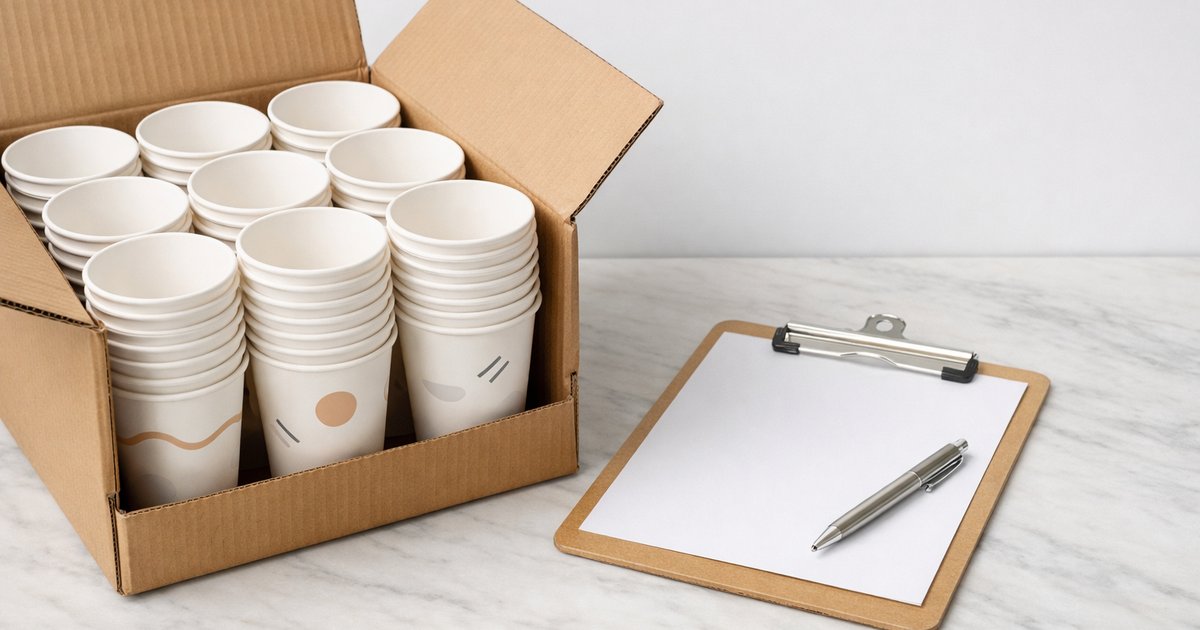
    Short answer: spend ten minutes on the delivery before you put it away. Check the carton count against the paperwork, open one carton and compare a cup against your approved proof, look for transit damage, test a lid, then store the rest properly. Problems found on day one are straightforward to resolve. Problems found in week six, halfway through the stock, are much harder for anyone to help with.

    Do this before the driver leaves

    • Count the cartons against the delivery docket. Not the cups, the cartons. Takes thirty seconds.
    • Look at the outside of every carton. Crushed corners, water staining, punctures or tape that has been opened and resealed.
    • Note any damage on the docket before signing. A signature with no notation makes a transit claim considerably harder.
    • Photograph anything that looks wrong while it is still on the truck or the pallet.

    Freight damage is the one category where the evidence disappears fastest.

    Open one carton and check the print

    Have your approved proof in front of you. Not your original artwork file, the proof you signed off, because that is the agreed reference.

    • Colour. Compare against the proof, in daylight if you can. Some shift between screen and cup stock is expected and normal, which is why the proof exists. What you are looking for is a clear departure from what was approved. See CMYK vs RGB.
    • Registration. Are the colour layers aligned, or is there a visible halo or double edge around detail?
    • Position. Is the artwork sitting where it should vertically, with sensible clearance at rim and base?
    • The seam. Check nothing critical has been swallowed by the overlap. See bleed, safe zone and wrap.
    • Text and fine detail. Read the small text. Check any QR code actually scans, with a phone, now.
    • Consistency. Pull five or six cups from different points in the sleeve rather than judging from the top one.

    Check the physical cups

    • Rim. Run a finger around the curl. It should be smooth, even and continuous.
    • Base. Sit a cup on a flat surface. It should sit flat and not rock.
    • Seam. Should be flat and firmly bonded, with no lifting edge.
    • Nesting. Cups should separate cleanly from each other. Cups that stick together are a service problem at the counter.
    • Feel and smell. Board should feel crisp, not soft or limp. Any strong odour means the stock has picked something up and should be raised straight away.

    The water test

    Take one cup, fill it with hot water, and leave it on a clean dry surface for ten minutes. Then look underneath and at the seam.

    It costs you one cup and it is the only way to verify the seals before a customer does it for you. If it leaks, test two or three more from different cartons to establish whether it is an isolated cup or a batch issue. See why paper cups leak.

    Test the lids

    If lids came with the order, fit one now. It should seat evenly all the way round and stay put when the cup is tilted.

    Confirm the diameters match your sizes: 80mm lids for 6oz and 8oz, 89mm for squat 8oz, 12oz and 16oz. A mismatch here is the most common ordering error and the easiest to fix on day one. See squat vs tall cups and the lids guide.

    Then store them properly

    Once you are satisfied, storage determines whether the cups are still good in three months.

    • Keep cups in their sleeves and cartons until needed. That packaging is structural.
    • Off the floor, on a pallet or shelving.
    • Dry, away from any damp wall or wet area.
    • Out of direct sunlight, which fades print over time.
    • Away from strong-smelling stock and cleaning chemicals, because board absorbs odour.
    • Nothing heavy stacked on top.
    • Rotate stock, oldest first.

    Full detail in how to store paper coffee cups.

    The ten-minute checklist

    Step Check
    1 Carton count matches the docket
    2 No transit damage, noted on the docket if there is
    3 Print matches the approved proof for colour, registration and position
    4 Several cups checked from different points, not just the top one
    5 Rim, base and seam sound; cups nest and separate cleanly
    6 Hot water test passed
    7 Lids fit and seat correctly
    8 Stored dry, off the floor, out of sunlight

    If something is wrong

    Contact us straight away rather than working around it. Have ready: your order number, clear photographs of the issue, roughly how many cups are affected, and which cartons they came from.

    Raising it immediately, with photographs, on an unopened majority of stock is the strongest position for everyone. Working through half the order first makes it much harder to establish what happened.

    Where to go from here

    Contact us if anything is not right. Planning your next order? See how many cups your cafe needs and how long custom cups take to produce.

  • The History of the Takeaway Coffee Cup, 1907 to Today

    The History of the Takeaway Coffee Cup, 1907 to Today

    Short answer: the paper cup was invented in 1907 as a public health measure, not a convenience product. It was created to stop people sharing communal tin drinking cups, and everything else about it, including the branding surface you are probably buying it for, came later.

    The shared dipper problem

    In the early 1900s, public drinking water in the United States was commonly served from a barrel with a shared tin cup or dipper attached. Everyone used the same cup. As germ theory took hold, this became recognised as an obvious route for transmitting disease, and public health campaigners began pushing to ban the practice.

    That created a gap. If you remove the communal cup, people still need something to drink from.

    1907: Lawrence Luellen’s invention

    Lawrence W. Luellen, a lawyer and inventor based in Boston, developed a disposable paper cup in 1907. His design used a circular blank of paper treated with paraffin wax, pleated into a one-piece cup that held its shape.

    The wax is worth noting. Every cup since has needed some way to stop paper dissolving when it meets liquid, and modern polyethylene and plant-based linings are direct descendants of that first paraffin treatment. See what paper coffee cups are made from.

    In 1910, Luellen partnered with Hugh Moore to form the Individual Drinking Cup Company of New York. The early product was sold through vending machines that dispensed cold water with a clean cup, positioned squarely as a hygiene product.

    1919: how it got the name Dixie

    The cup was initially marketed as the Health Kup, which tells you exactly how it was being sold. In 1919 it was renamed the Dixie Cup.

    The name came from a neighbour. Hugh Moore sought and received permission from doll-maker Alfred Schindler to borrow the name from Schindler’s Dixie Doll Company, with whom the business shared manufacturing space. One of the most recognisable names in disposable packaging came from the sign on a shared building.

    From water to hot coffee

    A wax-lined cup handles cold water well and hot coffee badly, since wax softens with heat. The move to hot beverages required better linings and stronger board construction, and it followed the growth of coffee culture through the mid-century.

    The double wall cup, which adds a second outer layer with an insulating air gap, is a comparatively recent refinement addressing the problem that a hot drink in a single layer of board is uncomfortable to hold. See single wall vs double wall coffee cups.

    1963: the Anthora, and the cup as an icon

    In 1963, Leslie Buck, born Laszlo Büch, a Czech immigrant, designed a cup for the Sherri Cup Company of Connecticut. Aimed at New York’s Greek-owned diners, it used a blue and white palette with a Greek meander pattern, amphora motifs and the words “We Are Happy To Serve You”.

    The Anthora became one of the most recognisable objects in New York City, appearing constantly in film and television as visual shorthand for the city itself.

    It is the moment the takeaway cup stopped being purely functional. A printed cup could carry identity, and people formed an attachment to it. Everything the industry now does with branded cups traces back to that idea.

    The Australian chapter

    Australia’s takeaway coffee culture developed along its own path, shaped by postwar Italian and Greek migration bringing espresso culture to Melbourne and Sydney, and by a strong cafe tradition that produced drinks the rest of the world later adopted, the flat white being the obvious example.

    One consequence is that Australian cup sizing skews smaller than the American norm, because the drinks are shorter and stronger. It is also why cup profile matters here, with squat cups suiting milk-based coffee where the surface of the drink is part of the presentation. See squat vs tall cups.

    The reckoning

    The cup was invented to solve a public health problem, and by solving it at scale it created a waste problem. Australia now uses an estimated 1.8 billion single-use hot drink cups a year, most of which go to landfill because the lining that makes a cup work also makes it hard to recycle.

    The current era of the cup is about that tension: compostable linings, separate collection schemes, state regulations on single-use items, and honest accounting for impact. See how many cups Australia uses and single-use cup regulations in Australia.

    The through line

    Look at the arc and one thing stands out. Every stage of this history has been driven by the lining. Paraffin made a disposable cup possible in 1907. Better linings made hot drinks possible. The lining is what stops cups being recycled today, and changing it is the centre of every serious attempt to fix that.

    A takeaway cup is, and always has been, a piece of paper wrapped around a barrier. The interesting part was never the paper.

    Where to go from here

    To design your own, start with our buyer’s guide to custom printed coffee cups.

    Sources

    • Hugh Moore Dixie Cup Company Collection, Lafayette College
    • Dixie Cup company history
  • Cup Recycling Programs in Australia: How They Actually Work

    Cup Recycling Programs in Australia: How They Actually Work

    Short answer: your kerbside recycling bin cannot process a plastic-lined cup, but dedicated collection programs can. They work by keeping cups out of general waste entirely, collecting them separately, and sending them to processors with technology that separates the plastic liner from the paper fibre. Simply Cups is the best-established program in Australia. It is a paid service, and it only works if your team actually uses it properly.

    Why a separate program is needed at all

    A takeaway cup is paperboard laminated to a thin plastic film. Standard material recovery facilities are not equipped to separate them, so cups in a kerbside bin are generally screened out and landfilled, and can contaminate the paper stream on the way.

    That is the gap these programs fill. They are not a different bin for the same system. They are a parallel collection route to a different kind of processor. Background in are paper coffee cups recyclable in Australia.

    Simply Cups

    Simply Cups is an initiative of Closed Loop and is Australia’s largest paper cup recycling program. The model works like this:

    • You register as a collection point and receive collection equipment, typically a dedicated back-of-house 240 litre bin.
    • Cups are collected separately from your general waste, on a schedule you choose. Weekly, fortnightly and four-weekly options are available depending on your volume.
    • Collected cups go to processors who separate the liner from the fibre.
    • The recovered material is turned into products such as bench seating, kerbing and car stops.
    • You receive reporting on the volume collected, which is genuinely useful if you report on sustainability.

    It is a paid service, charged as a regular fee that depends on your collection frequency and volume. Pricing changes, so get a current quote directly rather than relying on a figure quoted on a blog.

    Other routes worth knowing

    • Council and precinct schemes. Some councils and business districts run cup collection trials or permanent programs. These come and go, so check what is currently operating in your area rather than assuming.
    • Large site programs. Universities, hospitals, stadiums and corporate campuses often run their own collections, which is why you will see dedicated cup bins on campuses. See university and school branded cups.
    • Commercial organics. If you use compostable cups and have a commercial organics service that explicitly accepts certified compostable packaging, that is a legitimate route. Confirm acceptance in writing, because many organics streams exclude packaging. See can compostable cups go in my green bin.
    • Responsible Cafes. Focused on encouraging reusables rather than collecting cups, but a useful network if reducing cup volume is your aim.

    What actually determines whether it works

    Every venue that has tried this will tell you the same thing: the technology is not the hard part. Contamination is.

    • Lids and straws are usually not accepted with the cups, because they are a different material. They have to be separated at the bin.
    • Liquid must be emptied. Cups half full of coffee cause problems downstream.
    • Front of house versus back of house matters. A public-facing bin gets contaminated by customers. Staff-managed back-of-house collection is far more reliable, which is why programs are often set up that way.
    • Signage and staff briefing are not optional. A bin with no explanation becomes a general waste bin within a week.

    A badly run collection produces a contaminated load that gets rejected, which means you paid for a service and still sent cups to landfill.

    Questions to ask before signing up

    1. What is the total cost, including equipment, collection and any minimum term?
    2. What exactly is accepted, and are lids included or excluded?
    3. What is the contamination threshold, and what happens to a rejected load?
    4. Is my location actually serviced, at the frequency I need?
    5. What reporting do I receive, and in what format?
    6. What happens to the material afterwards, specifically?

    Be careful how you advertise it

    Joining a program does not make your cups recyclable in a general sense, and it does not entitle you to print “recyclable” on them. What you can accurately say is that your venue participates in a cup collection program, and that cups returned to your venue are recycled through it.

    That distinction matters under Australian Consumer Law. See eco claims on coffee cups.

    The honest ranking

    If reducing cup impact is the goal, in order of effect:

    1. Serve sit-in customers in ceramic. Free, immediate, and removes the cup entirely.
    2. Encourage reusables for regulars, with a discount if it suits your pricing.
    3. Join a collection program for the cups you genuinely cannot avoid.
    4. Choose the lining deliberately, matched to the disposal route you actually have.
    5. Order accurately so you are not throwing away unused stock. See how many cups your cafe needs.

    Note that changing cup material sits fourth. Where the cup goes matters more than what it is made of, which is the single most useful thing to understand about this topic.

    Where to go from here

    See how to make your coffee cup packaging more sustainable and how many cups Australia uses each year. For compostable options, view our compostable custom coffee cups.

  • Eco Claims on Coffee Cups: What You Can Legally Print

    Eco Claims on Coffee Cups: What You Can Legally Print

    Short answer: the words you print on a cup are marketing, and environmental marketing is regulated. Under Australian Consumer Law you must be able to substantiate green claims, and the ACCC has published eight principles setting out what good practice looks like. “Eco”, “green” and “environmentally friendly” printed on their own are exactly the kind of broad, unqualified claims the regulator warns against.

    This is general information to help you ask better questions, not legal advice. If a claim is central to your marketing, get it reviewed properly.

    Why a cup counts as advertising

    Businesses tend to think of packaging as packaging and advertising as advertising. The law does not draw that line. A statement printed on a cup, presented to a customer as a reason to feel good about a purchase, is a representation to consumers in trade or commerce.

    Misleading or deceptive conduct provisions apply to it, the same as they would to a billboard. The ACCC considers a business to be greenwashing where it uses a claim making a product seem better or less harmful for the environment than it really is.

    The ACCC’s eight principles

    In December 2023 the ACCC published Making environmental claims: A guide for business, setting out eight principles:

    1. Make accurate and truthful claims
    2. Have evidence to back up your claims
    3. Don’t hide or omit important information
    4. Explain any conditions or qualifications on your claims
    5. Avoid broad and unqualified claims
    6. Use clear and easy-to-understand language
    7. Visual elements should not give the wrong impression
    8. Be direct and open about your sustainability transition

    Principles 5 and 7 are the ones takeaway cups trip over most often, for reasons worth spelling out.

    Where cup claims go wrong

    “Eco-friendly” and “green” on their own

    These are the textbook broad, unqualified claims. Friendly compared with what? In which respect? A claim that cannot be tested cannot be substantiated. Say the specific thing instead.

    “Recyclable” without the conditions

    The high-risk claim for cups. A standard lined cup is technically recyclable only where specialised separation processing exists, which is not most kerbside systems. Printing “recyclable” with no qualification tells a customer they can put it in their yellow bin, which is generally wrong. See are paper coffee cups recyclable in Australia.

    If a claim depends on conditions, principle 4 says explain them.

    “Compostable” without saying which kind

    Industrial composting and home composting are different claims with different standards behind them. A cup certified for industrial composting is not a home compostable cup, and a customer putting it in a backyard bin has been misled. Access to industrial organics collection also varies by council. See what compostable actually means.

    Visual greenwashing

    Principle 7 catches what the words do not. Green colourways, leaf motifs, kraft-brown stock and imagery of forests all communicate an environmental claim without stating one. If the cup is a standard plastic-lined cup, that visual language may create a misleading impression on its own.

    This is the practical risk in choosing kraft board and letting it do your marketing for you. See are kraft coffee cups actually more eco-friendly.

    Symbols and logos you are not entitled to use

    Certification marks belong to certification schemes. Use one and you are representing that the product holds that certification. Only use marks you hold current certification for, and only in the form the scheme permits. A generic recycling arrows symbol is also a representation, not decoration.

    Better and worse ways to say it

    Risky Why Safer
    Eco-friendly cup Broad, unqualified, untestable Name the specific attribute you can evidence
    Recyclable Usually conditional on specialist processing State where and how it can actually be recycled
    Compostable Ambiguous between industrial and home Certified commercially compostable, where facilities accept it
    Plastic-free Often untrue of the lining Only if the whole cup genuinely contains no polymer
    Carbon neutral Requires a substantiated methodology Only with a documented, verifiable basis

    A practical process before you print

    1. Write down every environmental claim on the artwork, including implied ones from colour and imagery.
    2. For each, ask what evidence you hold. Not what your supplier said in an email. A document.
    3. Get supplier documentation in writing, naming the specific stock, certification and standard.
    4. Add the conditions. If a claim depends on facilities being available, say so.
    5. Check the visuals separately. Cover the words and ask what the design alone implies.
    6. Keep the file. Substantiation you cannot produce later is not substantiation.

    Proofing is the natural checkpoint for this, because it is the last moment before thousands of cups carry the claim. See how coffee cup printing works.

    How we handle it

    We will tell you what our stock is and provide what documentation the manufacturer supplies. We will not write green marketing copy for you or sign off claims, because the claim is yours and the substantiation obligation sits with the business making it.

    If you want to say something specific about your cups and are unsure whether it holds up, ask us what the material actually is and start from the facts.

    Where to go from here

    Read the ACCC’s Making environmental claims: A guide for business on the ACCC website. Then see compostable vs standard paper cups and cup recycling programs in Australia for what you can genuinely say about end-of-life.

  • How Many Takeaway Coffee Cups Does Australia Use Each Year?

    How Many Takeaway Coffee Cups Does Australia Use Each Year?

    Short answer: Australia is generally estimated to use around 1.8 billion single-use hot drink cups a year, and the large majority go to landfill because standard kerbside recycling cannot process a plastic-lined cup. Below are the commonly cited figures, who publishes them, and the caveats that rarely get mentioned alongside them.

    The headline figures

    Figure Commonly cited value Source
    Single-use hot drink cups per year ~1.8 billion Widely cited, including WWF-Australia and Simply Cups
    Share going to landfill The large majority Clean Up Australia and others
    Cups as a litter item Among the most collected items in national clean-up data Clean Up Australia Litter Report

    Some sources put the total nearer 1.5 billion and others above 1.84 billion. That spread tells you something important about the numbers, which we come back to below.

    What that scale means in practice

    1.8 billion cups a year works out at roughly 5 million a day, or about 70 cups per Australian per year. For an individual, that is a coffee or two a week in a takeaway cup, which sounds unremarkable. Multiplied by a population, it becomes a waste stream.

    Why so few are recycled

    This is the part that surprises people, and it is not about consumer behaviour.

    A takeaway cup is a laminate of paperboard and a thin plastic film. Most Australian paper mills and material recovery facilities cannot separate those two materials, so a cup put in a kerbside recycling bin is generally screened out and sent to landfill anyway.

    Putting cups in the recycling bin does not fix this, and can contaminate the paper stream. The full explanation is in are paper coffee cups recyclable in Australia.

    Specialised processing does exist. Programs such as Simply Cups collect cups separately and use technology that separates the liner from the fibre, with the recovered material going into products like bench seating and kerbing. That requires separate collection, not kerbside. See cup recycling programs in Australia.

    What about compostable cups?

    Compostable cups only deliver their benefit if they reach an industrial composting facility that accepts them. In a general waste bin they go to landfill like any other cup, and in a kerbside recycling bin they are a contaminant.

    Access to appropriate organics collection varies enormously by council. See can compostable cups go in my green bin.

    Read these numbers carefully

    We would rather set out the limitations than repeat a statistic with false confidence.

    • They are estimates, not measurements. No one counts cups nationally. Figures are modelled from consumption data, industry supply estimates and surveys, which is why credible sources disagree.
    • Definitions differ. Some counts cover hot drink cups only. Others include cold cups, lids or all disposable food service items. Comparing two numbers built on different definitions is meaningless.
    • Many figures are years old. A statistic quoted in 2026 may trace back to a study conducted well before the pandemic reshaped takeaway behaviour.
    • Round numbers travel. “1.8 billion” gets repeated because it is memorable, and repetition is not corroboration.

    If you are citing a figure in a tender, a sustainability report or marketing material, trace it to its original source and cite that. And be aware that using such figures in your own environmental marketing brings ACCC obligations, covered in eco claims on coffee cups.

    What actually moves the number

    For a cafe, the interventions that measurably reduce cup volume are unglamorous:

    • Ceramic for sit-in customers. The largest single reduction available, and it lowers your costs.
    • Separate cup collection. Changes where cups go, which is the actual problem.
    • Accurate ordering. Unused and damaged stock is waste before it ever holds a coffee. See how many cups your cafe needs.
    • Lids only when asked. A meaningful share of drinks do not need one.

    Notice that changing cup material is not top of that list. Where the cup ends up matters more than what it is made of.

    Our position

    We sell single-use printed cups, so we have an obvious interest here. Our view is that takeaway cups serve a real purpose, that the volumes involved are genuinely large, and that businesses should reduce where they can and handle the rest properly. Pretending the waste question does not exist helps nobody.

    Where to go from here

    For the environmental detail, read the carbon footprint of a paper coffee cup and how to make your packaging more sustainable. For state rules, see single-use cup regulations in Australia.

    Sources

    • Clean Up Australia, Single Use Coffee Cups, and the annual Litter Report
    • WWF-Australia and Plastic Free July, policy briefing on disposable coffee cups
    • Simply Cups, an initiative of Closed Loop
    • Department of Climate Change, Energy, the Environment and Water, coffee cup recycling
  • Squat vs Tall Cups: Why Two 8oz Cups Aren’t the Same Shape

    Squat vs Tall Cups: Why Two 8oz Cups Aren’t the Same Shape

    Short answer: two cups can both hold 8oz while being completely different shapes. A tall 8oz is narrow and upright with an 80mm rim. A squat 8oz is wider and shorter with an 89mm rim, the same diameter as a 12oz. They hold the same drink and they do not take the same lid. That difference is the single most common cause of ordering the wrong lids.

    Same volume, different geometry

    Volume is a product of diameter and height, so there is more than one way to build a cup that holds a given amount. Manufacturers make both because they suit different service styles.

    • Tall 8oz. Narrower and taller. The standard takeaway profile in most of Australia, and what people usually picture as a small takeaway coffee.
    • Squat 8oz. Wider and shorter, with a broader opening. Common in cafe and dine-in-adjacent service, and popular for flat whites and cappuccinos where a wider surface shows off latte art and gives a better ratio of crema to cup.

    Why the shape genuinely matters

    Drink presentation. A wider mouth gives more surface area, which is why squat cups suit milk-based coffee where the top of the drink is part of the product.

    Stability. A shorter, wider cup has a lower centre of gravity, so it is less prone to tipping on a tray or a car cup holder. A tall cup is easier to hold in one hand.

    Fit in service equipment. Under-machine clearance, cup dispensers and carriers are all sized around specific profiles. Changing profile can quietly break part of your workflow.

    Print area shape. A squat cup gives you a short wide canvas, a tall cup a taller narrow one. The same artwork does not sit the same way on both, which matters if you are designing a wrap. See bleed, safe zone and wrap.

    The lid trap

    This is the practical consequence and it costs people money every year.

    Lids fit by rim diameter, not by cup volume. Order lids by the number on the cup and you will eventually get it wrong.

    Cup Rim diameter Lid size
    6oz 80mm 80mm
    8oz (tall) 80mm 80mm
    8oz squat 89mm 89mm
    12oz 89mm 89mm
    16oz 89mm 89mm

    Read that table again on the 8oz rows. A squat 8oz takes the same lid as a 12oz, not the same lid as a tall 8oz. An order for “8oz lids” is ambiguous unless you say which profile you have.

    The symptom of getting it wrong is a lid that will not seat, or one that sits on but pops off when the cup is moved, which usually presents as a leak. See why paper cups leak.

    What we supply

    Our printed cups are the tall profile in 6oz, 8oz, 12oz and 16oz. Our 8oz is a tall 8oz and takes an 80mm lid.

    We stock lids in both diameters, so if you already run squat 8oz cups from another source, our 89mm lids will fit them. The lid sizing on our range is listed as 80mm for 6oz and 8oz, and 89mm for squat 8oz, 12oz and 16oz, precisely so this is unambiguous at the point of ordering. Options and pricing are in the paper cup lids guide.

    How to check what you have

    Do not go by the printed size. Do this instead:

    1. Measure the rim. Across the outside of the top curl, in millimetres. You are looking for roughly 80 or roughly 89.
    2. Compare against a 12oz. If your 8oz rim matches your 12oz rim, you have squat cups.
    3. Check an existing lid. If your current 8oz and 12oz share a lid, that confirms it.
    4. Order lids by diameter, not by cup volume.

    Which should you choose?

    If you are ordering printed cups and lids together from us, this resolves itself: our tall profile and matching lids are supplied to fit.

    If you are switching profile, think about it as a workflow change rather than just a cup change. Your lids change, your dispensers may need adjusting, your machine clearance changes, and your artwork proportions change. None of that is difficult, but all of it is easier to plan than to discover.

    Where to go from here

    See sizes and pricing on our printed coffee cups, or browse coffee cup lids in both diameters. If you are unsure what profile your existing cups are, measure the rim and tell us the number and we will match it.

  • 6oz Coffee Cups: What the Small Size Is Actually For

    6oz Coffee Cups: What the Small Size Is Actually For

    Short answer: 6oz is the size for short, strong drinks and for serving a lot of people a small amount. Piccolo lattes, short blacks, macchiatos, tastings, kids’ babyccinos and sampling at events. It is the smallest cup we print, it takes an 80mm lid, and it costs less per cup than any other size.

    How big is a 6oz cup?

    Six fluid ounces is roughly 175 millilitres to the brim, which in practice means a serve of about 150 millilitres once you allow sensible headroom. Alongside the rest of the range:

    Size Approx. capacity Typical use
    6oz ~175ml Piccolo, short black, macchiato, tastings, kids
    8oz 237ml Standard small takeaway coffee
    12oz 355ml The medium that carries most cafe trade
    16oz 473ml Large, and the practical choice for iced drinks

    The full breakdown is in what size coffee cup do I need.

    Where 6oz genuinely earns its place

    Short, strong coffee

    An 8oz cup holding a piccolo looks wrong, and it feels like a serving error to the customer even when the coffee is correct. Australian coffee culture is built on short drinks, and matching cup to drink is a basic quality signal. See why takeaway cup quality matters.

    Tastings and sampling

    This is where 6oz does something no other size can. If you are running a tasting, a market stall or a product sampling activation, you want to serve the maximum number of people from a fixed quantity of product, at the lowest cost per serve. A smaller cup does both at once.

    Sampling at events is one of the strongest uses of branded cups generally, because the cup goes on being seen after the sample is finished. See promotional coffee cups for trade shows.

    Kids’ drinks

    Babyccinos in a full-size cup are mostly froth and disappointment. A 6oz cup is the right vessel, and for cafes with a family trade it is a small detail that gets noticed.

    Offices, conferences and catering

    Where people take a coffee back to a desk or a session, a smaller serve reduces waste from half-finished cups and costs less per head. See branded cups for offices and corporate events and conferences.

    Espresso bars and secondary service points

    Venues running a dedicated espresso point, or a second bar at a busy site, often want a size that says “quick and strong” rather than “settle in”.

    The cost argument

    6oz is the least expensive size we print, at every quantity break. For a high-volume sampling activation, the difference between a 6oz and an 8oz cup across several thousand serves is real money, and the smaller serve also stretches your product further.

    Current pricing across sizes and quantities is on the printed coffee cups page. Our minimum order is 500 per size and configuration.

    Lids and construction

    Lids. 6oz cups take an 80mm lid, the same fit as our standard 8oz. That is genuinely convenient if you run both sizes, because one lid covers your two smallest cups. Options are smooth PS in white or black, moulded fibre, or compostable CPLA. See the paper cup lids guide.

    Construction. 6oz is available as a single wall cup, in standard PE or compostable lining. It is not made as a double wall cup. In practice this matters far less at this size than it would at 16oz: a short drink is smaller, cooler at the wall and finished quickly, so the insulation case is weak. See single wall vs double wall.

    What about 4oz?

    4oz cups exist in the market, used mainly for straight espresso and very small tasting pours. We do not print 4oz. For almost every practical use, 6oz covers the short-drink requirement while still holding a piccolo or a macchiato properly, which a 4oz cup does not.

    Designing for a small cup

    A 6oz cup has less wall area, and that changes what works:

    • Simplify. A logo and one short line beats a full layout. Detail that works at 16oz becomes cramped at 6oz.
    • Do not shrink your 12oz artwork. Scaling down makes type unreadable. Rework it for the space.
    • Mind the safe zone. Proportionally, the rim and base allowances eat more of a small cup. See bleed, safe zone and wrap.
    • Full colour is included, so use the area boldly rather than sparingly.

    Where to go from here

    Order 6oz from our printed coffee cups range, or read how to design artwork for custom coffee cups before you start. Planning a sampling run and not sure on quantities? Tell us the event and we will help you size it.

  • Coffee Cup Sleeves: Types, Costs and When They’re Worth It

    Coffee Cup Sleeves: Types, Costs and When They’re Worth It

    Short answer: a sleeve is a separate corrugated band that slides over a single wall cup to protect the customer’s hand. They work, they are cheap per unit, and they add a second item to buy, store, handle and throw away. For most businesses buying custom printed cups, a double wall cup solves the same problem more elegantly. We do not supply sleeves, and this guide explains the trade-off honestly.

    What a sleeve actually does

    A single wall cup is one layer of lined board. Fill it with a drink at serving temperature and that layer is all that stands between the liquid and your customer’s fingers. It gets uncomfortably warm.

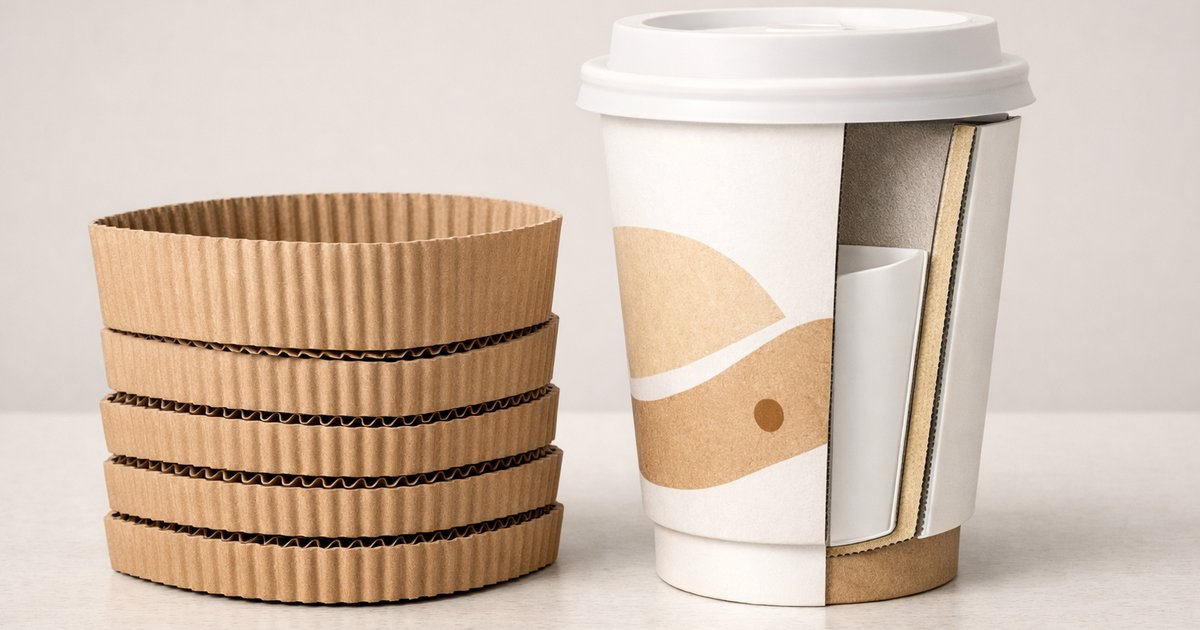
    A sleeve adds a corrugated band around the middle of the cup. The flutes trap air, which slows heat transfer, and the extra layer gives grip. It is a genuinely effective solution to a genuine problem.

    The main types

    • Corrugated kraft. The standard. Fluted brown or white board, cheap, effective, and by far the most common.
    • Smooth paperboard. A flat band without flutes. Better print surface, less insulation, more of a branding device than a thermal one.
    • Textured or embossed. Corrugated with a decorative pattern. Slightly more premium feel at slightly more cost.
    • Reusable fabric or silicone. Sold to consumers rather than bought by venues, so not usually a procurement decision.

    Sleeves as a branding surface

    There is a legitimate case for sleeves that has nothing to do with heat.

    A printed sleeve on a plain cup lets you change your message without reprinting cups. That is useful for short campaigns, seasonal promotions, single events, or co-branding with a partner. Cups have a minimum order and a lead time, and sleeves let you run a message at lower commitment.

    The catch is that a sleeve covers the middle of the cup, which is the most visible part of it. If your cup is already printed, the sleeve is competing with your own branding for the same real estate. Running a printed cup and a printed sleeve together usually looks cluttered rather than considered.

    So sleeves make branding sense mainly when the cup underneath is plain.

    The real cost of sleeves

    People compare the unit price of a sleeve against the price gap between single and double wall cups and conclude sleeves are cheaper. Per unit, they usually are. That comparison misses most of the cost.

    • Not every drink needs one, so your usage is variable and harder to forecast.
    • Storage. A second item taking up space in a small back room.
    • Handling time. A second action on every hot drink, repeated hundreds of times a day. Small, and it accumulates in a queue.
    • Waste. Two items to dispose of instead of one, which undercuts any environmental positioning.
    • Ordering overhead. Another line to track and another stockout to avoid. See working out what to reorder.

    Sleeve plus single wall, or double wall?

    The honest comparison:

    Single wall plus sleeve Double wall
    Heat protection Good, where the sleeve sits Good, over the whole cup
    Items to buy and store Two One
    Handling per drink Two actions One
    Branding surface Sleeve covers the cup Full uninterrupted wrap
    Perceived quality Functional Premium
    Waste per serve Two items One item

    For a business investing in custom printed cups, double wall usually wins, because the whole point of printing your own cups is the branding, and a sleeve covers it. Our comparison is in single wall vs double wall coffee cups.

    When sleeves still make sense

    • You already hold a large stock of single wall cups. Sleeves bridge the gap without writing off inventory.
    • Volume trade at the lowest possible cost per serve, where single wall plus occasional sleeve genuinely is the cheapest route.
    • Short campaigns on plain cups, where a printed sleeve is the flexible branding layer.
    • Events where cups are supplied by a venue and a sleeve is the only surface you control.

    What we supply

    We supply printed cups, not sleeves. Our single wall and double wall cups take standard sleeves if you source them elsewhere, since sleeve sizing follows standard cup diameters.

    Our honest recommendation, if you are ordering custom printed cups anyway: go double wall and skip the sleeve entirely. You get better insulation across the whole cup, one item instead of two, and your branding stays visible, which is what you are paying for. Ripple wall is a third construction that also removes the need for a sleeve, covered in ripple wall coffee cups.

    Where to go from here

    See double wall custom coffee cups for the sleeve-free option, or single wall custom coffee cups if cost per serve is the priority. Not sure which suits your service? Ask us.

  • Kraft Brown Coffee Cups: Are They Actually More Eco-Friendly?

    Kraft Brown Coffee Cups: Are They Actually More Eco-Friendly?

    Short answer: not automatically, no. Kraft brown is a board colour, not an environmental property. A brown cup with a standard plastic lining is exactly as recyclable, or as unrecyclable, as a white cup with the same lining. What determines the environmental outcome is the lining and where the cup ends up, not the shade of the paper.

    This is one of the most persistent assumptions in takeaway packaging, and it is worth unpicking carefully, because acting on it can lead you to make a claim you cannot support.

    What kraft actually is

    Kraft refers to a pulping process. Kraft board is typically unbleached or only lightly bleached, which is where the brown colour comes from. White cup board has been bleached to a consistent white.

    So the honest environmental difference is the bleaching stage. Skipping or reducing bleaching does avoid some processing, and that is a genuine if modest difference. It is not nothing, and it is also not the thing people imagine when they see a brown cup.

    What kraft does not change

    Here is the part that matters. A kraft cup still needs a waterproof lining, for exactly the same reason a white cup does: paper alone dissolves under hot liquid.

    That lining is what makes cups difficult to recycle, because most paper mills cannot separate a polymer film from board. So a brown cup with a standard PE lining faces precisely the same end-of-life problem as a white one. See are paper coffee cups recyclable in Australia.

    The visual cue and the actual property have come apart. Brown looks unprocessed, so it reads as compostable. The colour is telling you nothing about the lining.

    The thing that actually matters: the lining

    If your goal is a lower-impact cup, the decision that carries real weight is the lining, not the colour:

    • PE lining. Fossil-based plastic film. Standard, cheapest, hardest to process at end of life.
    • PLA lining. Plant-based, compostable in industrial facilities where accepted.

    A white cup with a compostable lining has a better environmental story than a brown cup with a PE lining, even though the brown one looks greener on the counter. The comparison is set out in PLA vs PE cup lining.

    And the lining only pays off if the cup reaches the right waste stream. A compostable cup in a general waste bin goes to landfill like anything else. See can compostable cups go in my green bin.

    The branding trade-off

    There is a practical printing consequence that often gets discovered too late.

    Kraft board is brown, so it is not a neutral canvas. Every colour you print sits on a warm brown base and shifts accordingly. Blues dull, whites are not achievable as a printed colour, and bright vivid tones lose their punch. Photographic imagery in particular does not reproduce well.

    Designs that work on kraft are the ones that embrace it: one or two colours, bold shapes, strong line work, and the brown itself used as part of the palette. Designs that fight it, like a precise corporate blue or a full-colour photograph, will disappoint you.

    We cover this in how to make your brand colours pop on a paper cup. If your brand depends on exact colour matching, white stock gives you a far more predictable result.

    The claims risk

    This is where the assumption gets expensive. If you choose brown cups and then describe them as eco-friendly, sustainable or recyclable without checking what the lining actually is and where the cup can actually go, you are making an environmental claim you may not be able to substantiate.

    The ACCC has published guidance for businesses making environmental claims, and unsubstantiated green claims attract real regulatory attention. We cover what you can and cannot safely say in eco claims on coffee cups.

    The blunt version: do not let the colour of your cup write your marketing copy.

    So is there any case for kraft?

    Yes, an aesthetic one, and that is a perfectly legitimate reason. Kraft communicates warmth, craft and informality, and it suits a lot of brands. Choose it because it looks right for your business, with a clear understanding that the colour itself is a design decision rather than an environmental one.

    What to do instead if impact is the goal

    1. Choose the lining deliberately. This is the decision with actual environmental content.
    2. Sort out where cups end up. Collection determines outcome more than material does. See cup recycling programs in Australia.
    3. Serve sit-in customers in ceramic. The highest-impact and cheapest change available.
    4. Order accurately. Cups you never use are pure waste. See how many cups your cafe needs.
    5. Make claims you can back. Specific and substantiated beats vague and green.

    Where to go from here

    If your priority is genuinely lower impact, look at compostable custom coffee cups and read compostable vs standard paper cups. To talk through stock options for your design, get in touch.

  • Cold Cups Explained: Why Hot Cups Don’t Work for Iced Drinks

    Cold Cups Explained: Why Hot Cups Don’t Work for Iced Drinks

    Short answer: a hot cup and a cold cup are solving different engineering problems. Hot cups manage heat and steam. Cold cups manage condensation, ice volume and a dome lid for straws and toppings. You can serve a cold drink in a hot cup, and plenty of venues do, but it comes with real downsides. We supply hot cups, not cold cups, and this guide explains the difference so you can plan properly.

    The problem cold drinks create

    When a drink is colder than the surrounding air, moisture from the air condenses on the outside of the cup. That is the entire design challenge, and it drives everything else.

    Condensation causes three practical problems:

    • Slippery cups. A wet exterior is harder to hold and easier to drop.
    • Wet surfaces. Rings on tables, damp counters, soggy napkins and paper bags.
    • Board softening. Sustained external moisture works against paperboard, which is designed to resist liquid on the inside face, not the outside.

    A hot cup’s lining is on the inside. Its outer surface is printed board with no barrier against external moisture, which is precisely what condensation attacks.

    Four other differences

    Ice takes up space. An iced drink is typically half ice by volume, so cold cups are usually specified larger than the equivalent hot drink. A 16oz iced coffee holds far less coffee than 16oz suggests.

    Lids are a different shape. Cold drinks want a dome lid, for a straw, or to clear whipped cream or toppings. Hot cup lids are flat or lightly raised with a sip opening, and are designed to control steam and splashing. Our lid range is built for hot cups: see the paper cup lids guide.

    Cold drinks are often meant to be seen. Layered iced lattes, cold brew and colourful drinks sell partly on appearance, which is why clear cups dominate that market. An opaque paper cup hides the product.

    Insulation matters less. Keeping cold in is a lower priority than keeping hot in, since ice does much of the work and cold drinks are usually consumed faster.

    What cold cups are usually made from

    • PET. Clear rigid plastic. The standard for iced drinks because it shows the product, resists condensation damage entirely, and takes a dome lid.
    • PLA. A clear plant-based alternative to PET, but with a lower heat tolerance, which matters in a hot car or in summer storage.
    • Cold-specific paper cups. Paper cups specified for cold service, usually with a different board and coating suited to external moisture. These do exist and are used where a business wants a paper look for cold drinks.

    Australian state regulations on single-use plastics affect what is permitted for some of these materials and vary by state. Check single-use cup regulations in Australia before committing to a plastic cold cup.

    Can you just use hot cups for cold drinks?

    Yes, within limits, and it is a reasonable choice if iced drinks are a small part of your trade.

    What to expect if you do:

    • Condensation on the outside, so plan for napkins or coasters
    • Cups should not sit filled for long periods
    • Your lid options are hot-drink lids, so no dome and no straw provision
    • Print quality is unaffected while the cup is dry, but a persistently wet exterior is not doing your branding any favours

    A double wall cup handles this better than a single wall one, because the outer wall stays drier and the extra rigidity resists softening. If you are going to serve cold drinks in hot cups, use double wall.

    What we supply

    Our range is printed hot cups in 6oz, 8oz, 12oz and 16oz, with hot-drink lids. We do not currently supply PET cold cups, dome lids or cold-specific cup stock.

    We would rather say that plainly than take an order that will not do what you need. If iced drinks are a significant share of your trade, you will want a dedicated cold cup supplier for that part of your range. If they are occasional, our 16oz cups are the practical option and plenty of venues use them that way.

    Where to go from here

    For hot drink service, see what size coffee cup do I need and our printed coffee cups. If you are unsure whether our cups suit your menu, tell us what you serve and we will give you a straight answer.