
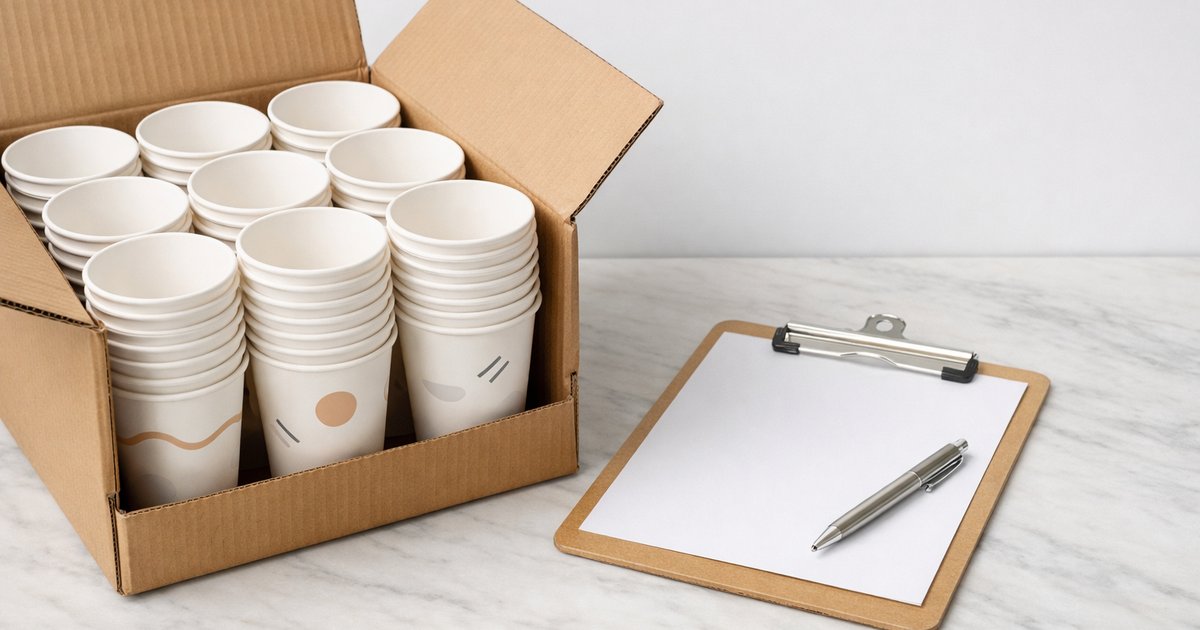
Short answer: spend ten minutes on the delivery before you put it away. Check the carton count against the paperwork, open one carton and compare a cup against your approved proof, look for transit damage, test a lid, then store the rest properly. Problems found on day one are straightforward to resolve. Problems found in week six, halfway through the stock, are much harder for anyone to help with.
Do this before the driver leaves
- Count the cartons against the delivery docket. Not the cups, the cartons. Takes thirty seconds.
- Look at the outside of every carton. Crushed corners, water staining, punctures or tape that has been opened and resealed.
- Note any damage on the docket before signing. A signature with no notation makes a transit claim considerably harder.
- Photograph anything that looks wrong while it is still on the truck or the pallet.
Freight damage is the one category where the evidence disappears fastest.
Open one carton and check the print
Have your approved proof in front of you. Not your original artwork file, the proof you signed off, because that is the agreed reference.
- Colour. Compare against the proof, in daylight if you can. Some shift between screen and cup stock is expected and normal, which is why the proof exists. What you are looking for is a clear departure from what was approved. See CMYK vs RGB.
- Registration. Are the colour layers aligned, or is there a visible halo or double edge around detail?
- Position. Is the artwork sitting where it should vertically, with sensible clearance at rim and base?
- The seam. Check nothing critical has been swallowed by the overlap. See bleed, safe zone and wrap.
- Text and fine detail. Read the small text. Check any QR code actually scans, with a phone, now.
- Consistency. Pull five or six cups from different points in the sleeve rather than judging from the top one.
Check the physical cups
- Rim. Run a finger around the curl. It should be smooth, even and continuous.
- Base. Sit a cup on a flat surface. It should sit flat and not rock.
- Seam. Should be flat and firmly bonded, with no lifting edge.
- Nesting. Cups should separate cleanly from each other. Cups that stick together are a service problem at the counter.
- Feel and smell. Board should feel crisp, not soft or limp. Any strong odour means the stock has picked something up and should be raised straight away.
The water test
Take one cup, fill it with hot water, and leave it on a clean dry surface for ten minutes. Then look underneath and at the seam.
It costs you one cup and it is the only way to verify the seals before a customer does it for you. If it leaks, test two or three more from different cartons to establish whether it is an isolated cup or a batch issue. See why paper cups leak.
Test the lids
If lids came with the order, fit one now. It should seat evenly all the way round and stay put when the cup is tilted.
Confirm the diameters match your sizes: 80mm lids for 6oz and 8oz, 89mm for squat 8oz, 12oz and 16oz. A mismatch here is the most common ordering error and the easiest to fix on day one. See squat vs tall cups and the lids guide.
Then store them properly
Once you are satisfied, storage determines whether the cups are still good in three months.
- Keep cups in their sleeves and cartons until needed. That packaging is structural.
- Off the floor, on a pallet or shelving.
- Dry, away from any damp wall or wet area.
- Out of direct sunlight, which fades print over time.
- Away from strong-smelling stock and cleaning chemicals, because board absorbs odour.
- Nothing heavy stacked on top.
- Rotate stock, oldest first.
Full detail in how to store paper coffee cups.
The ten-minute checklist
| Step | Check |
|---|---|
| 1 | Carton count matches the docket |
| 2 | No transit damage, noted on the docket if there is |
| 3 | Print matches the approved proof for colour, registration and position |
| 4 | Several cups checked from different points, not just the top one |
| 5 | Rim, base and seam sound; cups nest and separate cleanly |
| 6 | Hot water test passed |
| 7 | Lids fit and seat correctly |
| 8 | Stored dry, off the floor, out of sunlight |
If something is wrong
Contact us straight away rather than working around it. Have ready: your order number, clear photographs of the issue, roughly how many cups are affected, and which cartons they came from.
Raising it immediately, with photographs, on an unopened majority of stock is the strongest position for everyone. Working through half the order first makes it much harder to establish what happened.
Where to go from here
Contact us if anything is not right. Planning your next order? See how many cups your cafe needs and how long custom cups take to produce.