Short answer: Australia introduced national bans on three of the best-known PFAS chemicals from 1 July 2025. The rules are broad industrial chemical controls rather than a food-packaging-specific ban like the European Union’s, but they change what can legally be manufactured, imported and exported here. If you buy printed cups, the practical takeaway is to ask your supplier a direct question and get a direct answer.
What PFAS are and why packaging used them
PFAS stands for per- and polyfluoroalkyl substances, a large family of synthetic chemicals valued for repelling both water and oil. They are often called “forever chemicals” because the carbon-fluorine bond is extremely stable and the compounds persist in the environment and in living things.
In food packaging, PFAS was historically used as a grease barrier. It is the reason a paper burger wrapper, popcorn bag, pie bag or moulded fibre bowl could hold oily food without going translucent and falling apart. Grease resistance is the specific problem PFAS solved.
Where takeaway coffee cups sit in this
This is the part worth understanding clearly, because it is usually reported vaguely.
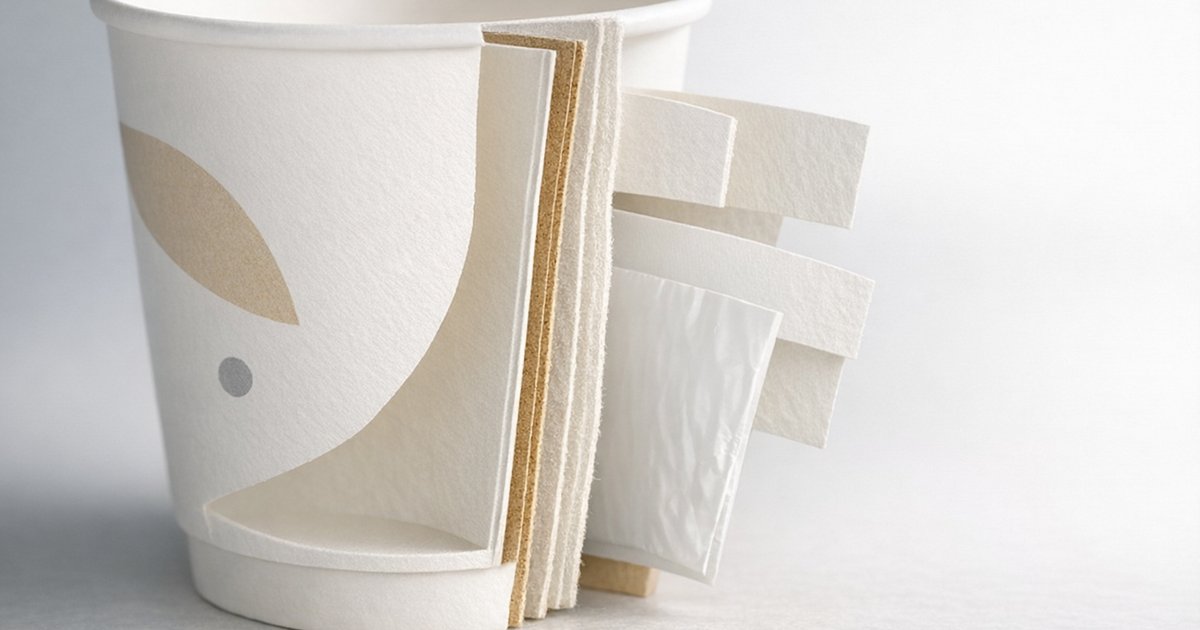
A hot drink cup has a different engineering problem to a chip box. It needs to hold a watery liquid at temperature without wicking, and that job is done by the polyethylene or PLA film laminated to the board. That lining is the barrier. Grease resistance is not a design requirement for a coffee cup in the way it is for oily food packaging, so cups have not been a primary application for PFAS-based grease-proofing.
Moulded fibre items are the higher-risk category historically, which is relevant if you buy fibre lids as well as cups.
What Australia actually did
Under the Industrial Chemicals Environmental Management Standard, known as IChEMS, Australia rolled out its first national environmental standards for industrial chemicals. From 1 July 2025, the import, export and manufacture of three PFAS chemicals became prohibited:
- PFOS, perfluorooctane sulfonic acid, and related substances
- PFOA, perfluorooctanoic acid, and related substances
- PFHxS, perfluorohexane sulfonic acid, and related substances
The prohibitions carry narrow exceptions for unintentional trace contamination below set thresholds, which the responsible department is due to review by 1 July 2027.
Two things are worth being precise about. First, this is a ban on specific named chemicals across industry, not a blanket ban on the entire PFAS family. Second, it is environmental chemicals regulation, not a food packaging standard. Food contact safety sits with Food Standards Australia New Zealand.
How this differs from the EU and the United States
Several jurisdictions have moved further and more specifically on packaging. The European Union’s packaging regulation restricts PFAS in food-contact packaging from August 2026, and a number of US states brought in food-packaging PFAS bans from January 2026.
Australian chemicals regulation has often moved in the same direction as Europe’s, so packaging-specific rules here are plausible in time, but nothing has been announced. It is not accurate to say Australia has already banned PFAS in food packaging, and you should be sceptical of any supplier marketing that implies otherwise.
What to ask your cup supplier
“Is it PFAS-free?” is a weaker question than it sounds, because a supplier can answer it honestly while meaning very little. Better questions:
- Is there a documented statement of compliance for the cup stock, and can I see it? A written declaration from the board manufacturer is the actual evidence.
- Does the declaration cover no intentionally added PFAS? This is the phrasing regulators and testing standards use.
- Does it cover the lids as well as the cups? Different materials, different suppliers, often overlooked.
- Which standard or test method does the claim rely on? Total organic fluorine screening is the common approach.
Be careful how you market it
If you plan to print or promote a claim about your cups being free of particular chemicals, that claim falls under Australian Consumer Law and the ACCC’s guidance on environmental and sustainability claims. You need to be able to substantiate it. We cover the rules in eco claims on coffee cups.
Where we stand
We would rather point you to a document than make a marketing claim on a blog page. If PFAS status matters for your procurement, tendering or reporting requirements, contact us and we will go back to the manufacturer of the specific stock your order would use and get you the current written declaration, rather than a general reassurance.
For related material questions, see are paper coffee cups safe and single-use cup regulations in Australia.