Category: Technical & Practical

  • Coffee Cup Sleeves: Types, Costs and When They’re Worth It

    Coffee Cup Sleeves: Types, Costs and When They’re Worth It

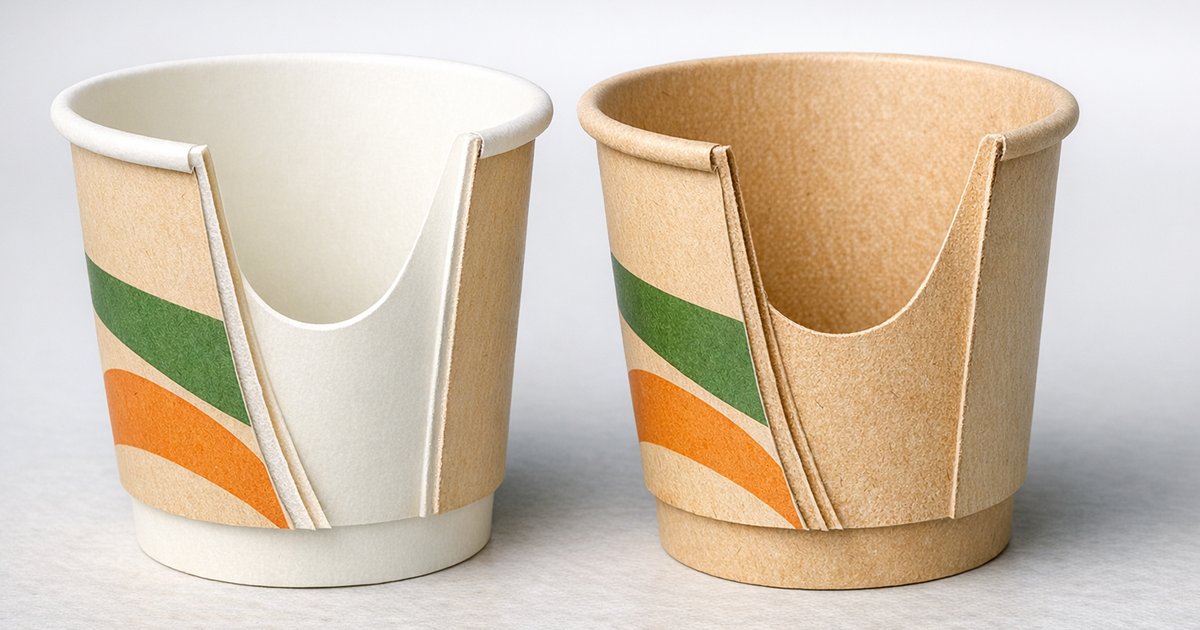
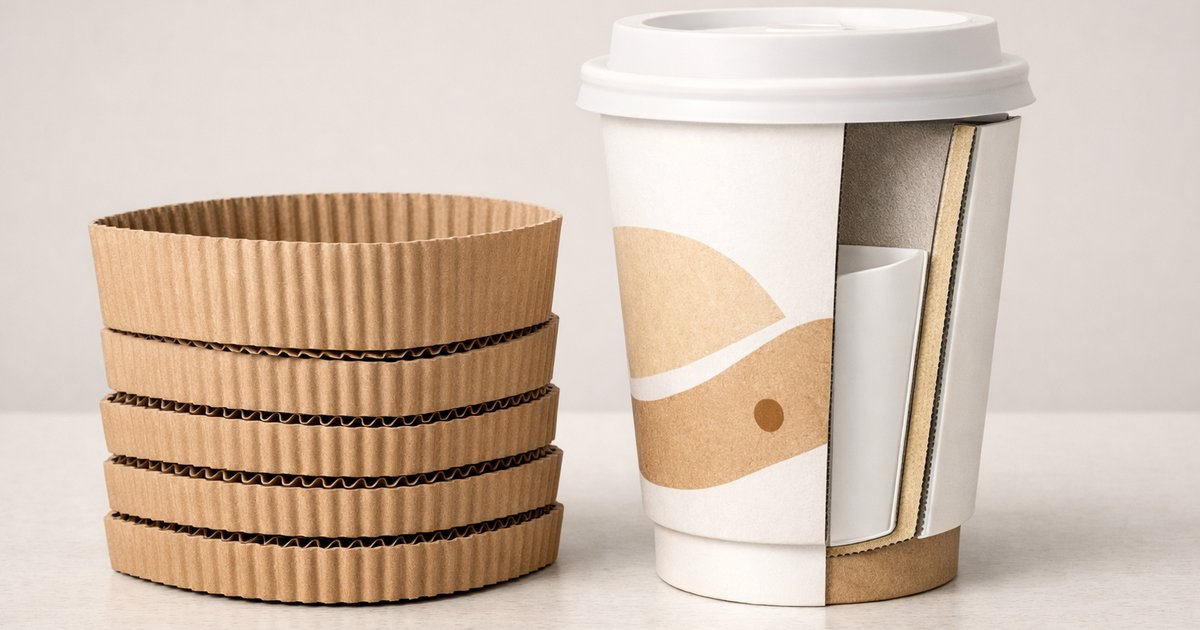
    Short answer: a sleeve is a separate corrugated band that slides over a single wall cup to protect the customer’s hand. They work, they are cheap per unit, and they add a second item to buy, store, handle and throw away. For most businesses buying custom printed cups, a double wall cup solves the same problem more elegantly. We do not supply sleeves, and this guide explains the trade-off honestly.

    What a sleeve actually does

    A single wall cup is one layer of lined board. Fill it with a drink at serving temperature and that layer is all that stands between the liquid and your customer’s fingers. It gets uncomfortably warm.

    A sleeve adds a corrugated band around the middle of the cup. The flutes trap air, which slows heat transfer, and the extra layer gives grip. It is a genuinely effective solution to a genuine problem.

    The main types

    • Corrugated kraft. The standard. Fluted brown or white board, cheap, effective, and by far the most common.
    • Smooth paperboard. A flat band without flutes. Better print surface, less insulation, more of a branding device than a thermal one.
    • Textured or embossed. Corrugated with a decorative pattern. Slightly more premium feel at slightly more cost.
    • Reusable fabric or silicone. Sold to consumers rather than bought by venues, so not usually a procurement decision.

    Sleeves as a branding surface

    There is a legitimate case for sleeves that has nothing to do with heat.

    A printed sleeve on a plain cup lets you change your message without reprinting cups. That is useful for short campaigns, seasonal promotions, single events, or co-branding with a partner. Cups have a minimum order and a lead time, and sleeves let you run a message at lower commitment.

    The catch is that a sleeve covers the middle of the cup, which is the most visible part of it. If your cup is already printed, the sleeve is competing with your own branding for the same real estate. Running a printed cup and a printed sleeve together usually looks cluttered rather than considered.

    So sleeves make branding sense mainly when the cup underneath is plain.

    The real cost of sleeves

    People compare the unit price of a sleeve against the price gap between single and double wall cups and conclude sleeves are cheaper. Per unit, they usually are. That comparison misses most of the cost.

    • Not every drink needs one, so your usage is variable and harder to forecast.
    • Storage. A second item taking up space in a small back room.
    • Handling time. A second action on every hot drink, repeated hundreds of times a day. Small, and it accumulates in a queue.
    • Waste. Two items to dispose of instead of one, which undercuts any environmental positioning.
    • Ordering overhead. Another line to track and another stockout to avoid. See working out what to reorder.

    Sleeve plus single wall, or double wall?

    The honest comparison:

    Single wall plus sleeve Double wall
    Heat protection Good, where the sleeve sits Good, over the whole cup
    Items to buy and store Two One
    Handling per drink Two actions One
    Branding surface Sleeve covers the cup Full uninterrupted wrap
    Perceived quality Functional Premium
    Waste per serve Two items One item

    For a business investing in custom printed cups, double wall usually wins, because the whole point of printing your own cups is the branding, and a sleeve covers it. Our comparison is in single wall vs double wall coffee cups.

    When sleeves still make sense

    • You already hold a large stock of single wall cups. Sleeves bridge the gap without writing off inventory.
    • Volume trade at the lowest possible cost per serve, where single wall plus occasional sleeve genuinely is the cheapest route.
    • Short campaigns on plain cups, where a printed sleeve is the flexible branding layer.
    • Events where cups are supplied by a venue and a sleeve is the only surface you control.

    What we supply

    We supply printed cups, not sleeves. Our single wall and double wall cups take standard sleeves if you source them elsewhere, since sleeve sizing follows standard cup diameters.

    Our honest recommendation, if you are ordering custom printed cups anyway: go double wall and skip the sleeve entirely. You get better insulation across the whole cup, one item instead of two, and your branding stays visible, which is what you are paying for. Ripple wall is a third construction that also removes the need for a sleeve, covered in ripple wall coffee cups.

    Where to go from here

    See double wall custom coffee cups for the sleeve-free option, or single wall custom coffee cups if cost per serve is the priority. Not sure which suits your service? Ask us.
  • Cold Cups Explained: Why Hot Cups Don’t Work for Iced Drinks

    Cold Cups Explained: Why Hot Cups Don’t Work for Iced Drinks

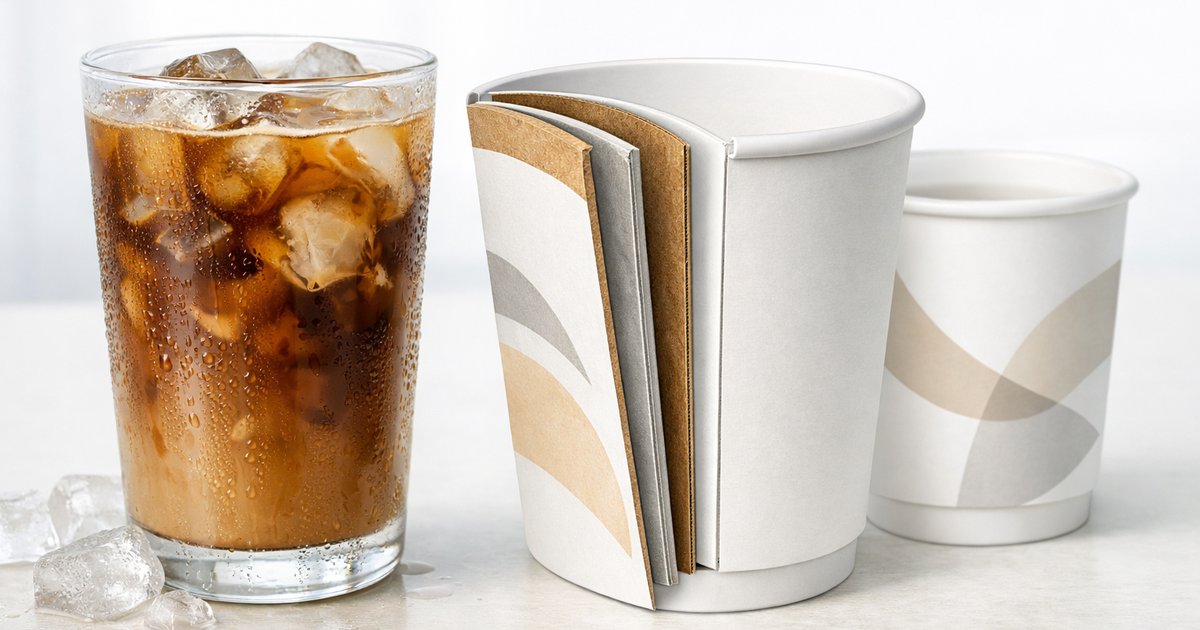
    Short answer: a hot cup and a cold cup are solving different engineering problems. Hot cups manage heat and steam. Cold cups manage condensation, ice volume and a dome lid for straws and toppings. You can serve a cold drink in a hot cup, and plenty of venues do, but it comes with real downsides. We supply hot cups, not cold cups, and this guide explains the difference so you can plan properly.

    The problem cold drinks create

    When a drink is colder than the surrounding air, moisture from the air condenses on the outside of the cup. That is the entire design challenge, and it drives everything else.

    Condensation causes three practical problems:

    • Slippery cups. A wet exterior is harder to hold and easier to drop.
    • Wet surfaces. Rings on tables, damp counters, soggy napkins and paper bags.
    • Board softening. Sustained external moisture works against paperboard, which is designed to resist liquid on the inside face, not the outside.

    A hot cup’s lining is on the inside. Its outer surface is printed board with no barrier against external moisture, which is precisely what condensation attacks.

    Four other differences

    Ice takes up space. An iced drink is typically half ice by volume, so cold cups are usually specified larger than the equivalent hot drink. A 16oz iced coffee holds far less coffee than 16oz suggests.

    Lids are a different shape. Cold drinks want a dome lid, for a straw, or to clear whipped cream or toppings. Hot cup lids are flat or lightly raised with a sip opening, and are designed to control steam and splashing. Our lid range is built for hot cups: see the paper cup lids guide.

    Cold drinks are often meant to be seen. Layered iced lattes, cold brew and colourful drinks sell partly on appearance, which is why clear cups dominate that market. An opaque paper cup hides the product.

    Insulation matters less. Keeping cold in is a lower priority than keeping hot in, since ice does much of the work and cold drinks are usually consumed faster.

    What cold cups are usually made from

    • PET. Clear rigid plastic. The standard for iced drinks because it shows the product, resists condensation damage entirely, and takes a dome lid.
    • PLA. A clear plant-based alternative to PET, but with a lower heat tolerance, which matters in a hot car or in summer storage.
    • Cold-specific paper cups. Paper cups specified for cold service, usually with a different board and coating suited to external moisture. These do exist and are used where a business wants a paper look for cold drinks.

    Australian state regulations on single-use plastics affect what is permitted for some of these materials and vary by state. Check single-use cup regulations in Australia before committing to a plastic cold cup.

    Can you just use hot cups for cold drinks?

    Yes, within limits, and it is a reasonable choice if iced drinks are a small part of your trade.

    What to expect if you do:

    • Condensation on the outside, so plan for napkins or coasters
    • Cups should not sit filled for long periods
    • Your lid options are hot-drink lids, so no dome and no straw provision
    • Print quality is unaffected while the cup is dry, but a persistently wet exterior is not doing your branding any favours

    A double wall cup handles this better than a single wall one, because the outer wall stays drier and the extra rigidity resists softening. If you are going to serve cold drinks in hot cups, use double wall.

    What we supply

    Our range is printed hot cups in 6oz, 8oz, 12oz and 16oz, with hot-drink lids. We do not currently supply PET cold cups, dome lids or cold-specific cup stock.

    We would rather say that plainly than take an order that will not do what you need. If iced drinks are a significant share of your trade, you will want a dedicated cold cup supplier for that part of your range. If they are occasional, our 16oz cups are the practical option and plenty of venues use them that way.

    Where to go from here

    For hot drink service, see what size coffee cup do I need and our printed coffee cups. If you are unsure whether our cups suit your menu, tell us what you serve and we will give you a straight answer.

  • Ripple Wall Coffee Cups: What They Are and How They Compare

    Ripple Wall Coffee Cups: What They Are and How They Compare

    Short answer: a ripple wall cup has a corrugated outer layer bonded to a smooth inner cup, giving strong insulation and a distinctive textured grip. It sits alongside single wall and double wall as the third construction type. We supply single wall and double wall cups, not ripple, and this guide explains the differences so you can judge which construction you actually need.

    The three constructions

    • Single wall. One layer of lined board. Lightest and lowest cost.
    • Double wall. A second smooth outer wall bonded over the inner cup, with a thin air gap between them. Insulates well and gives a clean, premium print surface.
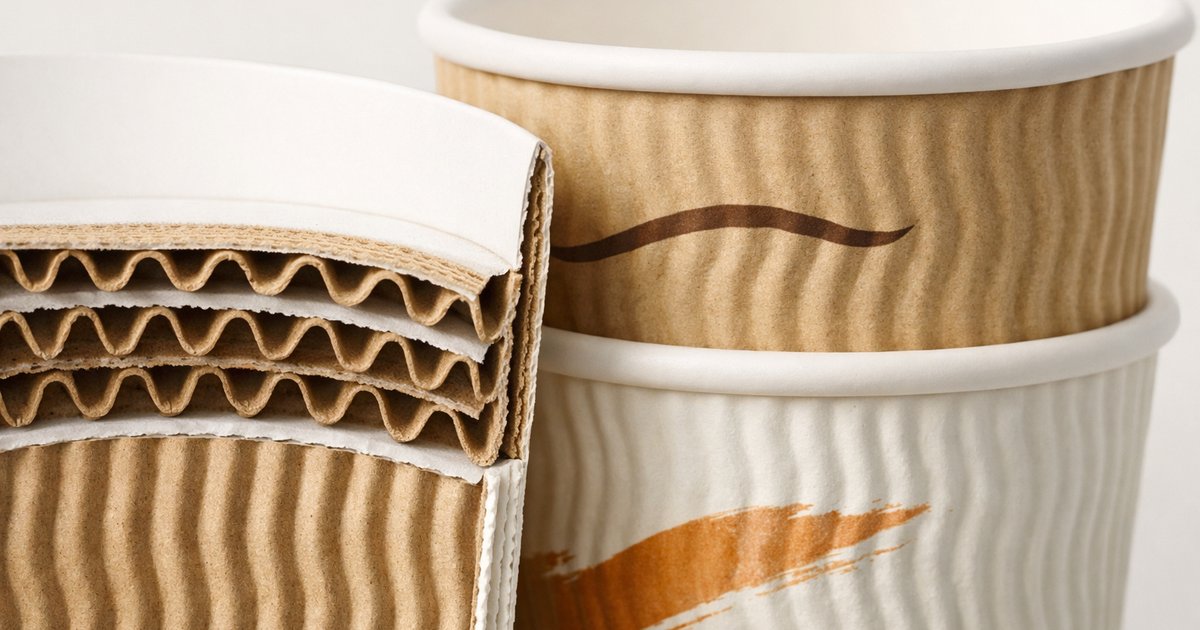
    • Ripple wall. An outer layer that has been fluted, like miniature corrugated cardboard, bonded to the inner cup. The flutes create air channels and a ridged outer texture.

    All three use the same inner lining principle and the same lids. The difference is entirely in the wall.

    How ripple wall performs

    Insulation. The fluted structure traps air in channels rather than a single gap, so ripple cups insulate strongly. In practice, a good double wall cup and a ripple cup both comfortably remove the need for a separate sleeve.

    Grip. This is where ripple genuinely stands out. The ridged surface gives real mechanical grip, which matters for large sizes and for customers carrying multiple cups. It is the most tactile of the three.

    Look and feel. Ripple reads as artisanal and casual, and it is strongly associated with the kraft-brown aesthetic. Whether that suits you depends entirely on your brand.

    The print trade-off

    This is the point most comparisons skip, and it is the one that matters most for a custom printed cup.

    A ripple cup’s outer surface is corrugated. Printing onto a ridged surface is not the same as printing onto a smooth one. Fine detail, small text, crisp logo edges and subtle gradients all suffer, because the surface itself is textured at roughly the scale of the detail you are trying to reproduce.

    If your brand identity depends on a precisely reproduced logo or fine typography, ripple is working against you. A smooth double wall cup will render your artwork far more faithfully. See making brand colours pop on a paper cup.

    Side by side

    Single wall Double wall Ripple wall
    Insulation Basic Strong Strong
    Grip Smooth Smooth Textured, best grip
    Print fidelity Good Best Reduced by texture
    Needs a sleeve? Often No No
    Material used Least More Most
    Typical cost Lowest Higher Highest
    Available from us Yes Yes No

    Which should you actually choose?

    Strip away the marketing and the decision is usually simple:

    • Cost is the priority and drinks are handed over and consumed quickly: single wall.
    • You want insulation and the best possible reproduction of your branding: double wall. For most businesses buying custom printed cups, this is the answer.
    • You want maximum grip and a rustic, textured look, and your artwork is simple enough to survive the surface: ripple.

    Our full comparison of the two we supply is in single wall vs double wall coffee cups.

    Why we do not stock ripple

    Two reasons, and we would rather state them than pretend the option does not exist.

    First, custom printed cups are our business, and ripple is the construction least suited to reproducing brand artwork cleanly. Recommending it to a customer who wants a sharp logo would be setting them up for disappointment.

    Second, ripple uses the most board of the three constructions, which puts it at the top of the cost range without delivering better print. For the customers we serve, double wall covers the insulation requirement with a better print surface.

    If your requirement is specifically grip-focused, tell us and we will be straight with you about whether we can help.

    Where to go from here

    Compare the constructions we do supply: double wall custom coffee cups and single wall custom coffee cups. If sleeves are on your mind, read coffee cup sleeves explained.

  • Food-Safe Inks on Coffee Cups: What to Ask Your Printer

    Food-Safe Inks on Coffee Cups: What to Ask Your Printer

    Short answer: print sits on the outside wall of the cup and never contacts your drink. Cup printing uses inks formulated for food packaging, which are designed and tested with migration in mind. That said, “food safe” is a phrase used loosely in this industry, so here is what it actually means and what to ask before you commit to a supplier.

    The most important point: print is on the outside

    The inside face of a cup is the food contact surface. It carries the waterproof lining and nothing else. All printing happens on the outer wall, and it happens while the cup is still a flat blank, before it is ever formed into a cup.

    So under normal use, printed ink and beverage never meet. This is the primary control, and it is a design principle rather than a coincidence. More on the constraint in can you print inside a coffee cup.

    Then why do inks matter at all?

    Because “not in direct contact” is not the same as “cannot possibly transfer”. Packaging regulators worldwide take two indirect routes seriously:

    • Set-off. Cups are stacked and nested. The printed outer wall of one cup rests against the inner face of the cup above it. In theory, ink components could transfer from one surface to another in the stack.
    • Migration through the substrate. Board is porous. Low-molecular-weight components can in principle move through it.

    This is exactly why packaging inks are a specialised category rather than ordinary commercial printing inks, and why the good ones are formulated with low-migration chemistry.

    What “food-grade ink” actually means

    There is no single global certificate that makes an ink “food safe”. What responsible manufacturers work to is a combination of:

    • Composition control. Formulated from materials assessed as suitable for food packaging use, avoiding substances of concern.
    • Low-migration design. Chemistry chosen so that components are unlikely to migrate in meaningful quantities.
    • Documented compliance. A written statement from the ink manufacturer, referencing the framework it complies with.

    In Australia, food contact materials fall under the general requirement that packaging must be safe for its intended use, administered through Food Standards Australia New Zealand. Australia does not maintain a separate positive list for printing inks in the way some jurisdictions do, so suppliers here typically rely on European or Swiss frameworks, which are the most developed. That is normal industry practice and worth understanding rather than being alarmed by.

    What to ask a supplier

    Vague questions get vague answers. These get useful ones:

    • “Can you provide the ink manufacturer’s declaration of compliance?” This is the single best question. A real document beats any verbal reassurance.
    • “Are the inks low-migration grade formulated for food packaging?” Specific and answerable.
    • “Which framework does the declaration reference?” You are looking for a named standard, not “it’s food safe”.
    • “Does this cover the varnish or coating as well as the inks?” Frequently overlooked, and it is a separate material.
    • “Is the board itself food-grade, with its own documentation?” The ink is only one part. See what paper coffee cups are made from.

    A supplier who cannot produce documentation for the specific stock they are selling you is telling you something useful.

    Two related questions people ask

    Does heat change anything? Hot liquid is inside the cup and the print is outside, separated by the board and the lining. The heat-related question that has actual research behind it concerns the lining, not the ink, and we cover it in are paper coffee cups safe.

    Does more ink coverage mean more risk? Not in a way that should change your design. Full-wall colour is standard across the industry and is accounted for in how packaging inks are formulated and applied. It is not a reason to restrict your artwork, and full colour is included in our pricing anyway. See full colour vs single colour printing.

    Where we stand

    We would rather hand you a document than a slogan. If your business needs ink or board compliance documentation for a tender, a food safety audit, or your own due diligence, contact us with what you need and we will request the current declaration for the specific stock your order would use.

    Related reading: PFAS in coffee cups and how coffee cup printing works.

  • Does Coffee Taste Different in a Paper Cup? What Research Shows

    Does Coffee Taste Different in a Paper Cup? What Research Shows

    Short answer: the coffee itself does not change, but how people perceive it measurably does. Sensory research has repeatedly found that the vessel affects judgements of sweetness, acidity, aroma and quality. The effect is real, it has been demonstrated in trained tasters as well as ordinary drinkers, and it is worth understanding if you sell coffee.

    The effect is genuine, and it has a name

    Researchers call it sensation transference: qualities of the packaging transfer to how the contents are judged. It is not imagination or snobbery. It shows up under controlled conditions with the same coffee in different vessels.

    The practical implication for a cafe is direct. The cup is not a neutral container. It is part of the product experience, in the same way plating is part of a restaurant dish.

    What the studies found

    Texture changes perceived flavour

    Work published in Food Quality and Preference examined how the surface texture of a cup influenced evaluation of specialty coffee. It found significant effects on aftertaste and mouthfeel judgements. Notably, professional Q graders perceived higher acidity when drinking from a rough-textured cup, while general consumers described coffee from a smooth cup as sweeter.

    Both groups were affected. Expertise did not remove the effect, it changed how it expressed itself.

    Firmness and quality perception

    Related research has found that a firm, solid-feeling vessel improves perceived quality of the drink compared with a flimsy one. A cup that flexes when picked up communicates cheapness before the first sip.

    Colour and weight

    Studies covered by the Specialty Coffee Association have examined cup colour and weight in multisensory coffee evaluation, finding both influence how coffee is rated. Heavier vessels tend to read as higher quality, and cup colour affects perceived intensity and sweetness.

    The aroma question

    Much of coffee flavour is aroma, and aroma delivery is where a lidded takeaway cup differs most from an open cup. A lid restricts the path from the drink to your nose and directs it through a small opening. Drinking through a lid is a different aromatic experience from drinking from an open vessel, regardless of what the cup is made from.

    This is largely a lid design question rather than a cup material question. See our paper cup lids guide.

    Does the lining affect taste?

    Here we should be careful to separate what is established from what is repeated online.

    Cup linings are food-grade materials selected to be neutral in contact with beverages, and a cup within its rated temperature range should not impart flavour. Where people do report an off taste, the usual suspects are a cup stored badly and having absorbed odours from its environment, or a drink left standing far longer than intended.

    Storage is genuinely worth taking seriously, because board is absorbent and will pick up smells from nearby cleaning products or strong-smelling stock. See how to store paper coffee cups. On the broader materials question, see are paper coffee cups safe.

    Temperature does most of the work

    The single largest driver of how coffee tastes over the life of a takeaway drink is temperature. Perceived sweetness, acidity and bitterness all shift as a coffee cools, which is why the same cup can taste noticeably different at the start and end.

    That gives cup construction a real role. A double wall cup holds temperature longer, which keeps the drink in its intended flavour window for longer. It is the most defensible taste-related argument for double wall, and it is a thermal argument rather than a material one.

    What this means if you sell coffee

    • The cup is part of the product. A thin, flexing cup undermines a carefully made coffee before it is tasted.
    • Heft signals quality. This is one of the more consistent findings across studies, and it favours double wall.
    • Hold temperature. Insulation keeps the drink where you intended it, flavour-wise, for longer.
    • Store cups properly. Cheap insurance against the one genuine material-related taste complaint.
    • Design matters more than you think. Perception starts before the first sip. See why takeaway cup quality matters.

    The honest summary

    Does coffee chemically change because it is in a paper cup? No. Do people reliably rate the same coffee differently depending on the cup it arrives in? Yes, and that has been shown repeatedly under controlled conditions.

    For a business selling coffee, the second question is the one that affects your revenue.

    Where to go from here

    If you are choosing between cup types, read single wall vs double wall. To see options and pricing, view our printed coffee cups or ask us which construction suits your service style.

  • Flexo, Offset and Digital: Coffee Cup Printing Methods Compared

    Flexo, Offset and Digital: Coffee Cup Printing Methods Compared

    Short answer: cups are printed flat, before they are formed into cups, using one of three methods. Flexographic printing dominates high-volume production, offset delivers the finest detail, and digital removes setup costs which makes short runs viable. The method affects your minimum quantity, your unit cost and how faithfully fine detail reproduces.

    You do not need to specify a printing method when you order, but understanding the differences explains a lot about why cup pricing behaves the way it does.

    Everything happens flat

    Before comparing methods, the key fact: a cup is printed as a flat fan-shaped blank, then cut, rolled, seamed and base-sealed into a cup. Nothing is printed onto a finished three-dimensional cup in normal production.

    This is why artwork has to be supplied on a template with a wrap allowance, and why the seam and rim have constraints. See bleed, safe zone and wrap and how coffee cup printing works.

    Flexographic printing

    Flexo uses flexible relief plates, one per colour, mounted on rotating cylinders that transfer ink to the board as it runs through at speed.

    • Strengths: extremely fast, low cost per unit at volume, excellent on solid colour areas, well suited to the absorbent coated board cups are made from.
    • Limitations: a plate is made for every colour, so setup cost is real and is spread across the run. Very fine gradients and small text are harder than on offset.
    • Best for: the large majority of commercial cup production, especially bold brand-colour designs at volume.

    Offset lithography

    Offset transfers ink from a plate to a rubber blanket and then onto the board, relying on the separation of oil-based ink and water.

    • Strengths: the finest detail of the three. Superior for photographic images, subtle gradients, fine type and complex artwork.
    • Limitations: plate-making and make-ready mean high setup cost, so it needs volume to be economic.
    • Best for: premium or photographic designs at substantial quantities. See printing photos on paper cups.

    Digital printing

    Digital has no plates. Artwork goes from file to press directly, much like a very sophisticated office printer.

    • Strengths: no plate cost, so short runs become affordable. Easy to change artwork between jobs, and well suited to variable or multi-design work.
    • Limitations: cost per unit falls away more slowly as quantity rises, so at high volume it loses to flexo. Colour gamut can differ from spot-colour approaches.
    • Best for: lower quantities, events, trials, and businesses testing a design before committing.

    How they compare

    Flexographic Offset Digital
    Setup cost Moderate, plates per colour High None
    Cost per cup at volume Lowest Low Higher
    Fine detail and gradients Good Best Good
    Solid colour coverage Excellent Excellent Good
    Economic minimum quantity Higher Highest Lowest

    Why this explains cup pricing

    Every method carries a fixed cost that exists before the first cup is printed: plates, make-ready, colour setup, press time. That fixed cost is divided across the run.

    At 500 cups, the setup is spread thinly and the unit cost is relatively high. At 10,000, the same setup is spread across twenty times as many cups and the unit cost drops sharply. This is why our minimum order quantity exists, and why the price per cup improves so much at higher volumes. It is not a volume discount in the retail sense, it is the arithmetic of fixed costs.

    What this means for your artwork

    Whichever method runs your job, the same practical points apply:

    • Supply vector artwork where possible. It reproduces cleanly at any size.
    • Avoid very fine reversed-out type. Small white text on a dark background is the first thing to fill in on absorbent stock.
    • Expect substrate shift. Cup board is not glossy white paper, so colours read slightly differently. See CMYK vs RGB and making brand colours pop.
    • Use the proof. It is the point at which colour and detail questions get resolved.

    What we do

    Full colour printing across the whole outer wall is included in our pricing at no extra cost, so there is no saving in restricting yourself to one or two colours. See full colour vs single colour printing.

    Where to go from here

    Ready to design? Start with how to design artwork for custom coffee cups. If you have an unusual design and want to know how it will reproduce, send it over before you finalise it.

  • Why Do Paper Cups Leak? Causes and How to Prevent It

    Why Do Paper Cups Leak? Causes and How to Prevent It

    Short answer: a properly made cup should not leak. When one does, it is almost always the base seal, the side seam, overfilling, a poorly seated lid, or physical damage from storage. Each cause looks slightly different, and once you know which one you are seeing, the fix is usually straightforward.

    If a whole batch is leaking, that is a manufacturing fault and you should be talking to your supplier rather than working around it. If the occasional cup leaks, it is nearly always one of the handling causes below.

    How a cup is sealed in the first place

    A takeaway cup is made from two pieces of board. The wall is a printed blank rolled into a cone with a vertical overlap, and the base is a separate disc crimped up into the bottom of that cone. Both joins are bonded using heat, which melts the inner lining so it fuses to itself.

    So the cup relies on the same lining that makes it waterproof to also make it airtight and watertight at the joins. That single fact explains nearly every leak.

    The five real causes

    1. The base seal

    The base is a likely failure point, because it is where the most material is folded and compressed. A cup that leaves a ring of liquid on the counter, or drips from directly underneath, has a base problem.

    An isolated cup can happen in any high-speed forming process. If it is repeatable across a carton, it is a fault worth reporting with the batch details.

    2. The side seam

    A seam leak shows as a vertical wet line down the outside wall, typically appearing first near the fill line. Seams fail when the heat seal was marginal or when the cup has been squeezed hard enough to work the join open.

    3. Overfilling

    This is the cause people least expect and most often have. Cups are designed to be filled to a line below the rim, not to the brim. Fill to the top and you get liquid sitting in the curl of the rim, which then wicks out under the lid and runs down the outside as soon as the cup is tilted or knocked.

    It looks exactly like a leak and it is not one. Leaving proper headroom fixes it immediately, and it also stops the lid displacing liquid when it is pressed on.

    4. Lid fit

    A lid that is not fully seated all the way round will let liquid out at the rim the moment the cup moves. Two things cause this: the lid was not pressed home evenly, or it is the wrong diameter for the cup.

    Diameter mismatches are more common than people think, because an 8oz cup and an 8oz squat cup take different lids. We cover that in squat vs tall cups, and the fits for our range are listed in the paper cup lids guide.

    5. Crushing and storage damage

    Cups arrive nested in sleeves inside cartons, and that packaging is doing real structural work. Stack heavy items on top, let a carton get damp, or knock a sleeve hard, and you create micro-cracks in the lining at the base crimp that only reveal themselves when hot liquid arrives.

    Damp storage is the quiet one. Board absorbs atmospheric moisture, which weakens it and can affect how it behaves when filled. Our guide to storing paper coffee cups covers conditions and shelf life.

    Diagnosing it in ten seconds

    What you see Most likely cause Fix
    Drip from directly underneath, ring on the counter Base seal Check other cups from the same sleeve, report if repeatable
    Vertical wet line down the side Side seam Check for crushing in storage, report if repeatable
    Liquid escaping at the rim when tilted Overfilling or lid not seated Leave headroom, press the lid fully home
    Lid pops or weeps all round Wrong lid diameter Match lid size to cup, check squat vs tall
    Cups soft, board feels limp Damp storage Move to a dry area off the floor

    Does hot liquid weaken the cup?

    Within its rated temperature range, no. Cups are engineered for hot beverage service and the lining is stable at normal serving temperatures. What causes trouble is heat plus time: a cup used as a holding vessel for a long period is being asked to do a job it was not designed for. See how hot a paper coffee cup can handle for the actual limits.

    Reheating a cup in a microwave is a separate and worse idea, covered in can you microwave paper coffee cups.

    Does single wall or double wall make a difference?

    Not to leaking as such, since both use the same sealing principle. What double wall changes is how a leak feels: the outer wall keeps your hand dry for longer, so a slow seep can go unnoticed until it reaches the counter. Double wall cups are also more rigid, which makes them more resistant to the squeezing that opens seams. See single wall vs double wall.

    Prevention checklist

    • Store cartons off the floor, dry, out of direct sun, nothing heavy stacked on top
    • Keep cups in their sleeves until the point of use
    • Fill to a sensible line, not to the rim
    • Match lid diameter to cup size and press the lid fully home
    • Check a few cups from a new batch before a busy service

    Where to go from here

    New delivery just arrived? Run through our checklist for what to inspect before you start using them. If you have a batch that is genuinely failing, contact us with your order number and a photo and we will sort it out.

  • Aqueous Coated Cups: The Plastic-Free Lining Explained

    Aqueous Coated Cups: The Plastic-Free Lining Explained

    Short answer: an aqueous coating is a water-based barrier sprayed or applied onto cup board instead of laminating a plastic film to it. The appeal is recycling: without a polymer layer to separate, the cup behaves much more like ordinary paper in a mill. The trade-offs are cost, heat and moisture performance, and limited availability. We supply PE and PLA lined cups, not aqueous, and this guide explains the difference honestly.

    The problem aqueous coatings are trying to solve

    A standard takeaway cup is a laminate: paperboard with a thin polyethylene film bonded to the inner face. That construction works beautifully as a cup and badly as a recyclable item, because most paper mills cannot separate the two materials. It is the central reason paper coffee cups are difficult to recycle in Australia.

    Compostable PLA cups swap the fossil-based film for a plant-based one, which helps with composting but still leaves a polymer layer, and still needs industrial composting infrastructure to actually break down.

    Aqueous coating takes a different route: do not add a film at all. Apply a water-based dispersion that dries into a barrier layer thin enough that a paper mill’s normal pulping process can handle the sheet.

    How it works

    The coating is typically a water-carried dispersion of polymers, minerals and additives. It is applied to the board, the water evaporates, and what remains is a barrier against liquid penetration. Because the barrier is measured in fractions of the thickness of an extruded film, the finished sheet is far closer to plain paperboard by weight.

    The practical claim made for these coatings is repulpability: the cup can go into a standard paper recycling stream rather than needing the specialised separation technology that lined cups require.

    The trade-offs nobody should skip

    This is where marketing tends to get ahead of engineering.

    • Heat and time performance. A thin dispersion barrier generally has less margin than an extruded PE film when it comes to very hot liquid held for a long period. Specifications vary a lot between coating systems.
    • Cost. Coated stock is normally more expensive per cup, and the equipment and process control needed to run it well are not universal.
    • Availability at low volumes. Most aqueous cup stock is produced for large contract runs. It is difficult to access at the quantities a typical cafe or small business orders.
    • Recycling only helps if collection exists. A repulpable cup thrown into a general waste bin goes to landfill exactly like any other cup. The material change has to be matched by a collection change to deliver anything. See cup recycling programs in Australia.
    • “Plastic-free” needs care as a claim. Some aqueous systems still contain polymer content. If you intend to advertise the cup as plastic-free, read eco claims on coffee cups first.

    How the three linings compare

    Lining Barrier type End-of-life route Availability at 500 to 5,000 cups
    PE (standard) Extruded fossil-based film Landfill, or specialist cup recycling Widely available
    PLA (compostable) Extruded plant-based film Industrial composting where accepted Widely available
    Aqueous Water-based applied coating Paper recycling where repulpable Limited, mostly large contracts

    What we supply, and why

    Our cups use either a standard PE lining or a plant-based compostable lining. We have not brought aqueous-coated stock into the range because we cannot currently source it reliably at the order sizes our customers actually buy, which start at 500 cups.

    We would rather tell you that than imply we offer something we do not. If repulpable stock becomes available at sensible volumes, it is a genuinely interesting option and we will look at it again.

    Where to go from here

    If your priority is moving away from fossil-based plastic today, compostable cups are the option we can actually deliver. If your priority is recycling rather than composting, the higher-impact move is usually joining a cup collection scheme rather than changing the cup, because that is what determines where the cup ends up.

    Related reading: PLA vs PE cup lining and compostable vs standard paper cups.

  • PFAS in Coffee Cups: What Australia’s Rules Mean for Your Packaging

    PFAS in Coffee Cups: What Australia’s Rules Mean for Your Packaging

    Short answer: Australia introduced national bans on three of the best-known PFAS chemicals from 1 July 2025. The rules are broad industrial chemical controls rather than a food-packaging-specific ban like the European Union’s, but they change what can legally be manufactured, imported and exported here. If you buy printed cups, the practical takeaway is to ask your supplier a direct question and get a direct answer.

    What PFAS are and why packaging used them

    PFAS stands for per- and polyfluoroalkyl substances, a large family of synthetic chemicals valued for repelling both water and oil. They are often called “forever chemicals” because the carbon-fluorine bond is extremely stable and the compounds persist in the environment and in living things.

    In food packaging, PFAS was historically used as a grease barrier. It is the reason a paper burger wrapper, popcorn bag, pie bag or moulded fibre bowl could hold oily food without going translucent and falling apart. Grease resistance is the specific problem PFAS solved.

    Where takeaway coffee cups sit in this

    This is the part worth understanding clearly, because it is usually reported vaguely.

    A hot drink cup has a different engineering problem to a chip box. It needs to hold a watery liquid at temperature without wicking, and that job is done by the polyethylene or PLA film laminated to the board. That lining is the barrier. Grease resistance is not a design requirement for a coffee cup in the way it is for oily food packaging, so cups have not been a primary application for PFAS-based grease-proofing.

    Moulded fibre items are the higher-risk category historically, which is relevant if you buy fibre lids as well as cups.

    What Australia actually did

    Under the Industrial Chemicals Environmental Management Standard, known as IChEMS, Australia rolled out its first national environmental standards for industrial chemicals. From 1 July 2025, the import, export and manufacture of three PFAS chemicals became prohibited:

    • PFOS, perfluorooctane sulfonic acid, and related substances
    • PFOA, perfluorooctanoic acid, and related substances
    • PFHxS, perfluorohexane sulfonic acid, and related substances

    The prohibitions carry narrow exceptions for unintentional trace contamination below set thresholds, which the responsible department is due to review by 1 July 2027.

    Two things are worth being precise about. First, this is a ban on specific named chemicals across industry, not a blanket ban on the entire PFAS family. Second, it is environmental chemicals regulation, not a food packaging standard. Food contact safety sits with Food Standards Australia New Zealand.

    How this differs from the EU and the United States

    Several jurisdictions have moved further and more specifically on packaging. The European Union’s packaging regulation restricts PFAS in food-contact packaging from August 2026, and a number of US states brought in food-packaging PFAS bans from January 2026.

    Australian chemicals regulation has often moved in the same direction as Europe’s, so packaging-specific rules here are plausible in time, but nothing has been announced. It is not accurate to say Australia has already banned PFAS in food packaging, and you should be sceptical of any supplier marketing that implies otherwise.

    What to ask your cup supplier

    “Is it PFAS-free?” is a weaker question than it sounds, because a supplier can answer it honestly while meaning very little. Better questions:

    • Is there a documented statement of compliance for the cup stock, and can I see it? A written declaration from the board manufacturer is the actual evidence.
    • Does the declaration cover no intentionally added PFAS? This is the phrasing regulators and testing standards use.
    • Does it cover the lids as well as the cups? Different materials, different suppliers, often overlooked.
    • Which standard or test method does the claim rely on? Total organic fluorine screening is the common approach.

    Be careful how you market it

    If you plan to print or promote a claim about your cups being free of particular chemicals, that claim falls under Australian Consumer Law and the ACCC’s guidance on environmental and sustainability claims. You need to be able to substantiate it. We cover the rules in eco claims on coffee cups.

    Where we stand

    We would rather point you to a document than make a marketing claim on a blog page. If PFAS status matters for your procurement, tendering or reporting requirements, contact us and we will go back to the manufacturer of the specific stock your order would use and get you the current written declaration, rather than a general reassurance.

    For related material questions, see are paper coffee cups safe and single-use cup regulations in Australia.

  • Are Paper Coffee Cups Safe? What the Research Actually Says

    Are Paper Coffee Cups Safe? What the Research Actually Says

    Short answer: paper cups sold for food service in Australia must be made from food-grade materials, and they are used billions of times a year without incident. But research does show that the thin plastic lining inside a hot cup sheds microscopic particles into the drink. Here is what the studies actually measured, what regulators do and do not control, and what you can reasonably do about it.

    We sell printed paper cups for a living, so it would be easy to skip this topic. We would rather set out the evidence plainly, because it is the question customers ask most often once they understand that a “paper” cup is not only paper.

    Why a paper cup contains plastic at all

    Paper on its own turns to pulp when it meets hot liquid. Every takeaway cup therefore carries a thin waterproof film on the inside face. That film is normally one of two things:

    • PE (polyethylene), a fossil-based plastic. This is the standard lining worldwide and the one used in most cups.
    • PLA (polylactic acid), a plant-based polymer used in compostable cups.

    The lining is what makes the cup work. It is also the part the research focuses on. For the full construction, see what paper coffee cups are made from.

    What the microplastics research found

    The most widely cited work comes from researchers at the Indian Institute of Technology, published in the Journal of Hazardous Materials in 2020. They poured hot liquid at roughly 85 to 90 degrees Celsius into disposable paper cups and left it to stand for 15 minutes.

    After that time they measured an average of around 25,000 micron-sized plastic particles per 100 millilitres of liquid, along with traces of ions and heavy metals released from the degrading film. Later work has reported far higher counts once nanoplastics, which are too small to see or filter easily, are included.

    Follow-up studies have modelled lifetime intake for regular drinkers of hot beverages from lined cups. The direction of the findings is consistent: heat plus contact time equals particle release.

    The context that usually gets left out

    Those numbers are real, and they are also easy to misread. Three points matter:

    • The studies measured exposure, not harm. They counted particles entering a drink. They did not establish that this quantity causes disease in humans. The health effects of ingested micro and nanoplastics are still an open research question.
    • Test conditions are deliberately harsh. Liquid held at near-boiling temperature for a full 15 minutes in the cup is a laboratory condition, not how most takeaway coffee is drunk.
    • Lined paper is not uniquely bad. Comparable studies have found particle release from plastic bottles, kettles, teabags and reusable plastic cups. This is a property of polymers in contact with hot liquid, not a defect specific to takeaway cups.

    What Australian regulators actually require

    Food contact materials sold in Australia must be safe for their intended use, and cup stock is manufactured to food-grade specification. Food Standards Australia New Zealand does not currently set a maximum limit for microplastics in food or drink. Regulators internationally have been slow to set one, largely because there is not yet an agreed safe threshold or a standard test method.

    Separately, Australia introduced national bans on several long-lived fluorinated chemicals from 1 July 2025. We cover what that means for packaging in PFAS in coffee cups.

    What about the printing inks?

    Print sits on the outside wall of the cup. It does not touch the drink, and it is not in contact with the food surface at any point in normal use. Cup printing uses inks formulated for food packaging for exactly this reason. We go into detail in food-safe inks on coffee cups.

    Practical steps that genuinely reduce exposure

    If this matters to you or your customers, these are the levers that actually move:

    • Serve promptly. Particle release rises with contact time. A coffee handed over and drunk within a few minutes is a very different exposure to one left standing.
    • Use ceramic for sit-in customers. The simplest change available to any cafe, and it cuts cost as well.
    • Do not reheat in a cup. Microwaving a lined paper cup is a bad idea for several reasons. See can you microwave paper coffee cups.
    • Do not use hot cups for extended holding. Cups are designed for service, not storage.

    Switching from PE to a plant-based PLA lining removes fossil-based polyethylene from the cup and has real composting advantages, which we cover in PLA vs PE cup lining. It is worth being straight about the limits of that switch though: PLA is still a polymer film in contact with a hot drink, and the published research on particle release from plant-based linings is much thinner than it is for PE. We would not claim compostable cups solve the microplastics question, because the evidence does not yet support that claim.

    So, are they safe?

    For their intended use, a hot drink served and consumed promptly, paper cups are made from food-grade materials and are regulated as food contact packaging. The honest qualifier is that the lining does shed microscopic particles under heat, the amounts are not trivial, and the long-term health significance is not yet settled science.

    Anyone telling you the question is definitively closed, in either direction, is going beyond the evidence.

    Where to go from here

    If you want cups without a fossil-based lining, look at our compostable custom coffee cups. For the full range and how ordering works, start with our buyer’s guide to custom printed coffee cups, or get in touch with a question about materials and we will answer it straight.