
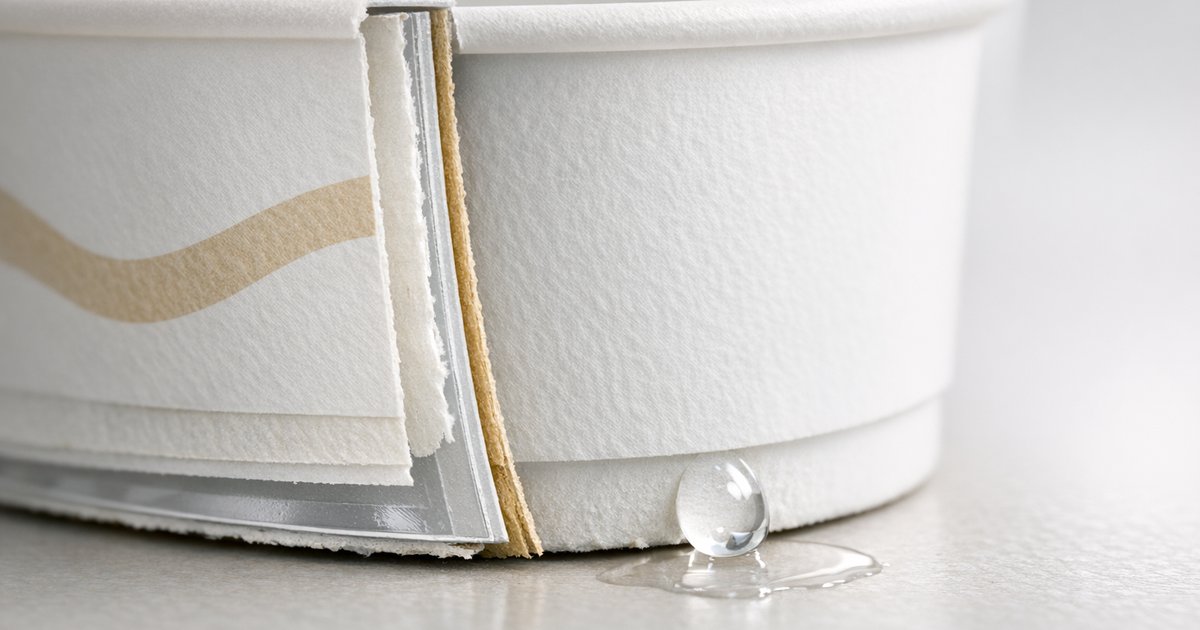
Short answer: a properly made cup should not leak. When one does, it is almost always the base seal, the side seam, overfilling, a poorly seated lid, or physical damage from storage. Each cause looks slightly different, and once you know which one you are seeing, the fix is usually straightforward.
If a whole batch is leaking, that is a manufacturing fault and you should be talking to your supplier rather than working around it. If the occasional cup leaks, it is nearly always one of the handling causes below.
How a cup is sealed in the first place
A takeaway cup is made from two pieces of board. The wall is a printed blank rolled into a cone with a vertical overlap, and the base is a separate disc crimped up into the bottom of that cone. Both joins are bonded using heat, which melts the inner lining so it fuses to itself.
So the cup relies on the same lining that makes it waterproof to also make it airtight and watertight at the joins. That single fact explains nearly every leak.
The five real causes
1. The base seal
The base is a likely failure point, because it is where the most material is folded and compressed. A cup that leaves a ring of liquid on the counter, or drips from directly underneath, has a base problem.
An isolated cup can happen in any high-speed forming process. If it is repeatable across a carton, it is a fault worth reporting with the batch details.
2. The side seam
A seam leak shows as a vertical wet line down the outside wall, typically appearing first near the fill line. Seams fail when the heat seal was marginal or when the cup has been squeezed hard enough to work the join open.
3. Overfilling
This is the cause people least expect and most often have. Cups are designed to be filled to a line below the rim, not to the brim. Fill to the top and you get liquid sitting in the curl of the rim, which then wicks out under the lid and runs down the outside as soon as the cup is tilted or knocked.
It looks exactly like a leak and it is not one. Leaving proper headroom fixes it immediately, and it also stops the lid displacing liquid when it is pressed on.
4. Lid fit
A lid that is not fully seated all the way round will let liquid out at the rim the moment the cup moves. Two things cause this: the lid was not pressed home evenly, or it is the wrong diameter for the cup.
Diameter mismatches are more common than people think, because an 8oz cup and an 8oz squat cup take different lids. We cover that in squat vs tall cups, and the fits for our range are listed in the paper cup lids guide.
5. Crushing and storage damage
Cups arrive nested in sleeves inside cartons, and that packaging is doing real structural work. Stack heavy items on top, let a carton get damp, or knock a sleeve hard, and you create micro-cracks in the lining at the base crimp that only reveal themselves when hot liquid arrives.
Damp storage is the quiet one. Board absorbs atmospheric moisture, which weakens it and can affect how it behaves when filled. Our guide to storing paper coffee cups covers conditions and shelf life.
Diagnosing it in ten seconds
| What you see | Most likely cause | Fix |
|---|---|---|
| Drip from directly underneath, ring on the counter | Base seal | Check other cups from the same sleeve, report if repeatable |
| Vertical wet line down the side | Side seam | Check for crushing in storage, report if repeatable |
| Liquid escaping at the rim when tilted | Overfilling or lid not seated | Leave headroom, press the lid fully home |
| Lid pops or weeps all round | Wrong lid diameter | Match lid size to cup, check squat vs tall |
| Cups soft, board feels limp | Damp storage | Move to a dry area off the floor |
Does hot liquid weaken the cup?
Within its rated temperature range, no. Cups are engineered for hot beverage service and the lining is stable at normal serving temperatures. What causes trouble is heat plus time: a cup used as a holding vessel for a long period is being asked to do a job it was not designed for. See how hot a paper coffee cup can handle for the actual limits.
Reheating a cup in a microwave is a separate and worse idea, covered in can you microwave paper coffee cups.
Does single wall or double wall make a difference?
Not to leaking as such, since both use the same sealing principle. What double wall changes is how a leak feels: the outer wall keeps your hand dry for longer, so a slow seep can go unnoticed until it reaches the counter. Double wall cups are also more rigid, which makes them more resistant to the squeezing that opens seams. See single wall vs double wall.
Prevention checklist
- Store cartons off the floor, dry, out of direct sun, nothing heavy stacked on top
- Keep cups in their sleeves until the point of use
- Fill to a sensible line, not to the rim
- Match lid diameter to cup size and press the lid fully home
- Check a few cups from a new batch before a busy service
Where to go from here
New delivery just arrived? Run through our checklist for what to inspect before you start using them. If you have a batch that is genuinely failing, contact us with your order number and a photo and we will sort it out.