
How Many Coffee Cups Fit in a Box? Storage & Shipping Explained
Short answer: If you need a quick planning figure for shipping or storage, most cartons hold between 500 and 1,000 cups. In practical terms, how many coffee cups fit in a box usually depends on cup size and carton configuration — our minimum order is 500 cups (typically one carton for 8oz or 12oz). Use the guidance below to estimate cartons, pallet quantities and freight.
How cups are packed for shipping
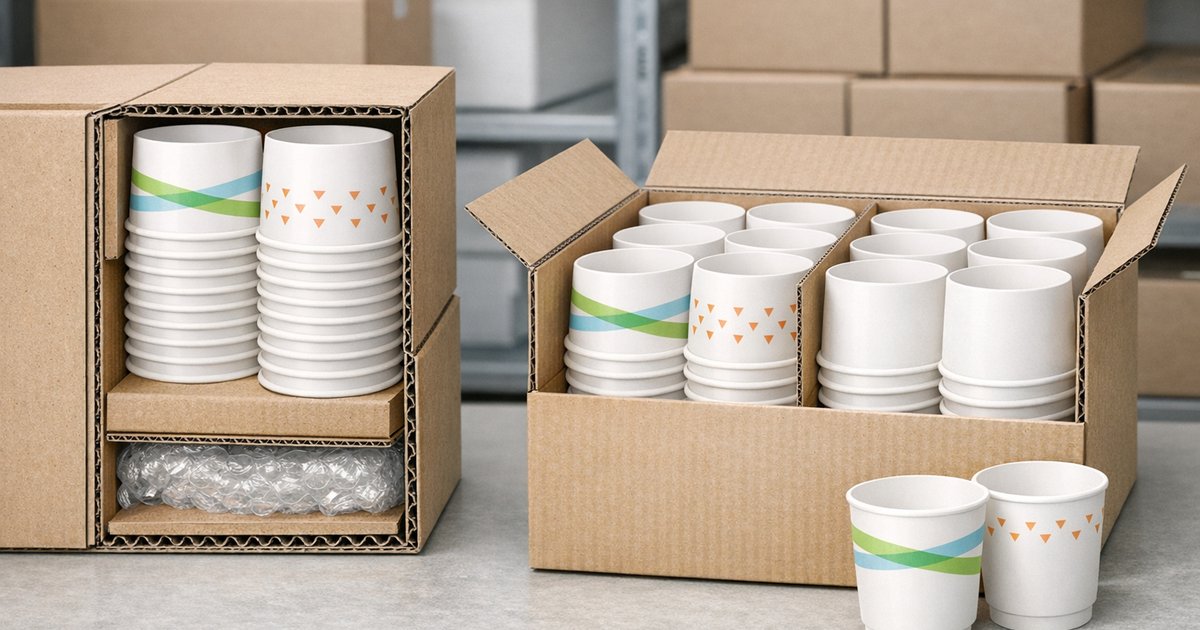
Suppliers save space by nesting paper and compostable cups. Key packing notes:
- Nested sleeves of cups — typically ~50 per sleeve for 8oz and 12oz; 16oz sleeves vary from 25–50 depending on taper.
- Sleeves are packed upright or on their side into cartons sized to hold roughly 500–1,000 cups, depending on cup type and carton layout.
Typical sleeve and carton counts
| Cup size | Cups per sleeve (approx.) | Common carton counts |
|---|---|---|
| 8oz (single-wall / double-wall) | ~50 | 500 per carton (10 sleeves × 50); 1,000 possible with high-density cartons |
| 12oz (single-wall / double-wall) | ~50 | 500 per carton common; 1,000 possible depending on carton size |
| 16oz (single-wall only) | ~25–50 (varies) | 500 or fewer per carton; 1,000 less common due to larger volume |
Approximate carton dimensions and weights
Dimensions and weights vary by cup type and sleeve count. Use these planning figures as a guide and always confirm exact sizes with your supplier:
- 500-cup carton (typical 8oz/12oz)
- Approx dimensions: 450–550mm (L) × 300–400mm (W) × 250–380mm (H)
- Gross weight (carton + cups): 4–9 kg — single-wall at the low end; double-wall or compostable at the high end.
- 1,000-cup carton
- Approx dimensions: 550–700mm (L) × 350–450mm (W) × 350–450mm (H)
- Gross weight: 8–18 kg depending on cup type.
Note: Exact carton sizes and weights should be confirmed with your supplier before ordering.
How many boxes on a pallet?
Palletisation can significantly affect freight pricing. Typical Australian guidance:
- Standard Australian pallet (1165 × 1165 mm) usually holds 8–20 cartons depending on each carton footprint and stacking height limits.
- Cartons ~550 × 350 mm often allow 10–12 cartons per layer with multiple layers stacked to a safe height.
- Pallet freight is generally cheaper per carton than parcel courier rates because carriers charge by weight/volume and palletised loads are easier to handle.
Storage requirements and shelf life
Store cartons in dry, temperature-stable conditions to protect adhesives, coatings and print:
- Keep cartons dry and off the floor on pallets or shelving.
- Avoid direct sunlight and high humidity — moisture can weaken cup walls and inner coatings.
- Recommended environment: 10–30°C and humidity under 60% where possible.
Shelf life (practical guidance):
- PE-lined paper cups: Stable for many years if stored dry; adhesives and print are best used within 1–2 years.
- PLA/CPLA compostable cups: Slightly shorter practical shelf life — we recommend using within 12 months and storing in cool, dry conditions.
How freight costs relate to number of cartons
Freight pricing is driven by weight, volume and shipment type (parcel vs pallet). Practical points:
- Small orders (1–2 cartons): Usually sent by courier; per-carton cost can be relatively high.
- Pallet orders (multiple cartons): Carrier pricing is more efficient — per-carton freight falls as carton count increases.
- Freight estimates: Typical ranges for metro deliveries can be around $30–$150 per carton at cost depending on destination and quantity (regional/interstate higher).
- Plan for receiving: pallet deliveries may require a forklift or manual handling arrangements.
Practical planning examples
- Our minimum order is 500 cups — this will usually be one carton for 8oz or 12oz.
- For a busy café using ~200 cups/day, a 500-cup carton covers ~2–3 days. Ordering multiple cartons or a pallet reduces freight and handling frequency.
- For events, 1,000 cups (two 500 cartons or one 1,000 carton) is a common single delivery — check storage space and stack safely.
For current prices, see the printed coffee cups page.
Lead times: standard 10 business days production plus 2–3 days metro freight; rush 5–7 business days.
Tips to reduce storage & freight costs
- Order pallet quantities to lower per-cup freight and handling costs.
- Consolidate sizes where possible — fewer SKUs makes stacking and storage easier.
- Request carton dimensions and weights from the supplier before ordering to plan racking and aisle space.
- Store lids separately if they bulk up carton volume — this can reduce freight charges.
Planning checklist for businesses
- Calculate weekly/monthly cup usage and multiply by desired stockholding weeks.
- Decide on cup type early — compostable cups may require faster turnover.
- Confirm carton counts and pallet stacking with your supplier before placing your order.
- Arrange receiving space and handling for pallet deliveries.
Where to start
Still unsure how many coffee cups fit in a box for your venue? Order a sample pack to check size and fit, or view our product and pricing on the custom printed coffee cups page. For broader planning and print options, read our Custom Printed Coffee Cups Australia Guide.
Final note: The simple answer to “how many coffee cups fit in a box” is usually 500–1,000 cups per carton. Adjust for 16oz variability, confirm carton sizes with your supplier, and optimise freight by ordering pallet quantities. If you’d like personalised help calculating space, pallet requirements or freight for an upcoming order, upload your estimated daily usage or event numbers and we’ll help plan quantities and delivery.