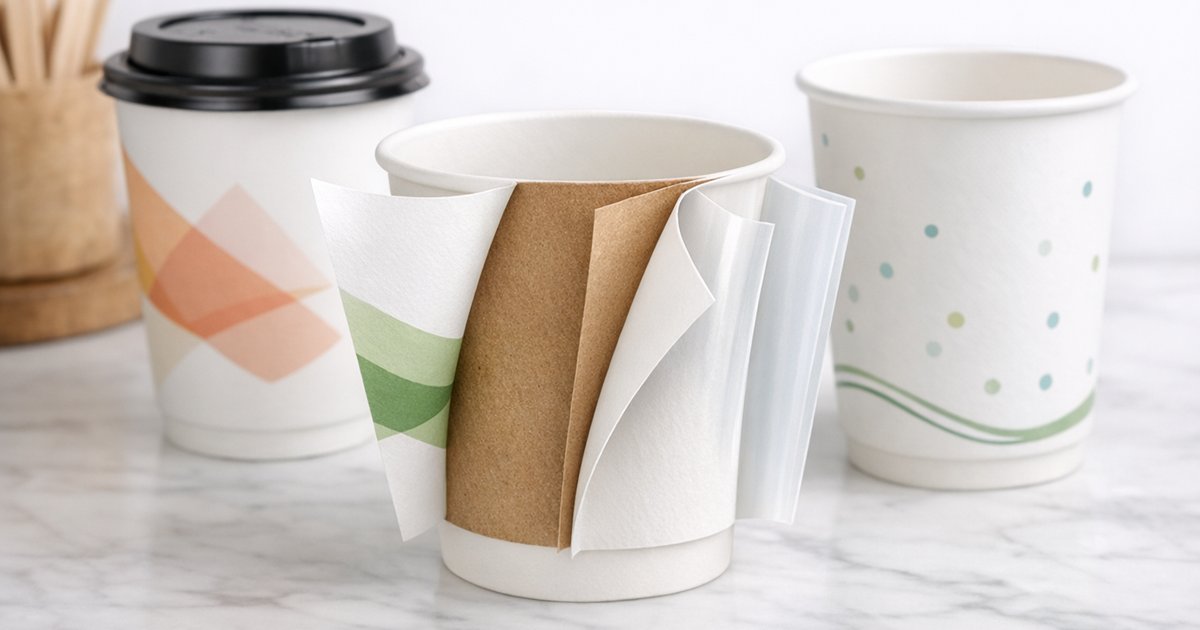
Short answer: If you’re asking “what are paper coffee cups made of”, they’re made from food‑grade paperboard (measured in GSM) with an inner waterproof lining — usually PE (polyethylene) for standard cups or PLA/CPLA for compostable options. Cups are available as single‑wall or double‑wall and are printed in full‑colour CMYK on the outer board.
Quick overview — what are paper coffee cups made of?
In short: an outer food‑grade paperboard (260–350 GSM) + an inner lining (PE or PLA/CPLA) + printed artwork. Use the notes below to choose the right cup for your café or event.
- Outer board: food‑grade paperboard, weight measured in GSM (common 260–350 GSM; ~300 GSM balances rigidity and feel).
- Inner lining: PE (standard) or PLA/CPLA (commercially compostable).
- Construction: single‑wall (economical) or double‑wall (extra insulation).
- Printing: full‑colour CMYK printed on the outer board before forming.
Outer layer: food‑grade paperboard and GSM
The visible surface is a sheet of food‑grade paperboard. Most takeaway cups use board between 260–350 GSM. Around 300 GSM is common because it gives good rigidity, high print quality and a premium feel without too much weight.
Inner lining: why a coating is essential
Paper soaks liquid, so the inner surface needs a waterproof coating. The two common linings are:
PE (polyethylene) — the standard lining
PE is a plastic lining used widely because it’s cost‑effective and reliably waterproof — the default choice for many cafés.
- Pros: lower cost, dependable waterproofing and consistent performance.
- Cons: not compostable; recycling depends on whether your local MRF accepts mixed paper/plastic containers.
PLA / CPLA — compostable linings
PLA is a plant‑based polymer (often from corn or sugarcane). CPLA (crystallised PLA) is heat‑stable for hotter drinks.
- Pros: commercially compostable in industrial facilities — good if you have a commercial organics program.
- Cons: higher cost than PE; requires industrial composting (not reliably home‑compostable); can contaminate recycling if wrongly disposed.
Single‑wall vs double‑wall
Single‑wall cups are one layer with an inner lining — lighter and cheaper. Double‑wall cups have two boards with an air gap for insulation, so they stay cooler to touch and the drink stays warmer longer, but they cost more and are bulkier.
How printing is applied
Artwork is printed on the flat outer board before cups are formed. We accept AI and PSD files, supply templates and offer a design layout service. Printing is full‑colour CMYK, using digital or flexographic processes depending on run size and artwork.
- Place your artwork on our flat board template (we supply AI & PSD).
- We print the board, laminate the inner lining and then form the cups.
- Cups are packed and shipped — you can request a sample pack first.
Minimums and lead times
Minimum order: 500 cups.
Turnaround: standard production 10 business days + 2–3 business days metro freight (freight charged at cost). Rush production: 5–7 business days. We include free templates.
Environmental and practical trade‑offs
Consider these operational and disposal points when choosing between PE and PLA/CPLA:
- Cost: PE is more economical; PLA/CPLA costs more.
- Disposal: PLA requires industrial composting; PE may be recyclable where your council/MRF accepts mixed paper/plastic — check local guidance.
- Operations: Compostable cups make sense only if you can collect them into commercial organics or a council program — otherwise they risk contaminating recycling streams.
Practical guidance for Australian cafés
- Default economical option: PE‑lined single‑wall cups.
- If you want better insulation and fewer sleeves: choose double‑wall (available in PE and compostable options).
- If you operate within a council organics program (Sydney, Melbourne, Brisbane etc.) or have commercial composting, PLA/CPLA can be an option — always verify acceptance with your council or composting provider first.
Common questions
Are PLA‑lined cups home‑compostable?
No — PLA and CPLA generally require industrial composting with sustained high temperatures. Home composts won’t reliably break them down.
Can PE‑lined cups be recycled?
Sometimes. Recycling depends on your local material recovery facility (MRF). Some councils accept mixed paper/plastic containers; many do not. Check your local council’s guidelines before advertising cups as recyclable.
Which lining should my café choose?
For most Australian cafés the practical default is PE for cost and consistency. Choose PLA/CPLA if you have access to industrial composting, clear customer messaging and bin infrastructure to keep compostables separate.
What are paper coffee cups made of — final recap
To recap “what are paper coffee cups made of”: food‑grade paperboard (GSM) with an inner waterproof lining of either PE (standard) or PLA/CPLA (compostable). You can choose single‑wall or double‑wall constructions depending on cost, insulation and end‑of‑life needs.
Design help, samples and ordering
We provide artwork templates (AI & PSD), a design layout service and a sample pack so you can feel the stock, compare linings and check print quality before ordering. Ready for pricing with your logo or want a quote? Visit our custom printed coffee cups page or read the complete buyer’s guide for more details.
Want to compare materials in person? Order a sample pack to check GSM, lining and print. Ready for pricing with your logo? Get a quote on our custom printed coffee cups page — minimum orders start at 500 cups.