Category: Buying Guide

  • Choosing a Coffee Cup Supplier in Australia: 7 Things to Check

    Short answer: Compare coffee cup suppliers on seven things: published pricing, proofing policy, minimum order, turnaround, material options, print coverage and freight transparency. Any supplier who hides one of them is making you do the work of finding out.

    1. Is pricing published?

    Suppliers who publish full quantity-tier pricing let you compare in minutes; suppliers who quote by email are pricing per customer. Every price on this site is public, per size and per tier, on the product pages.

    2. What is the proofing policy?

    A proof is your only protection against a full run of misprinted cups. Check how many proofs are included and whether they cost extra. Here, every order includes 2 free artwork proofs, and production starts only after you approve.

    3. What is the real minimum order?

    Custom printing minimums in the Australian market commonly range from 500 to 5,000 cups. If you are a small venue or ordering for one event, that difference decides who you can use. Our minimum is 500 cups.

    4. Turnaround, measured from what?

    “Two weeks” means little until you know when the clock starts. Look for turnaround measured from proof approval: ours is 10 business days standard, 5-7 rush, plus delivery.

    5. Material options

    A supplier should offer both standard PE-lined cups and a genuine compostable option (plant-based PLA lining), across sizes, not just one token line. Compare on our compostable range.

    6. Print coverage

    Some suppliers charge by print colours or restrict coverage to one panel. Full-colour, full-wrap printing at a single price is the modern standard, ask directly, because it changes what your designer can do.

    7. Freight honesty

    Cups are bulky, and freight varies with quantity and destination. A supplier should calculate it before you commit, not surprise you after. Our checkout calculates freight by destination and order size; the cups-per-box guide shows what to expect physically.

    The fastest way to judge any supplier

    Order a sample. Print quality, board weight and cup finish are impossible to fake in person. Our sample pack ships within 24 hours, and it is the same cup stock your order would be printed on.

  • Custom Disposable Coffee Cups: Options, Costs and How to Order

    Short answer: Custom disposable coffee cups come in four sizes (6oz to 16oz), two wall types, and two linings (standard PE or compostable PLA), printed full colour. This guide walks through every option so you order the right cup first time.

    Size: match the menu, not the shelf

    Stock the sizes your menu actually sells. Most venues run 8oz as the small and 12oz as the large; add 16oz only if extra-large drinks are a real seller, and 6oz for piccolos. Our cup size guide covers the details.

    Wall type: single for speed, double for hold time

    Single wall is the everyday standard: lighter, cheaper, ideal where drinks are handed over and consumed promptly. Double wall (8oz and 12oz) adds an insulating air gap, keeping drinks warmer and hands cooler for commuters and slow sippers. Full comparison: single wall vs double wall.

    Lining: standard or compostable

    Every paper cup needs a liquid-tight lining. Standard cups use PE; compostable cups use a plant-based PLA lining designed for commercial composting. If sustainability is part of your pitch, the compostable option lets the cup back the claim. Background reading: PLA vs PE linings explained.

    Lids

    Add lids to any cup order in the configurator: smooth lids in white or black, or compostable fibre and CPLA options. Lids are priced per quantity alongside the cups, one order, one delivery.

    What does it cost?

    Bulk buyers should start at the wholesale pricing page. All prices, for every size and combination, are published openly on each product page.

    Ordering checklist

    • Pick size(s) from real menu sales, not guesswork.
    • Choose wall type and lining to match your service style and brand.
    • Upload print-ready artwork (vector logo preferred).
    • Approve your proof, 2 free proofs are included.
    • Allow 10 business days production plus delivery, or 5-7 on rush.

    Unsure on quality? A sample pack ships within 24 hours so you can hold the cup before you order.

  • Your Custom Cups Have Arrived: What to Check Before You Use Them

    Your Custom Cups Have Arrived: What to Check Before You Use Them

    Short answer: spend ten minutes on the delivery before you put it away. Check the carton count against the paperwork, open one carton and compare a cup against your approved proof, look for transit damage, test a lid, then store the rest properly. Problems found on day one are straightforward to resolve. Problems found in week six, halfway through the stock, are much harder for anyone to help with.

    Do this before the driver leaves

    • Count the cartons against the delivery docket. Not the cups, the cartons. Takes thirty seconds.
    • Look at the outside of every carton. Crushed corners, water staining, punctures or tape that has been opened and resealed.
    • Note any damage on the docket before signing. A signature with no notation makes a transit claim considerably harder.
    • Photograph anything that looks wrong while it is still on the truck or the pallet.

    Freight damage is the one category where the evidence disappears fastest.

    Open one carton and check the print

    Have your approved proof in front of you. Not your original artwork file, the proof you signed off, because that is the agreed reference.

    • Colour. Compare against the proof, in daylight if you can. Some shift between screen and cup stock is expected and normal, which is why the proof exists. What you are looking for is a clear departure from what was approved. See CMYK vs RGB.
    • Registration. Are the colour layers aligned, or is there a visible halo or double edge around detail?
    • Position. Is the artwork sitting where it should vertically, with sensible clearance at rim and base?
    • The seam. Check nothing critical has been swallowed by the overlap. See bleed, safe zone and wrap.
    • Text and fine detail. Read the small text. Check any QR code actually scans, with a phone, now.
    • Consistency. Pull five or six cups from different points in the sleeve rather than judging from the top one.

    Check the physical cups

    • Rim. Run a finger around the curl. It should be smooth, even and continuous.
    • Base. Sit a cup on a flat surface. It should sit flat and not rock.
    • Seam. Should be flat and firmly bonded, with no lifting edge.
    • Nesting. Cups should separate cleanly from each other. Cups that stick together are a service problem at the counter.
    • Feel and smell. Board should feel crisp, not soft or limp. Any strong odour means the stock has picked something up and should be raised straight away.

    The water test

    Take one cup, fill it with hot water, and leave it on a clean dry surface for ten minutes. Then look underneath and at the seam.

    It costs you one cup and it is the only way to verify the seals before a customer does it for you. If it leaks, test two or three more from different cartons to establish whether it is an isolated cup or a batch issue. See why paper cups leak.

    Test the lids

    If lids came with the order, fit one now. It should seat evenly all the way round and stay put when the cup is tilted.

    Confirm the diameters match your sizes: 80mm lids for 6oz and 8oz, 89mm for squat 8oz, 12oz and 16oz. A mismatch here is the most common ordering error and the easiest to fix on day one. See squat vs tall cups and the lids guide.

    Then store them properly

    Once you are satisfied, storage determines whether the cups are still good in three months.

    • Keep cups in their sleeves and cartons until needed. That packaging is structural.
    • Off the floor, on a pallet or shelving.
    • Dry, away from any damp wall or wet area.
    • Out of direct sunlight, which fades print over time.
    • Away from strong-smelling stock and cleaning chemicals, because board absorbs odour.
    • Nothing heavy stacked on top.
    • Rotate stock, oldest first.

    Full detail in how to store paper coffee cups.

    The ten-minute checklist

    Step Check
    1 Carton count matches the docket
    2 No transit damage, noted on the docket if there is
    3 Print matches the approved proof for colour, registration and position
    4 Several cups checked from different points, not just the top one
    5 Rim, base and seam sound; cups nest and separate cleanly
    6 Hot water test passed
    7 Lids fit and seat correctly
    8 Stored dry, off the floor, out of sunlight

    If something is wrong

    Contact us straight away rather than working around it. Have ready: your order number, clear photographs of the issue, roughly how many cups are affected, and which cartons they came from.

    Raising it immediately, with photographs, on an unopened majority of stock is the strongest position for everyone. Working through half the order first makes it much harder to establish what happened.

    Where to go from here

    Contact us if anything is not right. Planning your next order? See how many cups your cafe needs and how long custom cups take to produce.

  • Squat vs Tall Cups: Why Two 8oz Cups Aren’t the Same Shape

    Squat vs Tall Cups: Why Two 8oz Cups Aren’t the Same Shape

    Short answer: two cups can both hold 8oz while being completely different shapes. A tall 8oz is narrow and upright with an 80mm rim. A squat 8oz is wider and shorter with an 89mm rim, the same diameter as a 12oz. They hold the same drink and they do not take the same lid. That difference is the single most common cause of ordering the wrong lids.

    Same volume, different geometry

    Volume is a product of diameter and height, so there is more than one way to build a cup that holds a given amount. Manufacturers make both because they suit different service styles.

    • Tall 8oz. Narrower and taller. The standard takeaway profile in most of Australia, and what people usually picture as a small takeaway coffee.
    • Squat 8oz. Wider and shorter, with a broader opening. Common in cafe and dine-in-adjacent service, and popular for flat whites and cappuccinos where a wider surface shows off latte art and gives a better ratio of crema to cup.

    Why the shape genuinely matters

    Drink presentation. A wider mouth gives more surface area, which is why squat cups suit milk-based coffee where the top of the drink is part of the product.

    Stability. A shorter, wider cup has a lower centre of gravity, so it is less prone to tipping on a tray or a car cup holder. A tall cup is easier to hold in one hand.

    Fit in service equipment. Under-machine clearance, cup dispensers and carriers are all sized around specific profiles. Changing profile can quietly break part of your workflow.

    Print area shape. A squat cup gives you a short wide canvas, a tall cup a taller narrow one. The same artwork does not sit the same way on both, which matters if you are designing a wrap. See bleed, safe zone and wrap.

    The lid trap

    This is the practical consequence and it costs people money every year.

    Lids fit by rim diameter, not by cup volume. Order lids by the number on the cup and you will eventually get it wrong.

    Cup Rim diameter Lid size
    6oz 80mm 80mm
    8oz (tall) 80mm 80mm
    8oz squat 89mm 89mm
    12oz 89mm 89mm
    16oz 89mm 89mm

    Read that table again on the 8oz rows. A squat 8oz takes the same lid as a 12oz, not the same lid as a tall 8oz. An order for “8oz lids” is ambiguous unless you say which profile you have.

    The symptom of getting it wrong is a lid that will not seat, or one that sits on but pops off when the cup is moved, which usually presents as a leak. See why paper cups leak.

    What we supply

    Our printed cups are the tall profile in 6oz, 8oz, 12oz and 16oz. Our 8oz is a tall 8oz and takes an 80mm lid.

    We stock lids in both diameters, so if you already run squat 8oz cups from another source, our 89mm lids will fit them. The lid sizing on our range is listed as 80mm for 6oz and 8oz, and 89mm for squat 8oz, 12oz and 16oz, precisely so this is unambiguous at the point of ordering. Options and pricing are in the paper cup lids guide.

    How to check what you have

    Do not go by the printed size. Do this instead:

    1. Measure the rim. Across the outside of the top curl, in millimetres. You are looking for roughly 80 or roughly 89.
    2. Compare against a 12oz. If your 8oz rim matches your 12oz rim, you have squat cups.
    3. Check an existing lid. If your current 8oz and 12oz share a lid, that confirms it.
    4. Order lids by diameter, not by cup volume.

    Which should you choose?

    If you are ordering printed cups and lids together from us, this resolves itself: our tall profile and matching lids are supplied to fit.

    If you are switching profile, think about it as a workflow change rather than just a cup change. Your lids change, your dispensers may need adjusting, your machine clearance changes, and your artwork proportions change. None of that is difficult, but all of it is easier to plan than to discover.

    Where to go from here

    See sizes and pricing on our printed coffee cups, or browse coffee cup lids in both diameters. If you are unsure what profile your existing cups are, measure the rim and tell us the number and we will match it.

  • 6oz Coffee Cups: What the Small Size Is Actually For

    6oz Coffee Cups: What the Small Size Is Actually For

    Short answer: 6oz is the size for short, strong drinks and for serving a lot of people a small amount. Piccolo lattes, short blacks, macchiatos, tastings, kids’ babyccinos and sampling at events. It is the smallest cup we print, it takes an 80mm lid, and it costs less per cup than any other size.

    How big is a 6oz cup?

    Six fluid ounces is roughly 175 millilitres to the brim, which in practice means a serve of about 150 millilitres once you allow sensible headroom. Alongside the rest of the range:

    Size Approx. capacity Typical use
    6oz ~175ml Piccolo, short black, macchiato, tastings, kids
    8oz 237ml Standard small takeaway coffee
    12oz 355ml The medium that carries most cafe trade
    16oz 473ml Large, and the practical choice for iced drinks

    The full breakdown is in what size coffee cup do I need.

    Where 6oz genuinely earns its place

    Short, strong coffee

    An 8oz cup holding a piccolo looks wrong, and it feels like a serving error to the customer even when the coffee is correct. Australian coffee culture is built on short drinks, and matching cup to drink is a basic quality signal. See why takeaway cup quality matters.

    Tastings and sampling

    This is where 6oz does something no other size can. If you are running a tasting, a market stall or a product sampling activation, you want to serve the maximum number of people from a fixed quantity of product, at the lowest cost per serve. A smaller cup does both at once.

    Sampling at events is one of the strongest uses of branded cups generally, because the cup goes on being seen after the sample is finished. See promotional coffee cups for trade shows.

    Kids’ drinks

    Babyccinos in a full-size cup are mostly froth and disappointment. A 6oz cup is the right vessel, and for cafes with a family trade it is a small detail that gets noticed.

    Offices, conferences and catering

    Where people take a coffee back to a desk or a session, a smaller serve reduces waste from half-finished cups and costs less per head. See branded cups for offices and corporate events and conferences.

    Espresso bars and secondary service points

    Venues running a dedicated espresso point, or a second bar at a busy site, often want a size that says “quick and strong” rather than “settle in”.

    The cost argument

    6oz is the least expensive size we print, at every quantity break. For a high-volume sampling activation, the difference between a 6oz and an 8oz cup across several thousand serves is real money, and the smaller serve also stretches your product further.

    Current pricing across sizes and quantities is on the printed coffee cups page. Our minimum order is 500 per size and configuration.

    Lids and construction

    Lids. 6oz cups take an 80mm lid, the same fit as our standard 8oz. That is genuinely convenient if you run both sizes, because one lid covers your two smallest cups. Options are smooth PS in white or black, moulded fibre, or compostable CPLA. See the paper cup lids guide.

    Construction. 6oz is available as a single wall cup, in standard PE or compostable lining. It is not made as a double wall cup. In practice this matters far less at this size than it would at 16oz: a short drink is smaller, cooler at the wall and finished quickly, so the insulation case is weak. See single wall vs double wall.

    What about 4oz?

    4oz cups exist in the market, used mainly for straight espresso and very small tasting pours. We do not print 4oz. For almost every practical use, 6oz covers the short-drink requirement while still holding a piccolo or a macchiato properly, which a 4oz cup does not.

    Designing for a small cup

    A 6oz cup has less wall area, and that changes what works:

    • Simplify. A logo and one short line beats a full layout. Detail that works at 16oz becomes cramped at 6oz.
    • Do not shrink your 12oz artwork. Scaling down makes type unreadable. Rework it for the space.
    • Mind the safe zone. Proportionally, the rim and base allowances eat more of a small cup. See bleed, safe zone and wrap.
    • Full colour is included, so use the area boldly rather than sparingly.

    Where to go from here

    Order 6oz from our printed coffee cups range, or read how to design artwork for custom coffee cups before you start. Planning a sampling run and not sure on quantities? Tell us the event and we will help you size it.

  • How Many Coffee Cups Does Your Cafe Need? A Reorder Guide

    How Many Coffee Cups Does Your Cafe Need? A Reorder Guide

    Short answer: take your daily coffee count, split it by cup size, multiply out to the period you want to cover, add your lead time and a safety buffer, then round to the price break that suits you. This guide walks through that calculation with realistic numbers so you order enough without burying yourself in stock.

    Getting this wrong is expensive in two directions. Order too little and you are paying premium unit rates repeatedly, or worse, running out mid-week. Order too much and you have tied up cash and floor space in cups you will use in eighteen months.

    Step 1: Find your true daily cup count

    Do not estimate this. Pull the actual number of takeaway coffees from your POS for a normal week, then divide by trading days.

    Two adjustments worth making:

    • Exclude dine-in. If you serve a meaningful share in ceramic, those are not cups.
    • Use a representative week. Not your best week, not a school holiday week. If your trade swings seasonally, work out a summer number and a winter number.

    Step 2: Split by size

    This is where most orders go wrong. A cafe orders equal quantities of each size, then runs out of 12oz in six weeks while a pallet of 16oz sits untouched.

    Your POS knows your real split. Pull it. A common pattern in Australian cafes is that the medium size carries the bulk of trade, with small and large sharing the rest, but yours will be specific to your menu and pricing.

    If you are opening and have no history, start with a conservative order across sizes and expect to correct on your second order. That is normal, and it is far cheaper than committing to a guess at high volume. For what each size suits, see what size coffee cup do I need.

    Step 3: Choose your coverage period

    Now multiply daily usage by trading days to reach a target period.

    Worked example. A cafe doing 120 takeaway coffees a day, six days a week, with a split of 20 percent small, 55 percent medium and 25 percent large:

    Size Per day Per week Three months (13 weeks)
    8oz 24 144 1,872
    12oz 66 396 5,148
    16oz 30 180 2,340

    That cafe should be thinking about roughly 2,000 of the small, 5,000 of the medium and 2,500 of the large to cover a quarter. Note how uneven that is. Ordering 3,000 of each would leave them short on medium and long on small.

    Step 4: Add lead time and a buffer

    You need enough stock to cover the gap between placing an order and receiving it, plus a margin for a busier than expected fortnight.

    Our standard production is 10 business days, with a rush option at 5 to 7 business days. Add freight time on top. See how long custom coffee cups take for the detail.

    The practical rule: reorder when you have about three weeks of stock left. That covers production and freight with room to spare, and it means a delay never becomes a crisis.

    Step 5: Check it against the price breaks

    Custom printing has a fixed setup component, so the cost per cup falls as quantity rises. Our minimum order is 500 per size and configuration, with breaks at 500, 1,000, 2,000, 3,000, 5,000 and 10,000.

    Once you have your target quantity, look at the next break up. Often the jump costs little more in total and materially less per cup. That is a genuine saving, provided you will actually use them, which brings us to the constraint people forget.

    The limit: storage and shelf life

    Cups are bulky. Before committing to a large quantity, work out where the cartons will physically live. A carton of cups takes real space, and cups stored badly are cups you will throw away. Our guide on how many coffee cups fit in a box helps you plan the footprint.

    Printed cups keep well when stored dry, off the floor and out of sunlight, so a quarter or two of stock is comfortable for most businesses. See storing paper coffee cups.

    There is a branding consideration too. If your artwork is likely to change, or you run seasonal designs, holding a year of stock locks you into today’s design. See seasonal cup campaigns.

    Do not forget the lids

    Lids are ordered separately and it is easy to under-order them. Two things to get right:

    • Not every drink gets a lid. Many venues run at well under one lid per cup, so check your real usage rather than assuming a one-to-one ratio.
    • Lid diameter follows cup size. Our lids come in 80mm for 6oz and 8oz cups, and 89mm for squat 8oz, 12oz and 16oz. Order against your size split, not a single total.

    A quick formula

    For each size: daily cups x trading days per week x weeks of coverage = order quantity, then reorder when roughly three weeks of stock remains, and round up to the nearest sensible price break you have room to store.

    Where to go from here

    If you want a hand sizing a first order, tell us your daily coffee count and size split and we will work the quantities with you. To see current pricing across sizes and quantities, view our printed coffee cups, or read minimum order quantities explained.
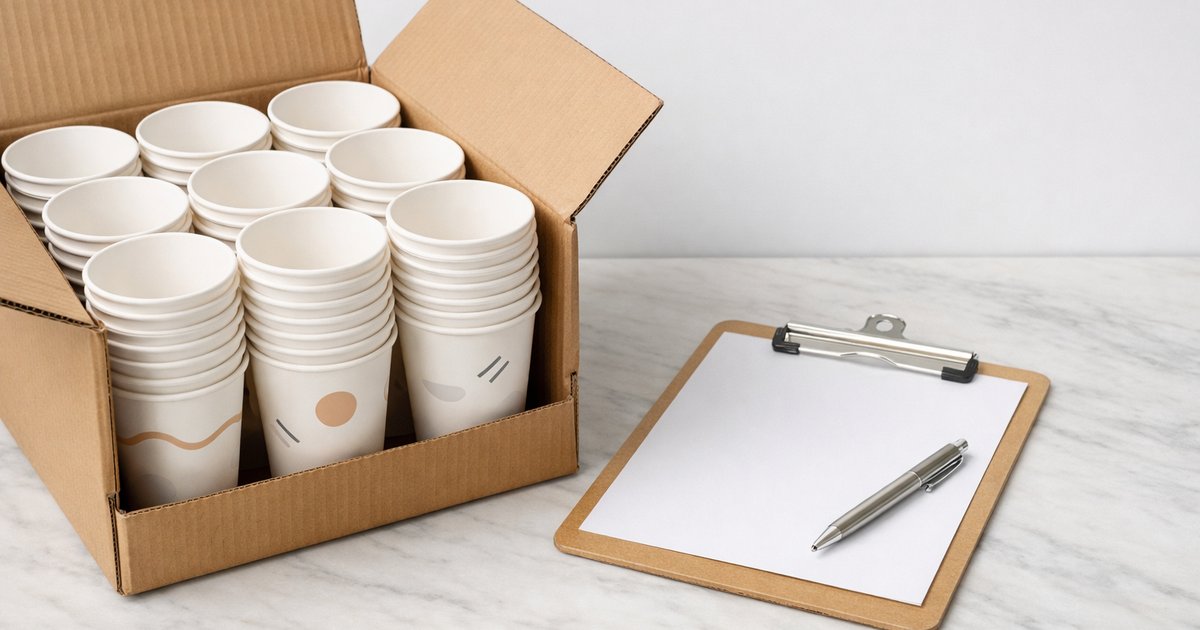
  • Branded Coffee Cups for Small Business: Is It Worth It at 500 Units?

    Branded Coffee Cups for Small Business: Is It Worth It at 500 Units?

    Yes — ordering 500 branded coffee cups for small business is often worth it. That includes full‑colour CMYK printing, free artwork templates. Standard production is 10 business days + 2–3 days metro freight; rush is 5–7 business days. Want to check materials first? Order a sample pack to inspect paper, print and lid fit.

    Is 500 branded coffee cups for small business worth it?

    Short answer: yes in many cases. A 500‑cup run is a low-cost way to trial branded cups, improve perceived value, generate mobile advertising and encourage social shares — all without a large upfront spend. It’s a practical test run for cafés, food trucks and hospitality operators wanting tangible marketing impact.

    For current prices, see the printed coffee cups page.

    Production notes & important extras

    • Minimum order: 500 cups.
    • Standard production: 10 business days + 2–3 days metro freight. Freight charged at cost (typically $30–$150 depending on destination).
    • Rush production: 5–7 business days.
    • Includes full‑colour CMYK printing, free artwork templates (AI & PSD).

    What a 500 run buys your business

    Ordering 500 branded coffee cups for small business delivers measurable retail and marketing benefits:

    • Stronger brand perception: professional, consistent packaging supports premium pricing.
    • Mobile advertising: cups become walking billboards in offices, on public transport and at events.
    • Social media potential: well‑designed cups are more likely to be photographed and shared on Instagram, TikTok and Facebook.
    • Improved customer experience: attractive packaging enhances the takeaway moment and can boost repeat visits.

    Practical example: 50 takeaway cups per day

    If your café serves ~50 takeaway coffees a day, a 500‑cup run covers about 10 service days — perfect for short promotions, menu launches or seasonal campaigns.

    • Visibility: roughly 50 mobile impressions per day while the stock lasts.

    How branded cups compare with other marketing

    • Social ads: can deliver thousands of impressions for $200–$500 but need ongoing optimisation and spend.
    • Flyers: 1,000 flyers usually cost $200–$500 and are often discarded quickly.
    • Signage: good long‑term presence but fixed location reach and higher upfront cost.
    • Branded cups: physical, mobile and experiential — they reach customers where they are and continue to advertise while in use.

    When 500 branded coffee cups for small business may not be ideal

    • Very low takeaway volumes (under ~10/day) — stock may sit for months.
    • If sustainability is a core brand value — consider compostable cups (higher cost) and fibre lids.
    • Frequent rebranding — if you change designs often, consider staggered orders or neutral base stock between campaigns.

    Design & samples — we make it easy

    We provide free artwork templates and a design layout service so your artwork is print‑ready. Prefer to feel the stock first? Order a sample pack to check material, print quality and lid fit before committing to 500 units.

    Measuring ROI

    Simple signals to track the impact of branded cups:

    • Change in daily takeaway sales over 10–30 days after switching to branded cups.
    • Increase in social mentions, tagged photos or branded hashtags.
    • Customer feedback or a quick barista survey on perceived value.
    • Foot traffic and repeat visit rates.

    Recommendations & next steps

    • Test with a 500× single‑wall 8oz run — the most cost‑effective way to trial branded cups for small business.
    • Order a sample pack first to inspect quality and sizing.
    • Need a quote, rush delivery or design help? Visit our custom printed coffee cups product page to request a personalised quote and layout.

    Want a deeper guide to materials, printing options and sustainability? Read our Custom Printed Coffee Cups Australia Guide for a comprehensive overview.

    Ready to try branded coffee cups for your small business? View product options and pricing on our custom printed coffee cups page or order a sample pack to see quality in hand. Need a personalised quote or design assistance? Contact us via the product page and we’ll prepare layouts and lead‑time details for your 500‑cup run.

  • How to Order Custom Coffee Cups Online (Step-by-Step)

    How to Order Custom Coffee Cups Online (Step-by-Step)

    Short answer: To order custom coffee cups online in Australia, pick your cup type (single‑wall, double‑wall or compostable), choose size and quantity (minimum 500), add lids if required, upload artwork or use our design layout service, approve a digital proof, then wait for production and delivery. Standard production is 10 business days + freight (rush 5–7 business days). Sample packs and artwork templates are available.

    Why follow a clear step-by-step process?

    Ordering printed cups involves choices that affect cost, timing and the customer experience. Use this concise 9-step guide to order custom coffee cups online confidently — ideal for cafés, events and branded takeaways across Australia.

    Quick overview

    • Cup types: Single‑wall (PE), Double‑wall (PE) — double‑wall available in 8oz & 12oz only — and Compostable (PLA/CPLA).
    • Sizes: 8oz, 12oz, 16oz (16oz is single‑wall only).
    • Minimum order: 500 cups.
    • Printing: Full‑colour CMYK. Free AI & PSD artwork templates and a design layout service available.
    • Turnaround: Standard production 10 business days + 2–3 business days metro freight. Rush 5–7 business days.

    Step-by-step: How to order custom coffee cups online

    Step 1 — Choose your cup type

    Decide between:

    • Single‑wall — lightweight and cost‑effective; suitable for most hot drinks.
    • Double‑wall — better insulation and hand feel; available in 8oz and 12oz.
    • Compostable — PLA/CPLA option if sustainability is a priority.

    Step 2 — Select size (8oz, 12oz, 16oz)

    Match cup sizes to your menu. 8oz and 12oz suit most cafés; 16oz is single‑wall only. If unsure, order a sample pack to check volumes, materials and lid fit.

    Step 3 — Choose quantity (minimum 500)

    Our minimum order is 500 cups. Prices fall at higher quantities — contact us for a tailored quote.

    Freight is charged at cost and depends on destination and order size.

    Step 4 — Add lids if needed

    Lids are optional and available in PS, fibre and CPLA. Always confirm lid compatibility with your chosen cup size and ask about lead times if you need lids quickly.

    Step 5 — Upload artwork or use our design service

    Upload print‑ready artwork at checkout. We accept AI, PSD and common high‑resolution formats. If you don’t have print‑ready files, our design layout service will prepare your artwork from your logo and brief. Download our free templates to ensure correct bleed and safe zones.

    Step 6 — We send a digital proof

    We supply a detailed digital mock‑up showing placement and approximate colours on your chosen cup. Digital proofs are a close visual guide but not a physical colour match — order a sample if exact colour fidelity is required.

    Step 7 — Approve the proof

    Check spelling, sizing, logo placement and alignment. Once you approve the proof production begins. Minor revisions can usually be made before final sign‑off.

    Step 8 — Production begins

    After approval we start production. Standard production is 10 business days. Rush production (5–7 business days) is available.

    Step 9 — Delivery

    We ship Australia‑wide. Metro freight is usually 2–3 business days; regional delivery may take longer. Freight is charged at cost and varies by location and order size.

    Pre-order checklist

    • Confirm cup type and size.
    • Decide quantity (minimum 500) and whether you need lids.
    • Prepare artwork or use our design layout service and download templates.
    • Allow production time: standard 10 business days (rush available).
    • Order a sample pack to inspect materials, print quality and lid fit before placing a full order.

    Common questions

    Can I order less than 500 cups?

    Our minimum order is 500 cups. For smaller needs, order a sample pack or contact us to discuss pooling orders or alternative stock options.

    How accurate are colours?

    We print full‑colour CMYK. Digital proofs represent colours closely but exact Pantone matches can vary on different stocks — request a physical sample if precise colour accuracy is critical.

    More resources

    For detailed advice on materials, printing methods and choosing the right cup for your business, see our complete buyer’s guide.

    Ready to order?

    Start your order on the custom printed coffee cups product page to choose cup type, size and quantity. Prefer to inspect first? Order a sample pack — we include templates and can provide a design layout to get you print‑ready.

    Call to action: Visit the product page to begin or request a sample pack today to check fit, feel and print quality before you commit.

    Related guides

  • How Long Does It Take to Get Custom Coffee Cups Printed?

    How Long Does It Take to Get Custom Coffee Cups Printed?

    How long does it take to get custom coffee cups printed?

    Quick answer: Standard custom coffee cups turnaround time is normally 10 business days production plus 2–3 business days metro freight — most metro orders arrive in about 2–3 weeks. Rush production is available in 5–7 business days. Allow 1–3 days for proof approval. Minimum order: 500 cups.

    What affects turnaround (at a glance)

    The main factors that determine your custom coffee cups turnaround time are production lead time, proofing & approvals, freight destination and cup choice. Order quantity, print complexity and how quickly you approve proofs also matter.

    Standard production & delivery

    • Production: 10 business days (standard run)
    • Proof approval: 1–3 business days (depends on how quickly you sign off)
    • Freight: 2–3 business days to metro addresses; longer for WA/NT and remote areas

    Combine these and most standard metro orders are delivered in about 2–3 weeks.

    Rush orders

    • Rush production: 5–7 business days
    • Rush jobs still require proof approval and freight — prompt client responses are essential. Some cup types (eg. large 16oz single‑wall) may not be available on rush — check with our team when ordering.

    Practical timeline example (metro delivery)

    1. Order placed and artwork submitted — Day 0
    2. Artwork review and first proof issued — Day 1
    3. Client approves proof — Day 1–3 (fast approval shortens overall time)
    4. Production — 10 business days
    5. Freight to metro address — 2–3 business days

    Total: roughly 2–3 weeks from order to delivery for standard jobs. For remote WA/NT addresses allow extra freight time.

    Freight & regional considerations

    • Metro (capital cities): 2–3 business days
    • Western Australia & Northern Territory: typically 4–5 business days
    • Regional / remote: add 1–2 business days on top

    Freight is charged at cost and varies by quantity and destination. When you enquire, tell us your delivery postcode so we can confirm exact timings and freight cost.

    Production variables that influence lead time

    • Cup type: single‑wall, double‑wall and compostable — compostable runs can take slightly longer depending on material availability.
    • Size: 8oz and 12oz are standard and fastest.
    • Print: full‑colour CMYK is standard — very complex artwork or many revisions can delay proofs and production.
    • Order quantity: minimum order is 500 cups; larger or split deliveries can affect scheduling and freight.

    For current prices, see the printed coffee cups page.

    Artwork, proofing and common delays

    Proof approval is the most common cause of delay. We provide free templates, a design layout service and a sample pack to help speed things up so you can be confident before you order.

    • AI & PSD templates available.
    • Proof approval usually takes 1–3 days if approved promptly; delayed approvals add directly to the overall timeline.

    Quick tips to speed up turnaround

    • Have final artwork ready: supply print‑ready files or use our templates.
    • Assign one approver: one person signing off avoids back‑and‑forth.
    • Choose standard sizes: 8oz and 12oz are the quickest.
    • Use rush production: 5–7 business day production when needed.
    • Order a sample first: request a sample pack to check material and print quality.

    How to plan for events and launches

    1. Set your delivery deadline and share the postcode with us when requesting a quote.
    2. Allow 2–3 business days for metro freight (add extra for regional/WA/NT).
    3. Add 10 business days production plus 1–3 days for proofing.
    4. If timelines are tight, choose rush production and ensure quick proof approvals.

    Frequently asked questions

    Can I get a sample before placing a large order?

    Yes — we offer a sample pack so you can check cups, lids and print quality before ordering.

    Do you provide artwork templates?

    Yes — AI and PSD templates and a design layout service are available to prepare print‑ready proofs.

    What if I need cups in less than 10 business days?

    Opt for our rush service (5–7 business days) and approve proofs immediately. Rush may not be available for all cup types — check with our team when ordering.

    Summary

    Standard custom coffee cups turnaround time is 10 business days production plus 2–3 business days metro freight — about 2–3 weeks total. Rush is 5–7 business days. Fast proof approvals and having artwork ready are the simplest ways to speed delivery.

    Ready to start? Browse our custom printed coffee cups or order a sample pack to check materials and print before you commit. For a full overview of sizes, materials and design options, see our complete buyer’s guide.

    Need a deadline confirmed? Upload your artwork and tell us your delivery date when you request a quote — we’ll confirm the earliest possible schedule and advise if rush production is required.

    Related guides

  • What Paper Are Coffee Cups Made From? PE vs PLA Lining Explained

    What Paper Are Coffee Cups Made From? PE vs PLA Lining Explained

    Short answer: If you’re asking “what are paper coffee cups made of”, they’re made from food‑grade paperboard (measured in GSM) with an inner waterproof lining — usually PE (polyethylene) for standard cups or PLA/CPLA for compostable options. Cups are available as single‑wall or double‑wall and are printed in full‑colour CMYK on the outer board.

    Quick overview — what are paper coffee cups made of?

    In short: an outer food‑grade paperboard (260–350 GSM) + an inner lining (PE or PLA/CPLA) + printed artwork. Use the notes below to choose the right cup for your café or event.

    • Outer board: food‑grade paperboard, weight measured in GSM (common 260–350 GSM; ~300 GSM balances rigidity and feel).
    • Inner lining: PE (standard) or PLA/CPLA (commercially compostable).
    • Construction: single‑wall (economical) or double‑wall (extra insulation).
    • Printing: full‑colour CMYK printed on the outer board before forming.

    Outer layer: food‑grade paperboard and GSM

    The visible surface is a sheet of food‑grade paperboard. Most takeaway cups use board between 260–350 GSM. Around 300 GSM is common because it gives good rigidity, high print quality and a premium feel without too much weight.

    Inner lining: why a coating is essential

    Paper soaks liquid, so the inner surface needs a waterproof coating. The two common linings are:

    PE (polyethylene) — the standard lining

    PE is a plastic lining used widely because it’s cost‑effective and reliably waterproof — the default choice for many cafés.

    • Pros: lower cost, dependable waterproofing and consistent performance.
    • Cons: not compostable; recycling depends on whether your local MRF accepts mixed paper/plastic containers.

    PLA / CPLA — compostable linings

    PLA is a plant‑based polymer (often from corn or sugarcane). CPLA (crystallised PLA) is heat‑stable for hotter drinks.

    • Pros: commercially compostable in industrial facilities — good if you have a commercial organics program.
    • Cons: higher cost than PE; requires industrial composting (not reliably home‑compostable); can contaminate recycling if wrongly disposed.

    Single‑wall vs double‑wall

    Single‑wall cups are one layer with an inner lining — lighter and cheaper. Double‑wall cups have two boards with an air gap for insulation, so they stay cooler to touch and the drink stays warmer longer, but they cost more and are bulkier.

    How printing is applied

    Artwork is printed on the flat outer board before cups are formed. We accept AI and PSD files, supply templates and offer a design layout service. Printing is full‑colour CMYK, using digital or flexographic processes depending on run size and artwork.

    1. Place your artwork on our flat board template (we supply AI & PSD).
    2. We print the board, laminate the inner lining and then form the cups.
    3. Cups are packed and shipped — you can request a sample pack first.

    Minimums and lead times

    Minimum order: 500 cups.

    Turnaround: standard production 10 business days + 2–3 business days metro freight (freight charged at cost). Rush production: 5–7 business days. We include free templates.

    Environmental and practical trade‑offs

    Consider these operational and disposal points when choosing between PE and PLA/CPLA:

    • Cost: PE is more economical; PLA/CPLA costs more.
    • Disposal: PLA requires industrial composting; PE may be recyclable where your council/MRF accepts mixed paper/plastic — check local guidance.
    • Operations: Compostable cups make sense only if you can collect them into commercial organics or a council program — otherwise they risk contaminating recycling streams.

    Practical guidance for Australian cafés

    • Default economical option: PE‑lined single‑wall cups.
    • If you want better insulation and fewer sleeves: choose double‑wall (available in PE and compostable options).
    • If you operate within a council organics program (Sydney, Melbourne, Brisbane etc.) or have commercial composting, PLA/CPLA can be an option — always verify acceptance with your council or composting provider first.

    Common questions

    Are PLA‑lined cups home‑compostable?

    No — PLA and CPLA generally require industrial composting with sustained high temperatures. Home composts won’t reliably break them down.

    Can PE‑lined cups be recycled?

    Sometimes. Recycling depends on your local material recovery facility (MRF). Some councils accept mixed paper/plastic containers; many do not. Check your local council’s guidelines before advertising cups as recyclable.

    Which lining should my café choose?

    For most Australian cafés the practical default is PE for cost and consistency. Choose PLA/CPLA if you have access to industrial composting, clear customer messaging and bin infrastructure to keep compostables separate.

    What are paper coffee cups made of — final recap

    To recap “what are paper coffee cups made of”: food‑grade paperboard (GSM) with an inner waterproof lining of either PE (standard) or PLA/CPLA (compostable). You can choose single‑wall or double‑wall constructions depending on cost, insulation and end‑of‑life needs.

    Design help, samples and ordering

    We provide artwork templates (AI & PSD), a design layout service and a sample pack so you can feel the stock, compare linings and check print quality before ordering. Ready for pricing with your logo or want a quote? Visit our custom printed coffee cups page or read the complete buyer’s guide for more details.

    Want to compare materials in person? Order a sample pack to check GSM, lining and print. Ready for pricing with your logo? Get a quote on our custom printed coffee cups page — minimum orders start at 500 cups.

    Related guides