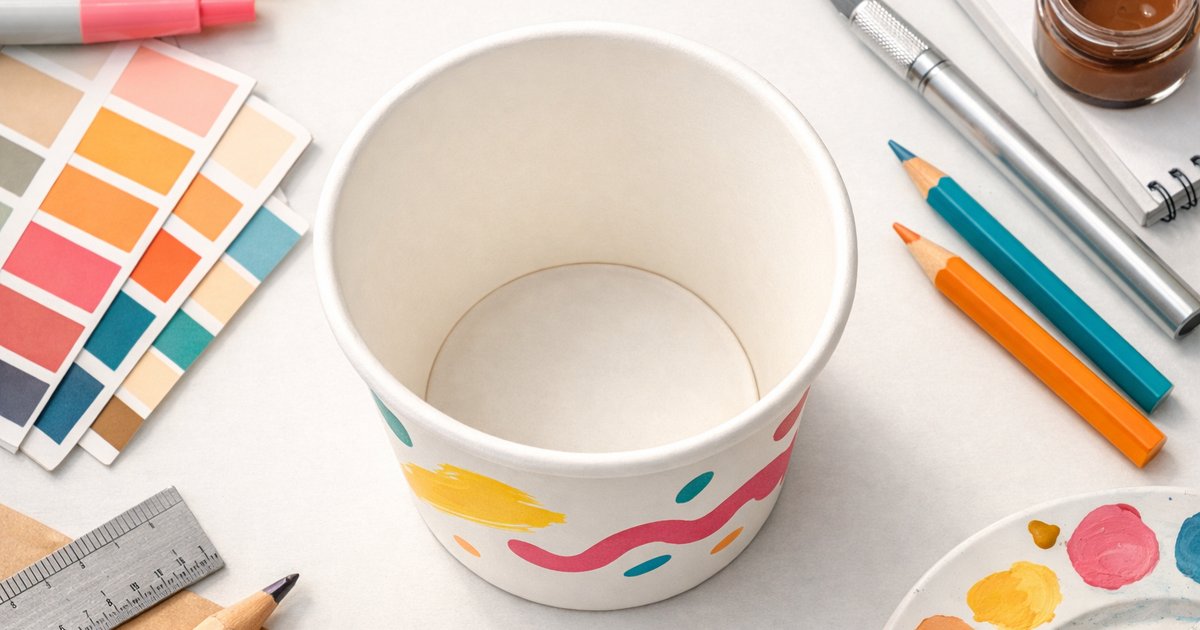
Short answer: no, the inside of the cup is not printable, and the base and the rolled rim are not usable print areas either. Printing happens on the outer wall, before the cup is formed. That is a manufacturing constraint rather than a pricing decision, and once you understand why, there are some effective ways to get a similar result inside the printable area.
Why the inside face stays blank
Two reasons, and the first one is the one that matters.
It is the food contact surface. The inner face is the side your drink touches. It carries the waterproof lining that makes the cup work, and keeping it free of applied inks is a basic food-packaging principle. Print goes on the outside precisely so it never contacts the beverage. There is more on this in food-safe inks on coffee cups.
The process runs flat. Cups are printed as flat board and then cut, rolled and formed. The press prints one face. By the time there is an “inside”, the cup already exists as a three-dimensional object and the printing stage is long finished. You can see the full sequence in how coffee cup printing works.
The base of the cup
The base is a separate disc of board, crimped and sealed into the bottom of the cup wall during forming. It is not part of the printed blank, and the sealing process puts the edge of that disc under mechanical and thermal stress.
So a printed base is not a normal option. Customers occasionally ask about a message on the bottom of the cup, the “you’ve finished your coffee” idea. It is a nice thought and it is not something the standard process delivers.
The rim
The top edge of a cup is rolled outward into a curl. That curl is what gives the cup its rigidity and what a lid clips onto, so it is functionally critical.
Two consequences for artwork:
- The rolled area consumes board that was flat when it was printed, so any artwork in that zone disappears into the curl.
- Registration near the very top edge is the least predictable part of the cup, because forming tolerances stack up there.
This is why every cup template has a safe zone at the top. Artwork that must be read should sit clear of it. Our guide to bleed, safe zones and wrap covers the measurements.
What about the seam?
The cup wall is a single printed blank wrapped into a cone, so there is a vertical overlap seam where one edge sits over the other. A small part of your design is hidden underneath and the join is visible on close inspection.
Practical rule: do not place a logo, a QR code or any critical text across the seam. Treat the wrap as having a start and an end rather than being a truly continuous 360 degree canvas. Repeating patterns handle the seam best.
How to get the effect anyway
Most requests for inside printing are really requests for one of these, and all of them are achievable:
- A surprise on the lower outer wall. The bottom of the outer wall is visible when the cup is tilted up to drink. It is the closest thing to a hidden message and it prints normally.
- A dark or coloured interior look. Rather than printing, this is a question of stock. Ask us what inner-face options exist for the size and lining you want, because availability changes.
- A scannable link. A QR code on the outer wall does everything an interior message would, and it is measurable. See QR codes on coffee cups.
- Full wrap coverage. Full colour printing across the entire outer wall is included at no extra cost, so use the area you do have properly. See full colour vs single colour printing.
Quick reference
| Area | Printable? | Why |
|---|---|---|
| Outer wall | Yes, full colour | The printed blank. This is your canvas. |
| Inner face | No | Food contact surface, and printing happens before forming. |
| Base disc | No | Separate component, crimped and heat-sealed during forming. |
| Rolled rim | No | Board is curled to form the lip and lid seat. |
| Seam overlap | Partly hidden | Wall wraps and overlaps itself. Keep key elements clear. |
Where to go from here
Download our templates and design within the printable area from the start, which is much easier than redrawing later. Start with how to design artwork for custom coffee cups, then check common artwork mistakes before you send files. If you are unsure whether an idea will survive the wrap, send it to us and we will tell you before you commit.