
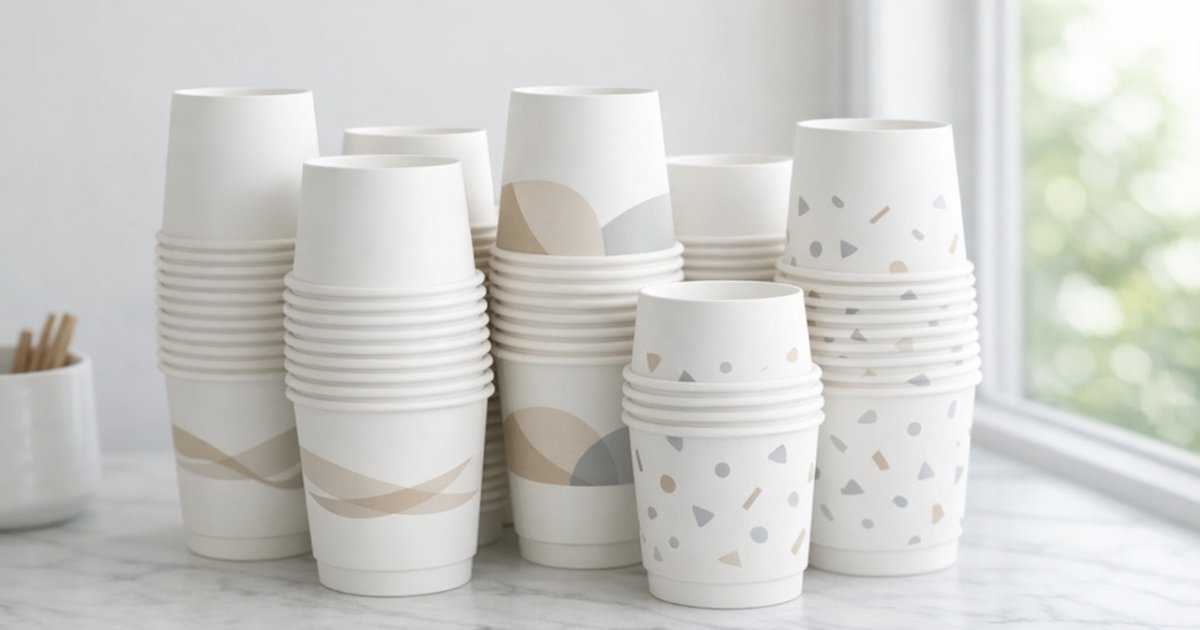
Short answer: take your daily coffee count, split it by cup size, multiply out to the period you want to cover, add your lead time and a safety buffer, then round to the price break that suits you. This guide walks through that calculation with realistic numbers so you order enough without burying yourself in stock.
Getting this wrong is expensive in two directions. Order too little and you are paying premium unit rates repeatedly, or worse, running out mid-week. Order too much and you have tied up cash and floor space in cups you will use in eighteen months.
Step 1: Find your true daily cup count
Do not estimate this. Pull the actual number of takeaway coffees from your POS for a normal week, then divide by trading days.
Two adjustments worth making:
- Exclude dine-in. If you serve a meaningful share in ceramic, those are not cups.
- Use a representative week. Not your best week, not a school holiday week. If your trade swings seasonally, work out a summer number and a winter number.
Step 2: Split by size
This is where most orders go wrong. A cafe orders equal quantities of each size, then runs out of 12oz in six weeks while a pallet of 16oz sits untouched.
Your POS knows your real split. Pull it. A common pattern in Australian cafes is that the medium size carries the bulk of trade, with small and large sharing the rest, but yours will be specific to your menu and pricing.
If you are opening and have no history, start with a conservative order across sizes and expect to correct on your second order. That is normal, and it is far cheaper than committing to a guess at high volume. For what each size suits, see what size coffee cup do I need.
Step 3: Choose your coverage period
Now multiply daily usage by trading days to reach a target period.
Worked example. A cafe doing 120 takeaway coffees a day, six days a week, with a split of 20 percent small, 55 percent medium and 25 percent large:
| Size | Per day | Per week | Three months (13 weeks) |
|---|---|---|---|
| 8oz | 24 | 144 | 1,872 |
| 12oz | 66 | 396 | 5,148 |
| 16oz | 30 | 180 | 2,340 |
That cafe should be thinking about roughly 2,000 of the small, 5,000 of the medium and 2,500 of the large to cover a quarter. Note how uneven that is. Ordering 3,000 of each would leave them short on medium and long on small.
Step 4: Add lead time and a buffer
You need enough stock to cover the gap between placing an order and receiving it, plus a margin for a busier than expected fortnight.
Our standard production is 10 business days, with a rush option at 5 to 7 business days. Add freight time on top. See how long custom coffee cups take for the detail.
The practical rule: reorder when you have about three weeks of stock left. That covers production and freight with room to spare, and it means a delay never becomes a crisis.
Step 5: Check it against the price breaks
Custom printing has a fixed setup component, so the cost per cup falls as quantity rises. Our minimum order is 500 per size and configuration, with breaks at 500, 1,000, 2,000, 3,000, 5,000 and 10,000.
Once you have your target quantity, look at the next break up. Often the jump costs little more in total and materially less per cup. That is a genuine saving, provided you will actually use them, which brings us to the constraint people forget.
The limit: storage and shelf life
Cups are bulky. Before committing to a large quantity, work out where the cartons will physically live. A carton of cups takes real space, and cups stored badly are cups you will throw away. Our guide on how many coffee cups fit in a box helps you plan the footprint.
Printed cups keep well when stored dry, off the floor and out of sunlight, so a quarter or two of stock is comfortable for most businesses. See storing paper coffee cups.
There is a branding consideration too. If your artwork is likely to change, or you run seasonal designs, holding a year of stock locks you into today’s design. See seasonal cup campaigns.
Do not forget the lids
Lids are ordered separately and it is easy to under-order them. Two things to get right:
- Not every drink gets a lid. Many venues run at well under one lid per cup, so check your real usage rather than assuming a one-to-one ratio.
- Lid diameter follows cup size. Our lids come in 80mm for 6oz and 8oz cups, and 89mm for squat 8oz, 12oz and 16oz. Order against your size split, not a single total.
A quick formula
For each size: daily cups x trading days per week x weeks of coverage = order quantity, then reorder when roughly three weeks of stock remains, and round up to the nearest sensible price break you have room to store.
Where to go from here
If you want a hand sizing a first order, tell us your daily coffee count and size split and we will work the quantities with you. To see current pricing across sizes and quantities, view our printed coffee cups, or read minimum order quantities explained.