
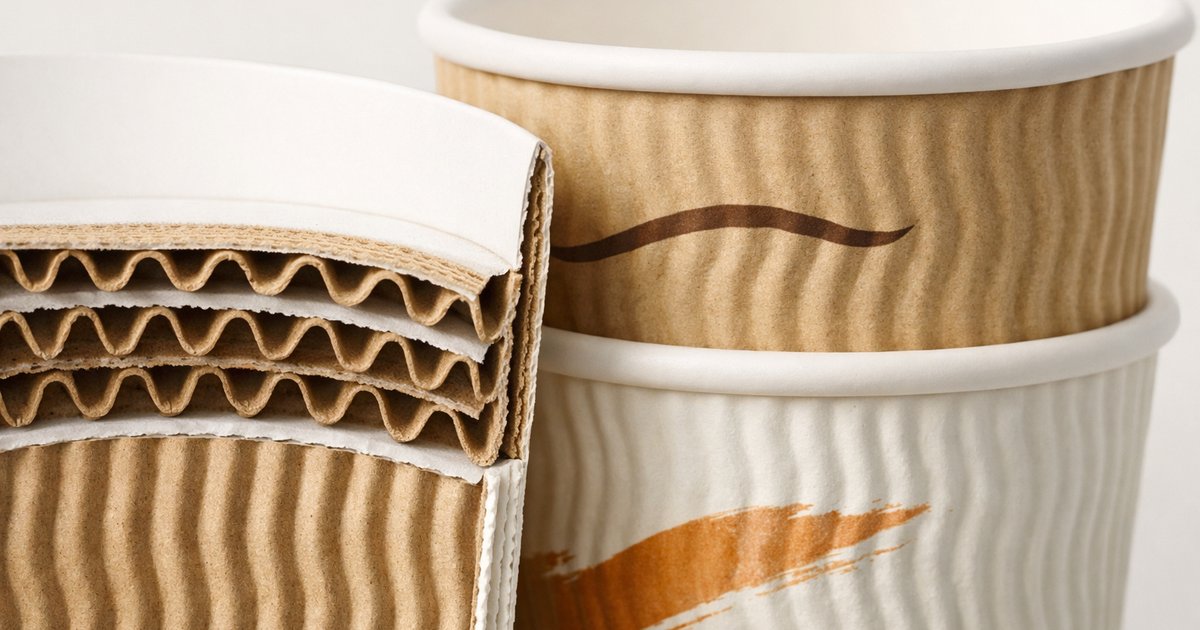
Short answer: a ripple wall cup has a corrugated outer layer bonded to a smooth inner cup, giving strong insulation and a distinctive textured grip. It sits alongside single wall and double wall as the third construction type. We supply single wall and double wall cups, not ripple, and this guide explains the differences so you can judge which construction you actually need.
The three constructions
- Single wall. One layer of lined board. Lightest and lowest cost.
- Double wall. A second smooth outer wall bonded over the inner cup, with a thin air gap between them. Insulates well and gives a clean, premium print surface.
- Ripple wall. An outer layer that has been fluted, like miniature corrugated cardboard, bonded to the inner cup. The flutes create air channels and a ridged outer texture.
All three use the same inner lining principle and the same lids. The difference is entirely in the wall.
How ripple wall performs
Insulation. The fluted structure traps air in channels rather than a single gap, so ripple cups insulate strongly. In practice, a good double wall cup and a ripple cup both comfortably remove the need for a separate sleeve.
Grip. This is where ripple genuinely stands out. The ridged surface gives real mechanical grip, which matters for large sizes and for customers carrying multiple cups. It is the most tactile of the three.
Look and feel. Ripple reads as artisanal and casual, and it is strongly associated with the kraft-brown aesthetic. Whether that suits you depends entirely on your brand.
The print trade-off
This is the point most comparisons skip, and it is the one that matters most for a custom printed cup.
A ripple cup’s outer surface is corrugated. Printing onto a ridged surface is not the same as printing onto a smooth one. Fine detail, small text, crisp logo edges and subtle gradients all suffer, because the surface itself is textured at roughly the scale of the detail you are trying to reproduce.
If your brand identity depends on a precisely reproduced logo or fine typography, ripple is working against you. A smooth double wall cup will render your artwork far more faithfully. See making brand colours pop on a paper cup.
Side by side
| Single wall | Double wall | Ripple wall | |
|---|---|---|---|
| Insulation | Basic | Strong | Strong |
| Grip | Smooth | Smooth | Textured, best grip |
| Print fidelity | Good | Best | Reduced by texture |
| Needs a sleeve? | Often | No | No |
| Material used | Least | More | Most |
| Typical cost | Lowest | Higher | Highest |
| Available from us | Yes | Yes | No |
Which should you actually choose?
Strip away the marketing and the decision is usually simple:
- Cost is the priority and drinks are handed over and consumed quickly: single wall.
- You want insulation and the best possible reproduction of your branding: double wall. For most businesses buying custom printed cups, this is the answer.
- You want maximum grip and a rustic, textured look, and your artwork is simple enough to survive the surface: ripple.
Our full comparison of the two we supply is in single wall vs double wall coffee cups.
Why we do not stock ripple
Two reasons, and we would rather state them than pretend the option does not exist.
First, custom printed cups are our business, and ripple is the construction least suited to reproducing brand artwork cleanly. Recommending it to a customer who wants a sharp logo would be setting them up for disappointment.
Second, ripple uses the most board of the three constructions, which puts it at the top of the cost range without delivering better print. For the customers we serve, double wall covers the insulation requirement with a better print surface.
If your requirement is specifically grip-focused, tell us and we will be straight with you about whether we can help.
Where to go from here
Compare the constructions we do supply: double wall custom coffee cups and single wall custom coffee cups. If sleeves are on your mind, read coffee cup sleeves explained.