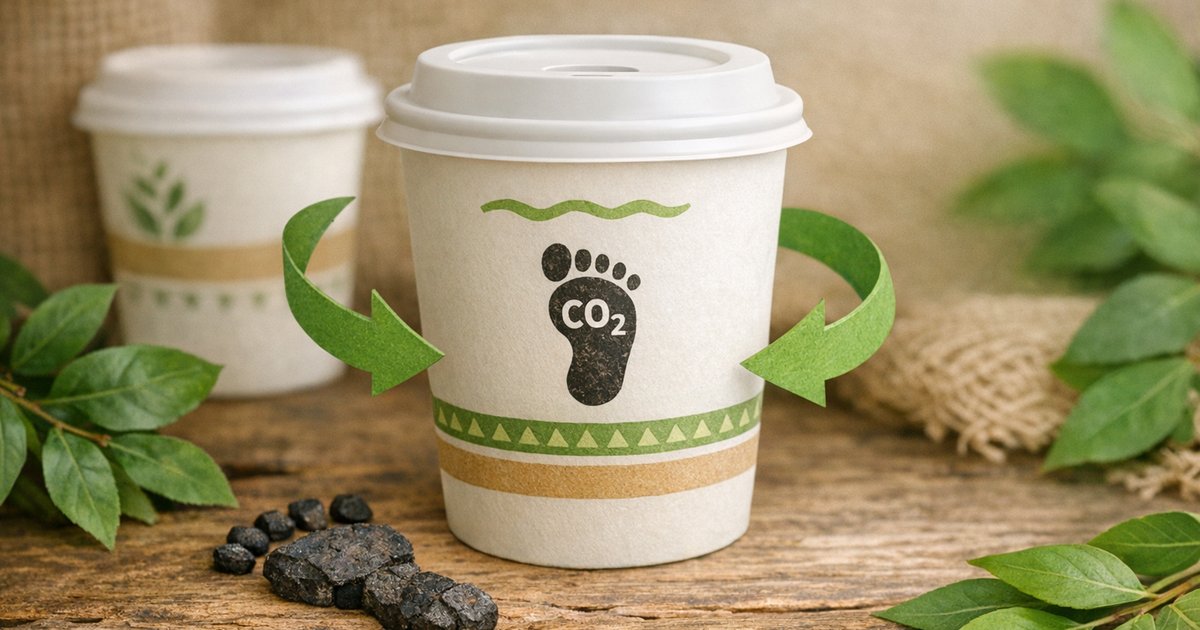
Short answer: The carbon footprint of a paper coffee cup typically sits around 30–80 g CO2e per cup for a standard PE‑lined single‑use cup. Most emissions come from fibre production, the plastic lining and transport; the final climate outcome depends on end‑of‑life handling (landfill, recycling or industrial composting). To inspect materials and print quality, order a sample pack or view our custom printed coffee cups. For a full buying overview, read our custom printed coffee cups guide.
What contributes to the carbon footprint of a paper coffee cup?
The carbon footprint of a paper coffee cup is the sum of greenhouse gases released across its life cycle. Key contributors are:
- Fibre production: Harvesting, pulping, bleaching and drying paper fibres. Virgin pulp normally has higher emissions than recycled content or certified fibre (eg FSC).
- Plastic lining: Most single‑use cups use a polyethylene (PE) lining; producing and applying that lining adds fossil‑fuel emissions.
- Printing & converting: Full‑colour CMYK printing and cup manufacture consume energy and consumables — accurate artwork avoids reprints (we offer free templates and a design layout service).
- Transport: Shipping raw materials and finished cups — local manufacture and consolidated orders reduce per‑cup transport emissions.
- End‑of‑life: Landfill, incineration, recycling or industrial composting change the net impact depending on local infrastructure and recovery rates.
Estimated emissions by life stage (typical ranges)
| Life stage | Approx. share of CO2e |
|---|---|
| Pulp production & paper manufacture | 40–60% |
| Lining (PE) & lamination | 15–30% |
| Manufacture & printing | 5–15% |
| Transport & distribution | 10–25% (highly variable with distance and shipping mode) |
| End‑of‑life | Variable — landfill can produce methane; composting helps only with the right facilities |
How the carbon footprint of a paper coffee cup compares with reusables
Whether a reusable cup has a lower footprint depends on how many times it’s used and how it’s cleaned. Typical break‑even use counts are:
- Ceramic mugs: Often ~100–300 uses (efficient dishwasher use reduces the break‑even point; hand‑washing increases it).
- Reusable polypropylene or stainless cups: Often ~50–200 uses depending on washing method and lifespan.
- Disposable paper cups: Lower manufacture emissions per item, but single‑use means higher per‑use footprint unless reusables are used many times.
For takeaway customers, single‑use cups remain practical. The best ways to reduce the carbon footprint of a paper coffee cup are to encourage reuse, choose responsibly sourced board, offer compostable options only where industrial composting exists, and optimise procurement.
Disposal: landfill, recycling and composting in Australia
- Landfill: PE‑lined cups break down slowly and anaerobic conditions can generate methane if organics degrade.
- Recycling: PE‑lined cups require specialised cup recycling streams (availability varies across Australian states and councils), so recycling rates are low in many regions.
- Composting: Compostable cups (PLA/CPLA) can be better at end‑of‑life — but only if they reach industrial composting facilities with the right temperatures and retention times; home composting and most kerbside green bins are often unsuitable.
Practical ways Australian businesses can reduce the footprint
Reducing your paper cup carbon footprint is practical and often cost‑effective. Actions for cafés, caterers and event organisers include:
- Encourage and incentivise reusables: Offer a discount for BYO cups or run an on‑site reusable cup program and track uptake.
- Choose compostable only where infrastructure exists: Offer PLA/CPLA cups if your council or local processor accepts them — otherwise they may contaminate recycling.
- Buy responsibly sourced board: Specify FSC or post‑consumer recycled content to lower forest‑related emissions.
- Consolidate orders: Avoid frequent small orders — our minimum order is 500 cups, and ordering to this or larger multiples reduces per‑cup transport and packaging impacts.
- Work with a local supplier: We manufacture in Australia. Standard production is 10 business days plus 2–3 days metro freight; rush is 5–7 business days.
- Right‑size cups: Offer 8oz, 12oz and 16oz options to avoid over‑serving.
- Use clear disposal signage: Simple labels and bins increase correct disposal rates and lower contamination.
Operational tips to cut per‑cup emissions
- Consolidate and time reorders to reduce transport intensity.
- Use lids only when necessary — lid options include PS, fibre and CPLA.
- Use our free artwork templates to avoid reprints caused by artwork errors.
- Monitor uptake of reusable incentives so you can optimise the program and measure impact.
Product choices and trade‑offs
Choose based on operational needs, end‑of‑life and budget.
- Single‑wall (PE) — lightweight and cost‑effective.
- Double‑wall (PE) — better heat retention and hand comfort.
- Compostable (PLA/CPLA) — better end‑of‑life where industrial composting exists.
Full‑colour CMYK printing is available. We provide AI & PSD artwork templates and a design layout service — upload your logo and we’ll prepare print files for approval. Want to inspect materials and print quality before ordering? Request a sample pack. Ready to order for your café or event? View our custom printed coffee cups and contact our team to discuss compostable or double‑wall options.
Balanced conclusion
The carbon footprint of a paper coffee cup is modest per item but accumulates quickly at scale. Reusables usually win after many uses, yet single‑use cups remain important for takeaway, events and hygiene. A pragmatic approach for Australian businesses is a mixed strategy: encourage reuse, offer compostable cups only where local industrial composting exists, buy responsibly sourced fibre and order efficiently to reduce transport emissions.
Quick checklist for businesses
- Check local access to industrial composting and specialised cup recycling in your council area.
- Choose cup type accordingly: compostable only where appropriate; otherwise use responsibly sourced PE‑lined or recycled board.
- Consolidate orders to reduce freight intensity; remember the minimum order is 500 cups.
- Promote reuse incentives and install clear disposal signage to cut contamination.
- Use supplier support — free artwork templates and request a sample pack before you order.
Production & ordering notes: Minimum order 500 cups. Standard production 10 business days plus 2–3 days metro freight. Rush option: 5–7 business days. Free templates available.
More on sustainable cups
- Compostable coffee cups explained
- Can compostable cups go in the green bin?
- Compostable vs standard paper cups
- PLA vs PE cup linings
- Sustainable coffee cup packaging
- Compostable custom coffee cups (product & pricing)
- Eco-friendly takeaway cups (product & pricing)