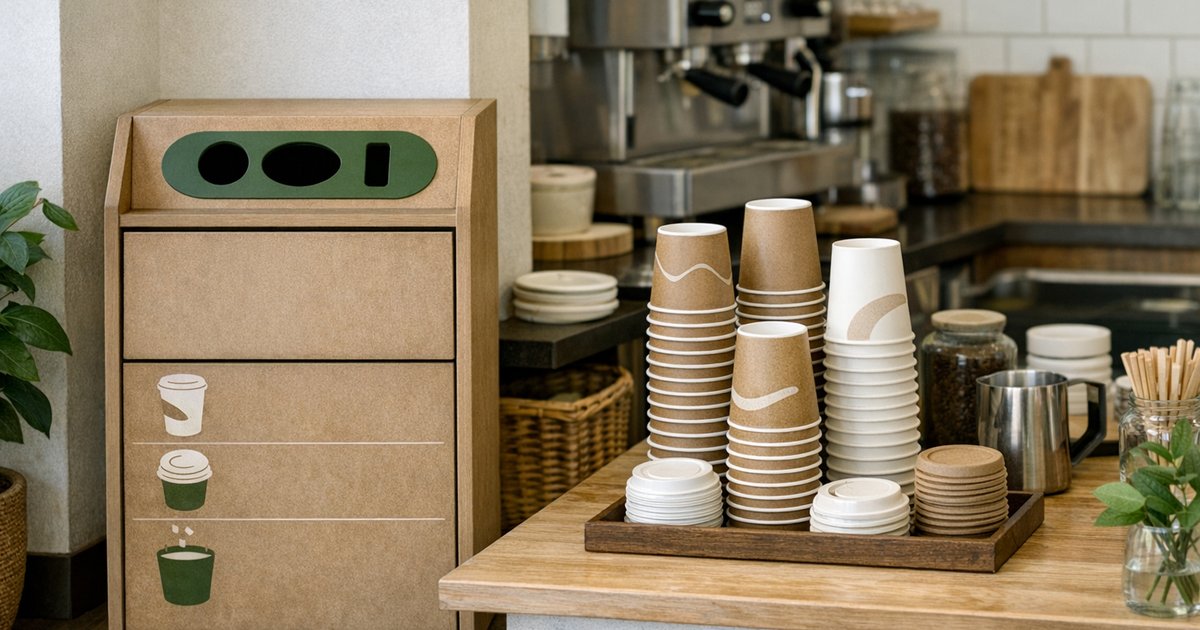
Short answer: your kerbside recycling bin cannot process a plastic-lined cup, but dedicated collection programs can. They work by keeping cups out of general waste entirely, collecting them separately, and sending them to processors with technology that separates the plastic liner from the paper fibre. Simply Cups is the best-established program in Australia. It is a paid service, and it only works if your team actually uses it properly.
Why a separate program is needed at all
A takeaway cup is paperboard laminated to a thin plastic film. Standard material recovery facilities are not equipped to separate them, so cups in a kerbside bin are generally screened out and landfilled, and can contaminate the paper stream on the way.
That is the gap these programs fill. They are not a different bin for the same system. They are a parallel collection route to a different kind of processor. Background in are paper coffee cups recyclable in Australia.
Simply Cups
Simply Cups is an initiative of Closed Loop and is Australia’s largest paper cup recycling program. The model works like this:
- You register as a collection point and receive collection equipment, typically a dedicated back-of-house 240 litre bin.
- Cups are collected separately from your general waste, on a schedule you choose. Weekly, fortnightly and four-weekly options are available depending on your volume.
- Collected cups go to processors who separate the liner from the fibre.
- The recovered material is turned into products such as bench seating, kerbing and car stops.
- You receive reporting on the volume collected, which is genuinely useful if you report on sustainability.
It is a paid service, charged as a regular fee that depends on your collection frequency and volume. Pricing changes, so get a current quote directly rather than relying on a figure quoted on a blog.
Other routes worth knowing
- Council and precinct schemes. Some councils and business districts run cup collection trials or permanent programs. These come and go, so check what is currently operating in your area rather than assuming.
- Large site programs. Universities, hospitals, stadiums and corporate campuses often run their own collections, which is why you will see dedicated cup bins on campuses. See university and school branded cups.
- Commercial organics. If you use compostable cups and have a commercial organics service that explicitly accepts certified compostable packaging, that is a legitimate route. Confirm acceptance in writing, because many organics streams exclude packaging. See can compostable cups go in my green bin.
- Responsible Cafes. Focused on encouraging reusables rather than collecting cups, but a useful network if reducing cup volume is your aim.
What actually determines whether it works
Every venue that has tried this will tell you the same thing: the technology is not the hard part. Contamination is.
- Lids and straws are usually not accepted with the cups, because they are a different material. They have to be separated at the bin.
- Liquid must be emptied. Cups half full of coffee cause problems downstream.
- Front of house versus back of house matters. A public-facing bin gets contaminated by customers. Staff-managed back-of-house collection is far more reliable, which is why programs are often set up that way.
- Signage and staff briefing are not optional. A bin with no explanation becomes a general waste bin within a week.
A badly run collection produces a contaminated load that gets rejected, which means you paid for a service and still sent cups to landfill.
Questions to ask before signing up
- What is the total cost, including equipment, collection and any minimum term?
- What exactly is accepted, and are lids included or excluded?
- What is the contamination threshold, and what happens to a rejected load?
- Is my location actually serviced, at the frequency I need?
- What reporting do I receive, and in what format?
- What happens to the material afterwards, specifically?
Be careful how you advertise it
Joining a program does not make your cups recyclable in a general sense, and it does not entitle you to print “recyclable” on them. What you can accurately say is that your venue participates in a cup collection program, and that cups returned to your venue are recycled through it.
That distinction matters under Australian Consumer Law. See eco claims on coffee cups.
The honest ranking
If reducing cup impact is the goal, in order of effect:
- Serve sit-in customers in ceramic. Free, immediate, and removes the cup entirely.
- Encourage reusables for regulars, with a discount if it suits your pricing.
- Join a collection program for the cups you genuinely cannot avoid.
- Choose the lining deliberately, matched to the disposal route you actually have.
- Order accurately so you are not throwing away unused stock. See how many cups your cafe needs.
Note that changing cup material sits fourth. Where the cup goes matters more than what it is made of, which is the single most useful thing to understand about this topic.
Where to go from here
See how to make your coffee cup packaging more sustainable and how many cups Australia uses each year. For compostable options, view our compostable custom coffee cups.