Short answer: print sits on the outside wall of the cup and never contacts your drink. Cup printing uses inks formulated for food packaging, which are designed and tested with migration in mind. That said, “food safe” is a phrase used loosely in this industry, so here is what it actually means and what to ask before you commit to a supplier.
The most important point: print is on the outside
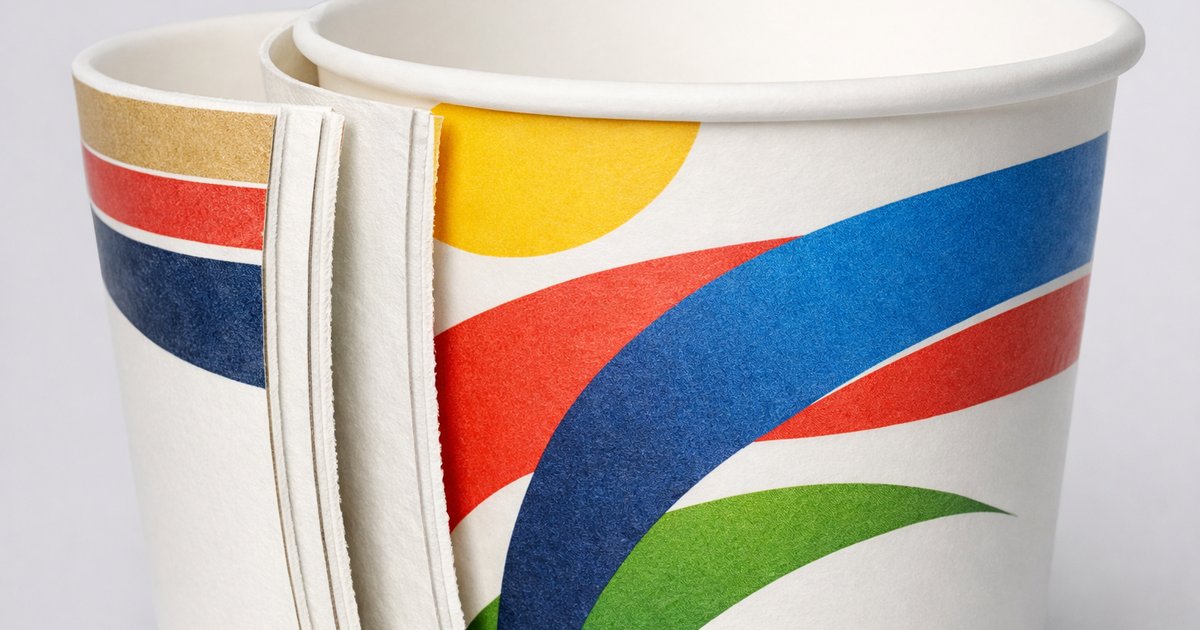
The inside face of a cup is the food contact surface. It carries the waterproof lining and nothing else. All printing happens on the outer wall, and it happens while the cup is still a flat blank, before it is ever formed into a cup.
So under normal use, printed ink and beverage never meet. This is the primary control, and it is a design principle rather than a coincidence. More on the constraint in can you print inside a coffee cup.
Then why do inks matter at all?
Because “not in direct contact” is not the same as “cannot possibly transfer”. Packaging regulators worldwide take two indirect routes seriously:
- Set-off. Cups are stacked and nested. The printed outer wall of one cup rests against the inner face of the cup above it. In theory, ink components could transfer from one surface to another in the stack.
- Migration through the substrate. Board is porous. Low-molecular-weight components can in principle move through it.
This is exactly why packaging inks are a specialised category rather than ordinary commercial printing inks, and why the good ones are formulated with low-migration chemistry.
What “food-grade ink” actually means
There is no single global certificate that makes an ink “food safe”. What responsible manufacturers work to is a combination of:
- Composition control. Formulated from materials assessed as suitable for food packaging use, avoiding substances of concern.
- Low-migration design. Chemistry chosen so that components are unlikely to migrate in meaningful quantities.
- Documented compliance. A written statement from the ink manufacturer, referencing the framework it complies with.
In Australia, food contact materials fall under the general requirement that packaging must be safe for its intended use, administered through Food Standards Australia New Zealand. Australia does not maintain a separate positive list for printing inks in the way some jurisdictions do, so suppliers here typically rely on European or Swiss frameworks, which are the most developed. That is normal industry practice and worth understanding rather than being alarmed by.
What to ask a supplier
Vague questions get vague answers. These get useful ones:
- “Can you provide the ink manufacturer’s declaration of compliance?” This is the single best question. A real document beats any verbal reassurance.
- “Are the inks low-migration grade formulated for food packaging?” Specific and answerable.
- “Which framework does the declaration reference?” You are looking for a named standard, not “it’s food safe”.
- “Does this cover the varnish or coating as well as the inks?” Frequently overlooked, and it is a separate material.
- “Is the board itself food-grade, with its own documentation?” The ink is only one part. See what paper coffee cups are made from.
A supplier who cannot produce documentation for the specific stock they are selling you is telling you something useful.
Two related questions people ask
Does heat change anything? Hot liquid is inside the cup and the print is outside, separated by the board and the lining. The heat-related question that has actual research behind it concerns the lining, not the ink, and we cover it in are paper coffee cups safe.
Does more ink coverage mean more risk? Not in a way that should change your design. Full-wall colour is standard across the industry and is accounted for in how packaging inks are formulated and applied. It is not a reason to restrict your artwork, and full colour is included in our pricing anyway. See full colour vs single colour printing.
Where we stand
We would rather hand you a document than a slogan. If your business needs ink or board compliance documentation for a tender, a food safety audit, or your own due diligence, contact us with what you need and we will request the current declaration for the specific stock your order would use.
Related reading: PFAS in coffee cups and how coffee cup printing works.