Author: admin

  • Bleed, Safe Zone & Wrap: Understanding Coffee Cup Print Templates

    Bleed, Safe Zone & Wrap: Understanding Coffee Cup Print Templates

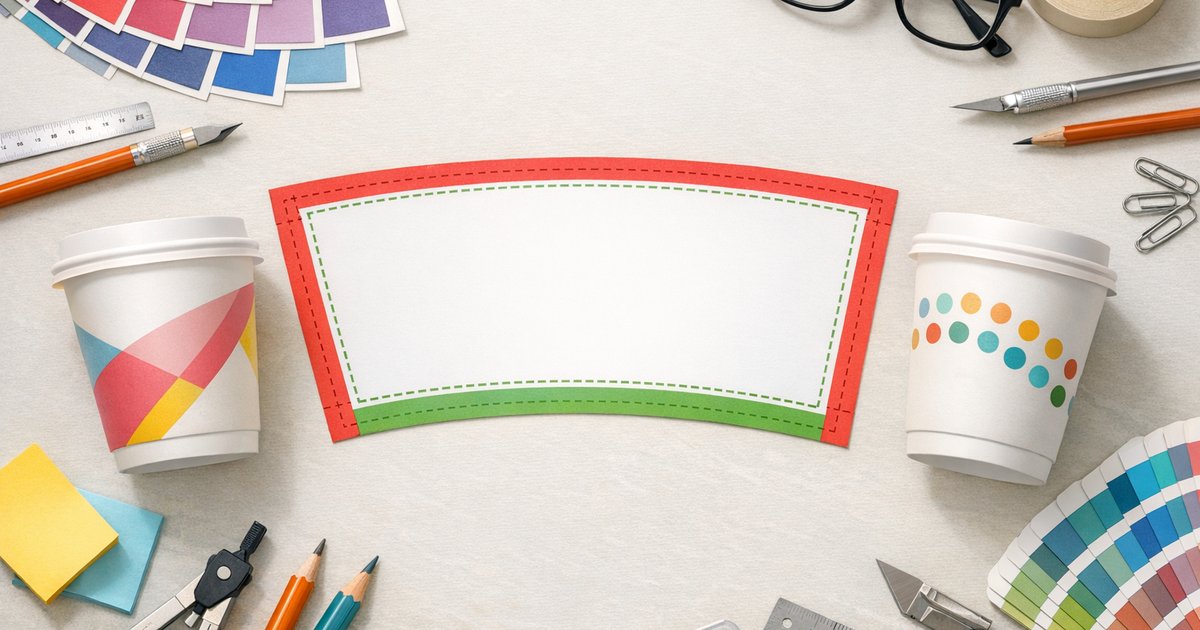
    What is a coffee cup print template? A coffee cup print template is the flattened dieline (a curved trapezoid) used to layout artwork for a tapered takeaway cup. It shows the trim line, a recommended 3mm bleed, the safe zone for logos and text, and the seam/glue overlap so artwork wraps correctly when the cup is formed. Always use the supplier’s exact template for single‑wall, double‑wall or compostable cups, and order a sample pack to check alignment and colour before full production — minimum order is 500 cups.

    Why this template matters

    Using the correct coffee cup print template prevents trimmed or distorted artwork and shows where to keep logos clear of the seam and curved edges. Suppliers supply separate dielines for different cup types and sizes, so match the template to the cup you’re ordering.

    Template components — a quick guide

    • Trim line: finished edge where the panel is cut — nothing critical should sit outside this line.
    • Bleed: extra artwork beyond the trim (we recommend 3mm) to avoid white edges after trimming.
    • Safe zone: inner margin to keep logos and text clear of trimming and curvature.
    • Seam / glue overlap: a small overlap area (commonly 5–8mm) where panels join — avoid placing important artwork here.

    How to place artwork on the dieline

    Designs wrap 360° around a tapered cup. Think about how people hold and view a cup when placing marks:

    • Front (primary view): place the main logo centred on the front panel and away from the seam.
    • Sides: use repeating patterns or supporting graphics; avoid important text near the seam.
    • Back / seam: position the seam at the rear where possible so the front is uninterrupted.

    Vertical lines may look tilted after forming because the flat template compensates for taper — always request a physical sample if alignment or colour is critical.

    File setup: formats, colour and resolution

    Follow these production standards to avoid delays:

    • Supply artwork in CMYK — we print full‑colour CMYK.
    • Use vector formats (AI, PDF, EPS) for logos and text. For images use high‑res PSD or TIFF at 300 dpi.
    • Outline fonts or embed them; include any linked images at original resolution.
    • Include 3mm bleed and respect the template’s safe zone and seam overlap.

    We provide free AI and PSD templates and a design layout service — upload your logo and our team will place it into the correct dieline for you.

    Recommended margins (quick reference)

    Item Recommendation Why
    Bleed 3mm Prevents white edges when trimmed
    Safe zone (top/bottom) 5–10mm Protects text and logos from curvature or trimming
    Seam overlap 5–8mm Secure join; avoid placing key elements here

    Common problems and fixes

    White rim after trimming

    Cause: insufficient bleed or thin outlines close to the trim. Fix: extend backgrounds into the 3mm bleed and avoid thin high‑contrast lines near the trim line.

    Logo cut off or too close to the seam

    Cause: artwork placed in the seam overlap. Fix: move logos at least 10mm from the seam or request the seam be placed at the rear of the cup.

    Artwork looks distorted on the finished cup

    Cause: using the wrong flat template for the cup style or size. Fix: download the correct dieline for single‑wall, double‑wall or compostable cups and order a physical sample to check alignment.

    Where to download templates and get help

    Each cup model has its own dieline. Download free artwork templates (AI & PSD) and design guides from our custom printed coffee cups product page. If you’d rather, upload your logo and our design team will prepare a print‑ready layout.

    Read the full buyer’s guide for Australian businesses on custom printed coffee cups in Australia.

    Production details — what to plan for

    • Minimum order: 500 cups
    • Cup sizes: 8oz, 12oz, 16oz (16oz available as single‑wall only)
    • Cup types: Single‑wall (PE), Double‑wall (PE), Compostable (PLA/CPLA)
    • Printing: Full‑colour CMYK
    • Standard production: 10 business days + 2–3 days metro freight
    • Rush production: 5–7 business days
    • Lids: PS, fibre and CPLA options
    • Free: artwork templates

    For current prices, see the printed coffee cups page.

    Artwork checklist before you upload

    1. Download the correct cup template for your cup type and size from the product page.
    2. Set the document to CMYK and 300 dpi (or supply vector files).
    3. Include 3mm bleed and keep important elements inside the safe zone.
    4. Keep logos and critical text 5–10mm from top/bottom trim and 10mm from the seam.
    5. Leave the seam/glue area clear of critical artwork.
    6. Outline fonts or embed them and supply source files for complex artwork.
    7. Order a sample pack or printed proof to check fit and colour before production.

    Need help or want a mockup?

    If you’re unsure which template matches your cup, download templates from our product page, read the complete buyer’s guide on custom printed coffee cups in Australia, or order a sample pack to see your artwork on a real cup. Our design team offers a layout service so you can approve artwork before you place a 500‑cup order.

    Ready to get started? Visit the printed coffee cups product page for templates, pricing and quotes, or request a sample pack to check fit and colour before ordering.
    Related reading

  • CMYK vs RGB: Why Your Cup Colours Might Look Different

    CMYK vs RGB: Why Your Cup Colours Might Look Different

    CMYK vs RGB: Why Your Cup colours might look different

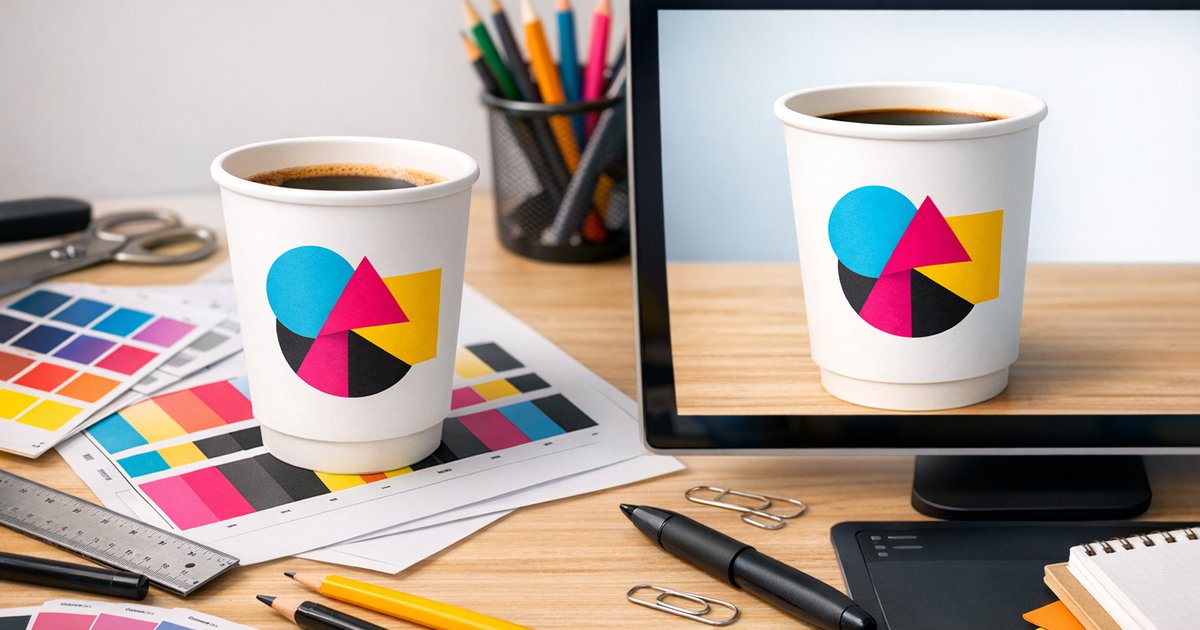
    Short answer: Screen colours (RGB) usually look brighter and more saturated than print because monitors emit light while printing uses inks (CMYK) with a smaller gamut. To avoid surprises with CMYK printing coffee cups, design in CMYK (or convert and proof), avoid neon tones and request a physical proof or sample before ordering.

    Why on‑screen colours and printed cup colours differ

    Monitors create colour by mixing red, green and blue light (RGB). Printing uses cyan, magenta, yellow and black inks (CMYK) on a physical substrate (paperboard, coatings and cup liner). Because print reflects light rather than emits it, very bright or fluorescent RGB colours (neons, electric blues, acid greens) will often shift, mute or change hue when printed on coffee cups.

    RGB vs CMYK — the quick technical difference

    RGB (screens)

    RGB is additive: colours are built from light. It’s the native mode for web and digital files and supports a wider gamut and more vivid hues than typical print processes.

    CMYK (print)

    CMYK is subtractive: inks overlap to absorb/reflect light and produce colour. Standard four‑colour process reproduces most everyday colours, but some saturated RGB tones can’t be matched exactly with the CMYK inks used for cup printing.

    Which colours shift most on cups?

    • Neon and fluorescent tones — effectively impossible to match with standard CMYK inks.
    • Electric blues — may look duller or shift toward teal/purple.
    • Vivid greens — can appear more yellow or darker.
    • Highly saturated reds — may lose vibrancy or warm slightly.

    How to prepare artwork for CMYK printing coffee cups

    Preparing files correctly reduces surprises and rework. Use this checklist when preparing artwork for CMYK printing coffee cups:

    • Work in CMYK from the start — set your document to CMYK in Illustrator, Photoshop or InDesign so on‑screen previews are closer to print.
    • Convert and review — if you start in RGB, convert to CMYK, inspect colours at 100% and tweak shifted hues.
    • Pantone/spot colours — use for critical brand matches and discuss Pantone matching with us if absolute accuracy is essential.
    • Avoid neons — choose CMYK‑friendly alternatives for predictable results.
    • File quality — images at 300 dpi and vector logos (AI/EPS/PDF/SVG) produce the cleanest print on a cup wrap.

    We convert files and provide proofing

    CustomCoffeeCups.com.au converts every incoming file to CMYK before production and offers digital and physical proofing so you can check for colour shifts on the actual cup substrate. Request a proof or order a sample pack early to save time and cost.

    Proofs, Pantone and colour control

    Proofing is the most reliable way to check colours before a full run:

    • Digital proofs — fast, but dependent on monitor calibration.
    • Hard (physical) proofs or sample cups — best: see ink on the actual cup stock and construction (single‑wall, double‑wall or compostable).
    • Pantone references — useful for brand matching; remember Pantone→CMYK conversion and substrate differences can still cause minor variation.

    Practical tips for predictable cup colour

    • Paperboard texture, internal coatings and cup curvature affect perceived colour — view a physical sample where possible.
    • Compostable stocks and double‑wall constructions can show slight colour differences compared with single‑wall PE cups.
    • Calibrate your monitor and review digital proofs on multiple devices to reduce surprises.
    • Allow time and budget for physical proofs or Pantone matching if you need exact brand accuracy.

    Minimums and lead times (Australia)

    For current prices, see the printed coffee cups page.

    Minimum order: 500 cups. Standard turnaround: 10 business days production + 2–3 business days metropolitan freight. Rush: 5–7 business days. Freight is charged at cost and varies by destination and quantity.

    Files and design help we provide

    We make colour setup easier with:

    • Free artwork templates (AI & PSD) for correct cup wrap layout.
    • Sample pack — order a sample to see stock and print quality in person: sample pack.

    Artwork checklist before you submit

    • Set document to CMYK or convert and review carefully.
    • Use 300 dpi images and vector logos where possible.
    • Avoid neon colours; select CMYK‑safe alternatives.
    • Consider Pantone spot colour for absolute brand accuracy.
    • Request a physical proof or sample prior to full production.

    Summary — minimise surprises with CMYK printing coffee cups

    Colours printed on a cup often look different to on‑screen colours because RGB offers a wider, brighter gamut. For consistent results with CMYK printing coffee cups, design in CMYK (or convert and proof), avoid neons, consider Pantone for critical brand colours and request a physical proof or sample. We convert all files to CMYK before printing and provide free templates to make the process straightforward.

    If you’d like to see your brand on a cup, order a sample pack or visit our custom printed coffee cups product page to upload artwork and request a proof. For a deeper overview of cup types, sustainability and workflows, read our complete buyer’s guide.

    Ready to proceed? Head to the product page to upload artwork and request a proof, or contact us to use our design layout service and get a realistic preview before production.

    Related guides

  • Coffee Cup Design Ideas: 15 Examples That Stand Out

    Coffee Cup Design Ideas: 15 Examples That Stand Out

    Coffee Cup Design Ideas: 15 Examples That Stand Out

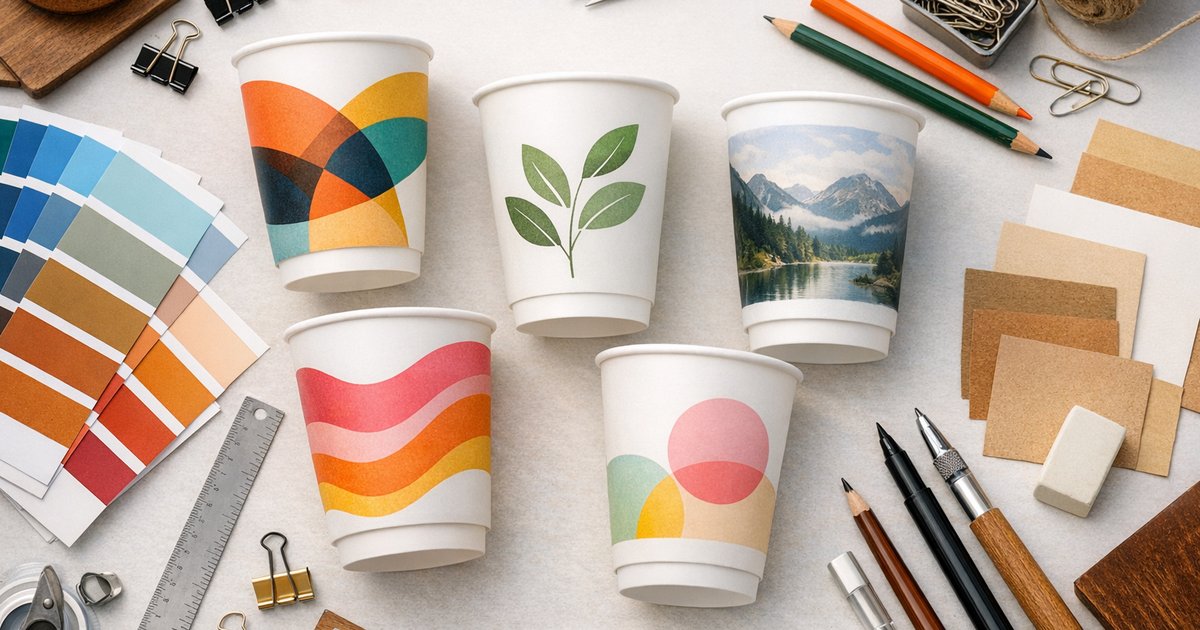
    Need memorable takeaway cups? Here are 15 practical coffee cup design ideas you can use today to make your café, roastery or event more recognisable — plus Australian production notes, pricing and how to get a sample or mock-up (minimum order 500 cups).

    Request a sample pack to feel the materials and get a print-ready mock-up, or jump straight to our custom printed coffee cups page to upload artwork and place an order.

    Why great coffee cup design matters

    Well-designed cups increase perceived quality, encourage social sharing and act as low-cost, mobile advertising. Use these coffee cup design ideas to pick a direction that suits your brand, location (Melbourne, Sydney, Brisbane, Perth or regional Australia) and customers.

    15 coffee cup design ideas (what they are and why they work)

    Below are concise concepts you can adapt to your brand colours, fonts and tone of voice.

    1. Minimalist: logo + solid colour

    Full-colour wrap in a single bold hue with a centred logo in white or black. Clean, premium and instantly recognisable — great for speciality cafés and corporate outlets.

    2. Inverted minimalist: colour block base + white top

    Two-tone split with a small logo near the rim. Highlights the drinking area and photographs consistently on phones.

    3. Bold geometric patterns

    Repeating shapes (triangles, chevrons, concentric circles) in high-contrast tones. Energetic and eye-catching for festivals, markets and busy cafés.

    4. Tropical or botanical repeats

    Layered palms, leaves or florals in muted or vibrant greens. Works well for beachside cafés, seasonal menus and brands emphasising freshness.

    5. Photographic: coffee beans close-up

    Macro shots of roasted beans wrapped around the cup with a subtle logo overlay. Use high-resolution images (300 dpi) for clean printing.

    6. Photographic: local landscape or cityscape

    Panoramic imagery of a local suburb, coastline or skyline builds community pride — ideal for regional roasters and cafés that celebrate place.

    7. Typography-led: bold statement word

    One large word (for example “WAKE”, “SIP”, “GOOD”) in a distinctive typeface. Simple and highly shareable on social media.

    8. Quirky quotes and micro-copy

    Short, playful lines like “Fuel for meetings” or “Handle with care.” Micro-copy humanises the brand and invites customers to read and share.

    9. Hand-lettered / illustrative style

    Hand-drawn doodles, script and illustrations for a handcrafted feel — perfect for independent roasters and boutique cafés.

    10. Character or mascot

    A friendly character interacting with the cup rim or logo. Works well for family-friendly cafés, pop-ups and event stalls.

    11. Negative-space logo play

    Use cut-outs or negative-space elements so the cup’s background becomes part of the mark. Modern and clever when artwork is crisp.

    12. Seasonal themes (Christmas, autumn)

    Limited-run festive patterns (eucalyptus and baubles for December, warm burnt-orange leaves for autumn). Seasonal cups create urgency and shareable moments.

    13. Event-specific designs

    Custom cups for markets, conferences or launches with event dates and sponsor logos — they act as walking promotions and keepsakes.

    14. Industry-specific concepts

    Designs tailored to verticals: blueprint motifs for property events, energetic lines for fitness studios, or pinstripes and monograms for corporate functions.

    15. Eco / compostable aesthetic

    Neutral kraft backgrounds, green accents and a clear compostable mark. Pair this style with our compostable cup options to signal genuine sustainability.

    How to pick the right design for your business

    Match the direction to brand personality and customer expectations. Quick guide:

    • Premium or corporate: minimalist, typographic, muted palettes.
    • Independent cafés & markets: bold patterns, illustrative styles, mascots.
    • Roasters emphasising origin: photographic wraps or local landscapes.
    • Eco-focused operators: kraft-style designs and clear compostable messaging.

    Production notes — ordering customised cups in Australia

    We print full‑colour CMYK artwork and supply AI/PSD templates. Our designers provide a design layout service to convert your logo into a print-ready mock-up.

    • Minimum order: 500 cups
    • Cup types: Single-wall (PE), Double-wall (PE) and Compostable (PLA/CPLA)
    • Sizes: 8oz, 12oz, 16oz
    • Standard turnaround: 10 business days production + 2–3 business days metro freight
    • Rush production: 5–7 business days production
    • Free: printable templates

    For current prices, see the printed coffee cups page.

    Design-to-print tips

    • Supply high-resolution images (300 dpi) for photographic wraps to avoid banding or pixelation.
    • Avoid fine detail near the rim and seams — thin strokes can disappear when the panel is wrapped.
    • Request both matte and gloss mock-ups: finishes change how colours and contrast read in real life.
    • Allow for bleed and panel seams when placing logos and important copy.
    • Order a physical sample pack to confirm material, print finish and lid fit before committing.

    Want help visualising your coffee cup design ideas?

    We offer a sample pack so you can feel the materials and inspect print quality. Upload your logo with the sample request and our design team will prepare a print-ready mock-up for approval.

    Ready to order? Visit our custom printed coffee cups page to choose cup type, confirm pricing and upload artwork, or request a sample pack first. For more planning advice, read our Custom Printed Coffee Cups Australia guide.

    Need personalised advice? Our team can recommend the best cup type, finish and quantity based on your menu, audience and sustainability goals — minimum orders start at 500 cups. Contact us via the product pages to upload artwork and start your layout.

    Related guides

  • Branded Coffee Cups for Small Business: Is It Worth It at 500 Units?

    Branded Coffee Cups for Small Business: Is It Worth It at 500 Units?

    Yes — ordering 500 branded coffee cups for small business is often worth it. That includes full‑colour CMYK printing, free artwork templates. Standard production is 10 business days + 2–3 days metro freight; rush is 5–7 business days. Want to check materials first? Order a sample pack to inspect paper, print and lid fit.

    Is 500 branded coffee cups for small business worth it?

    Short answer: yes in many cases. A 500‑cup run is a low-cost way to trial branded cups, improve perceived value, generate mobile advertising and encourage social shares — all without a large upfront spend. It’s a practical test run for cafés, food trucks and hospitality operators wanting tangible marketing impact.

    For current prices, see the printed coffee cups page.

    Production notes & important extras

    • Minimum order: 500 cups.
    • Standard production: 10 business days + 2–3 days metro freight. Freight charged at cost (typically $30–$150 depending on destination).
    • Rush production: 5–7 business days.
    • Includes full‑colour CMYK printing, free artwork templates (AI & PSD).

    What a 500 run buys your business

    Ordering 500 branded coffee cups for small business delivers measurable retail and marketing benefits:

    • Stronger brand perception: professional, consistent packaging supports premium pricing.
    • Mobile advertising: cups become walking billboards in offices, on public transport and at events.
    • Social media potential: well‑designed cups are more likely to be photographed and shared on Instagram, TikTok and Facebook.
    • Improved customer experience: attractive packaging enhances the takeaway moment and can boost repeat visits.

    Practical example: 50 takeaway cups per day

    If your café serves ~50 takeaway coffees a day, a 500‑cup run covers about 10 service days — perfect for short promotions, menu launches or seasonal campaigns.

    • Visibility: roughly 50 mobile impressions per day while the stock lasts.

    How branded cups compare with other marketing

    • Social ads: can deliver thousands of impressions for $200–$500 but need ongoing optimisation and spend.
    • Flyers: 1,000 flyers usually cost $200–$500 and are often discarded quickly.
    • Signage: good long‑term presence but fixed location reach and higher upfront cost.
    • Branded cups: physical, mobile and experiential — they reach customers where they are and continue to advertise while in use.

    When 500 branded coffee cups for small business may not be ideal

    • Very low takeaway volumes (under ~10/day) — stock may sit for months.
    • If sustainability is a core brand value — consider compostable cups (higher cost) and fibre lids.
    • Frequent rebranding — if you change designs often, consider staggered orders or neutral base stock between campaigns.

    Design & samples — we make it easy

    We provide free artwork templates and a design layout service so your artwork is print‑ready. Prefer to feel the stock first? Order a sample pack to check material, print quality and lid fit before committing to 500 units.

    Measuring ROI

    Simple signals to track the impact of branded cups:

    • Change in daily takeaway sales over 10–30 days after switching to branded cups.
    • Increase in social mentions, tagged photos or branded hashtags.
    • Customer feedback or a quick barista survey on perceived value.
    • Foot traffic and repeat visit rates.

    Recommendations & next steps

    • Test with a 500× single‑wall 8oz run — the most cost‑effective way to trial branded cups for small business.
    • Order a sample pack first to inspect quality and sizing.
    • Need a quote, rush delivery or design help? Visit our custom printed coffee cups product page to request a personalised quote and layout.

    Want a deeper guide to materials, printing options and sustainability? Read our Custom Printed Coffee Cups Australia Guide for a comprehensive overview.

    Ready to try branded coffee cups for your small business? View product options and pricing on our custom printed coffee cups page or order a sample pack to see quality in hand. Need a personalised quote or design assistance? Contact us via the product page and we’ll prepare layouts and lead‑time details for your 500‑cup run.

  • How to Order Custom Coffee Cups Online (Step-by-Step)

    How to Order Custom Coffee Cups Online (Step-by-Step)

    Short answer: To order custom coffee cups online in Australia, pick your cup type (single‑wall, double‑wall or compostable), choose size and quantity (minimum 500), add lids if required, upload artwork or use our design layout service, approve a digital proof, then wait for production and delivery. Standard production is 10 business days + freight (rush 5–7 business days). Sample packs and artwork templates are available.

    Why follow a clear step-by-step process?

    Ordering printed cups involves choices that affect cost, timing and the customer experience. Use this concise 9-step guide to order custom coffee cups online confidently — ideal for cafés, events and branded takeaways across Australia.

    Quick overview

    • Cup types: Single‑wall (PE), Double‑wall (PE) — double‑wall available in 8oz & 12oz only — and Compostable (PLA/CPLA).
    • Sizes: 8oz, 12oz, 16oz (16oz is single‑wall only).
    • Minimum order: 500 cups.
    • Printing: Full‑colour CMYK. Free AI & PSD artwork templates and a design layout service available.
    • Turnaround: Standard production 10 business days + 2–3 business days metro freight. Rush 5–7 business days.

    Step-by-step: How to order custom coffee cups online

    Step 1 — Choose your cup type

    Decide between:

    • Single‑wall — lightweight and cost‑effective; suitable for most hot drinks.
    • Double‑wall — better insulation and hand feel; available in 8oz and 12oz.
    • Compostable — PLA/CPLA option if sustainability is a priority.

    Step 2 — Select size (8oz, 12oz, 16oz)

    Match cup sizes to your menu. 8oz and 12oz suit most cafés; 16oz is single‑wall only. If unsure, order a sample pack to check volumes, materials and lid fit.

    Step 3 — Choose quantity (minimum 500)

    Our minimum order is 500 cups. Prices fall at higher quantities — contact us for a tailored quote.

    Freight is charged at cost and depends on destination and order size.

    Step 4 — Add lids if needed

    Lids are optional and available in PS, fibre and CPLA. Always confirm lid compatibility with your chosen cup size and ask about lead times if you need lids quickly.

    Step 5 — Upload artwork or use our design service

    Upload print‑ready artwork at checkout. We accept AI, PSD and common high‑resolution formats. If you don’t have print‑ready files, our design layout service will prepare your artwork from your logo and brief. Download our free templates to ensure correct bleed and safe zones.

    Step 6 — We send a digital proof

    We supply a detailed digital mock‑up showing placement and approximate colours on your chosen cup. Digital proofs are a close visual guide but not a physical colour match — order a sample if exact colour fidelity is required.

    Step 7 — Approve the proof

    Check spelling, sizing, logo placement and alignment. Once you approve the proof production begins. Minor revisions can usually be made before final sign‑off.

    Step 8 — Production begins

    After approval we start production. Standard production is 10 business days. Rush production (5–7 business days) is available.

    Step 9 — Delivery

    We ship Australia‑wide. Metro freight is usually 2–3 business days; regional delivery may take longer. Freight is charged at cost and varies by location and order size.

    Pre-order checklist

    • Confirm cup type and size.
    • Decide quantity (minimum 500) and whether you need lids.
    • Prepare artwork or use our design layout service and download templates.
    • Allow production time: standard 10 business days (rush available).
    • Order a sample pack to inspect materials, print quality and lid fit before placing a full order.

    Common questions

    Can I order less than 500 cups?

    Our minimum order is 500 cups. For smaller needs, order a sample pack or contact us to discuss pooling orders or alternative stock options.

    How accurate are colours?

    We print full‑colour CMYK. Digital proofs represent colours closely but exact Pantone matches can vary on different stocks — request a physical sample if precise colour accuracy is critical.

    More resources

    For detailed advice on materials, printing methods and choosing the right cup for your business, see our complete buyer’s guide.

    Ready to order?

    Start your order on the custom printed coffee cups product page to choose cup type, size and quantity. Prefer to inspect first? Order a sample pack — we include templates and can provide a design layout to get you print‑ready.

    Call to action: Visit the product page to begin or request a sample pack today to check fit, feel and print quality before you commit.

    Related guides

  • How Long Does It Take to Get Custom Coffee Cups Printed?

    How Long Does It Take to Get Custom Coffee Cups Printed?

    How long does it take to get custom coffee cups printed?

    Quick answer: Standard custom coffee cups turnaround time is normally 10 business days production plus 2–3 business days metro freight — most metro orders arrive in about 2–3 weeks. Rush production is available in 5–7 business days. Allow 1–3 days for proof approval. Minimum order: 500 cups.

    What affects turnaround (at a glance)

    The main factors that determine your custom coffee cups turnaround time are production lead time, proofing & approvals, freight destination and cup choice. Order quantity, print complexity and how quickly you approve proofs also matter.

    Standard production & delivery

    • Production: 10 business days (standard run)
    • Proof approval: 1–3 business days (depends on how quickly you sign off)
    • Freight: 2–3 business days to metro addresses; longer for WA/NT and remote areas

    Combine these and most standard metro orders are delivered in about 2–3 weeks.

    Rush orders

    • Rush production: 5–7 business days
    • Rush jobs still require proof approval and freight — prompt client responses are essential. Some cup types (eg. large 16oz single‑wall) may not be available on rush — check with our team when ordering.

    Practical timeline example (metro delivery)

    1. Order placed and artwork submitted — Day 0
    2. Artwork review and first proof issued — Day 1
    3. Client approves proof — Day 1–3 (fast approval shortens overall time)
    4. Production — 10 business days
    5. Freight to metro address — 2–3 business days

    Total: roughly 2–3 weeks from order to delivery for standard jobs. For remote WA/NT addresses allow extra freight time.

    Freight & regional considerations

    • Metro (capital cities): 2–3 business days
    • Western Australia & Northern Territory: typically 4–5 business days
    • Regional / remote: add 1–2 business days on top

    Freight is charged at cost and varies by quantity and destination. When you enquire, tell us your delivery postcode so we can confirm exact timings and freight cost.

    Production variables that influence lead time

    • Cup type: single‑wall, double‑wall and compostable — compostable runs can take slightly longer depending on material availability.
    • Size: 8oz and 12oz are standard and fastest.
    • Print: full‑colour CMYK is standard — very complex artwork or many revisions can delay proofs and production.
    • Order quantity: minimum order is 500 cups; larger or split deliveries can affect scheduling and freight.

    For current prices, see the printed coffee cups page.

    Artwork, proofing and common delays

    Proof approval is the most common cause of delay. We provide free templates, a design layout service and a sample pack to help speed things up so you can be confident before you order.

    • AI & PSD templates available.
    • Proof approval usually takes 1–3 days if approved promptly; delayed approvals add directly to the overall timeline.

    Quick tips to speed up turnaround

    • Have final artwork ready: supply print‑ready files or use our templates.
    • Assign one approver: one person signing off avoids back‑and‑forth.
    • Choose standard sizes: 8oz and 12oz are the quickest.
    • Use rush production: 5–7 business day production when needed.
    • Order a sample first: request a sample pack to check material and print quality.

    How to plan for events and launches

    1. Set your delivery deadline and share the postcode with us when requesting a quote.
    2. Allow 2–3 business days for metro freight (add extra for regional/WA/NT).
    3. Add 10 business days production plus 1–3 days for proofing.
    4. If timelines are tight, choose rush production and ensure quick proof approvals.

    Frequently asked questions

    Can I get a sample before placing a large order?

    Yes — we offer a sample pack so you can check cups, lids and print quality before ordering.

    Do you provide artwork templates?

    Yes — AI and PSD templates and a design layout service are available to prepare print‑ready proofs.

    What if I need cups in less than 10 business days?

    Opt for our rush service (5–7 business days) and approve proofs immediately. Rush may not be available for all cup types — check with our team when ordering.

    Summary

    Standard custom coffee cups turnaround time is 10 business days production plus 2–3 business days metro freight — about 2–3 weeks total. Rush is 5–7 business days. Fast proof approvals and having artwork ready are the simplest ways to speed delivery.

    Ready to start? Browse our custom printed coffee cups or order a sample pack to check materials and print before you commit. For a full overview of sizes, materials and design options, see our complete buyer’s guide.

    Need a deadline confirmed? Upload your artwork and tell us your delivery date when you request a quote — we’ll confirm the earliest possible schedule and advise if rush production is required.

    Related guides

  • What Paper Are Coffee Cups Made From? PE vs PLA Lining Explained

    What Paper Are Coffee Cups Made From? PE vs PLA Lining Explained

    Short answer: If you’re asking “what are paper coffee cups made of”, they’re made from food‑grade paperboard (measured in GSM) with an inner waterproof lining — usually PE (polyethylene) for standard cups or PLA/CPLA for compostable options. Cups are available as single‑wall or double‑wall and are printed in full‑colour CMYK on the outer board.

    Quick overview — what are paper coffee cups made of?

    In short: an outer food‑grade paperboard (260–350 GSM) + an inner lining (PE or PLA/CPLA) + printed artwork. Use the notes below to choose the right cup for your café or event.

    • Outer board: food‑grade paperboard, weight measured in GSM (common 260–350 GSM; ~300 GSM balances rigidity and feel).
    • Inner lining: PE (standard) or PLA/CPLA (commercially compostable).
    • Construction: single‑wall (economical) or double‑wall (extra insulation).
    • Printing: full‑colour CMYK printed on the outer board before forming.

    Outer layer: food‑grade paperboard and GSM

    The visible surface is a sheet of food‑grade paperboard. Most takeaway cups use board between 260–350 GSM. Around 300 GSM is common because it gives good rigidity, high print quality and a premium feel without too much weight.

    Inner lining: why a coating is essential

    Paper soaks liquid, so the inner surface needs a waterproof coating. The two common linings are:

    PE (polyethylene) — the standard lining

    PE is a plastic lining used widely because it’s cost‑effective and reliably waterproof — the default choice for many cafés.

    • Pros: lower cost, dependable waterproofing and consistent performance.
    • Cons: not compostable; recycling depends on whether your local MRF accepts mixed paper/plastic containers.

    PLA / CPLA — compostable linings

    PLA is a plant‑based polymer (often from corn or sugarcane). CPLA (crystallised PLA) is heat‑stable for hotter drinks.

    • Pros: commercially compostable in industrial facilities — good if you have a commercial organics program.
    • Cons: higher cost than PE; requires industrial composting (not reliably home‑compostable); can contaminate recycling if wrongly disposed.

    Single‑wall vs double‑wall

    Single‑wall cups are one layer with an inner lining — lighter and cheaper. Double‑wall cups have two boards with an air gap for insulation, so they stay cooler to touch and the drink stays warmer longer, but they cost more and are bulkier.

    How printing is applied

    Artwork is printed on the flat outer board before cups are formed. We accept AI and PSD files, supply templates and offer a design layout service. Printing is full‑colour CMYK, using digital or flexographic processes depending on run size and artwork.

    1. Place your artwork on our flat board template (we supply AI & PSD).
    2. We print the board, laminate the inner lining and then form the cups.
    3. Cups are packed and shipped — you can request a sample pack first.

    Minimums and lead times

    Minimum order: 500 cups.

    Turnaround: standard production 10 business days + 2–3 business days metro freight (freight charged at cost). Rush production: 5–7 business days. We include free templates.

    Environmental and practical trade‑offs

    Consider these operational and disposal points when choosing between PE and PLA/CPLA:

    • Cost: PE is more economical; PLA/CPLA costs more.
    • Disposal: PLA requires industrial composting; PE may be recyclable where your council/MRF accepts mixed paper/plastic — check local guidance.
    • Operations: Compostable cups make sense only if you can collect them into commercial organics or a council program — otherwise they risk contaminating recycling streams.

    Practical guidance for Australian cafés

    • Default economical option: PE‑lined single‑wall cups.
    • If you want better insulation and fewer sleeves: choose double‑wall (available in PE and compostable options).
    • If you operate within a council organics program (Sydney, Melbourne, Brisbane etc.) or have commercial composting, PLA/CPLA can be an option — always verify acceptance with your council or composting provider first.

    Common questions

    Are PLA‑lined cups home‑compostable?

    No — PLA and CPLA generally require industrial composting with sustained high temperatures. Home composts won’t reliably break them down.

    Can PE‑lined cups be recycled?

    Sometimes. Recycling depends on your local material recovery facility (MRF). Some councils accept mixed paper/plastic containers; many do not. Check your local council’s guidelines before advertising cups as recyclable.

    Which lining should my café choose?

    For most Australian cafés the practical default is PE for cost and consistency. Choose PLA/CPLA if you have access to industrial composting, clear customer messaging and bin infrastructure to keep compostables separate.

    What are paper coffee cups made of — final recap

    To recap “what are paper coffee cups made of”: food‑grade paperboard (GSM) with an inner waterproof lining of either PE (standard) or PLA/CPLA (compostable). You can choose single‑wall or double‑wall constructions depending on cost, insulation and end‑of‑life needs.

    Design help, samples and ordering

    We provide artwork templates (AI & PSD), a design layout service and a sample pack so you can feel the stock, compare linings and check print quality before ordering. Ready for pricing with your logo or want a quote? Visit our custom printed coffee cups page or read the complete buyer’s guide for more details.

    Want to compare materials in person? Order a sample pack to check GSM, lining and print. Ready for pricing with your logo? Get a quote on our custom printed coffee cups page — minimum orders start at 500 cups.

    Related guides

  • Full Colour vs Single Colour Printing on Coffee Cups

    Full Colour vs Single Colour Printing on Coffee Cups

    Full Colour vs Single Colour Printing on Coffee Cups

    Full-colour printed coffee cups use CMYK digital or offset printing to reproduce photographs, gradients and unlimited colours — ideal for cafés, events and marketing campaigns across Australia. Minimum order is 500 cups; standard production is 10 business days plus 2–3 days metro freight (rush option available). Order a sample pack or get a tailored quote on our custom printed coffee cups page.

    What is full-colour printing (CMYK)?

    Full-colour printing builds every colour from four inks: Cyan, Magenta, Yellow and Key/Black (CMYK). At CustomCoffeeCups.com.au we use CMYK digital/offset processes that support photographic images, smooth gradients, full-wrap designs and detailed artwork without charging per colour.

    Benefits of full-colour printed coffee cups

    • Unlimited colours & gradients — include photos, textures and photographic wraps at no per-colour fee.
    • Photo-quality results — good reproduction for images and subtle colour transitions.
    • Fine detail and small type — better edge sharpness for complex logos and small copy.
    • Flexible edits — update artwork without extra setup for spot inks or plates.
    • Strong brand impact — ideal for cafés, pop-ups, festivals and promotional campaigns in Australia.

    Full-colour vs single-colour (spot-colour)

    Spot-colour (single-colour) printing uses one or more solid inks. It can be more economical for deliberately simple designs at large quantities and can achieve exact Pantone matches (including some metallic effects). However, it’s limited creatively compared with CMYK full-colour printing.

    When spot-colour makes sense

    • Minimalist or single‑colour branding where the look is intentional.
    • Strict brand rules that require an exact Pantone/spot-colour match.
    • Very large runs where per-colour setup costs are spread across volume.

    Why many Australian cafés choose full-colour

    For cafés and marketers who need memorable packaging, full-colour printed coffee cups remove creative constraints — you can include photos, gradients and full-wrap designs without a separate charge per colour. For marketing-driven applications, full-colour often delivers greater impact for a similar price point to spot-colour options.

    Artwork, colour accuracy and proofs

    All full-colour jobs are produced in CMYK. If you supply RGB files (common for web) colours may shift during conversion — screens use light (RGB) while printers use ink (CMYK). To reduce surprises we offer:

    • Free artwork templates (AI & PSD) with correct dielines, bleed and safe areas.
    • Digital proofs before production so you can approve colour conversions.
    • A sample pack to inspect stock and print quality in person.

    Quick tips to avoid colour surprises

    • Design in CMYK where possible or ask our studio to convert and advise.
    • Avoid relying on neon or very bright RGB colours — they don’t have direct CMYK equivalents.
    • Keep important type and logos inside the template safe area.

    Production details and sizes

    Minimum order: 500 cups. Contact us for freight to regional and remote Australia.

    • Standard turnaround: 10 business days production + 2–3 days metro freight.
    • Rush option: 5–7 business days production available.
    • Freight: calculated at cost (typically $30–$150 depending on quantity and destination).
    • Free services: artwork templates.

    Quick comparison — full-colour vs single-colour

    • Full-colour printed coffee cups: Best for photos, gradients, full-wraps and complex logos; no per-colour charges; excellent for marketing impact.
    • Single‑colour / spot-colour: Suits intentionally minimalist designs and exact Pantone matches; useful when strict brand colour control is required.

    Proofing, samples and design support

    We provide digital proofs and free templates. Upload your artwork and our studio will prepare a print-ready proof and advise on colour conversions or Pantone matching. To check materials and print quality in person, order a sample pack — it includes example stocks and print types (single-wall, double-wall and compostable).

    Which printing should you choose?

    Choose full-colour printed coffee cups if you want photographic imagery, gradients or full-wrap branding — they’re flexible and cost-effective for most café and event applications. Choose spot-colour if your brand requires an exact Pantone match or a deliberate single-colour aesthetic. If you’re unsure, our studio can recommend the best method and prepare a proof.

    For a full overview of cup types, printing methods and design tips, see our complete buyer’s guide.

    Ready to see the difference? Order a sample pack or visit our custom printed coffee cups page for a tailored quote. Our team will convert files to CMYK, provide a digital proof and advise on compostable or double-wall options. Minimum order 500 cups; standard turnaround 10 business days (+ freight).

    Need help right now? Get a quote or upload your logo and we’ll prepare a proof and timeline.

    Related guides

  • Paper Cup Lids Guide: PS, Fibre, CPLA & Which to Choose

    Paper Cup Lids Guide: PS, Fibre, CPLA & Which to Choose

    Paper Cup Lids Guide: PS, Fibre, CPLA & Which to Choose

    Short answer: For most cafés and events choose PS (polystyrene) lids for the lowest cost and most reliable fit; pick CPLA if you need an industrially compostable lid with PS‑like performance, or moulded fibre for a natural, premium look. Minimum order for printed cups is 500 cups, and we offer a sample pack so you can test fit and feel before you buy coffee cup lids Australia.

    Which lid types we stock

    We supply three common lid types in the typical Australian café sizes (80mm and 89mm): PS (polystyrene), moulded fibre and CPLA. Each option has different cost, appearance and compostability traits — choose based on budget, branding and waste‑stream availability.

    PS (polystyrene) lids — standard & economical

    • What: Injection‑moulded plastic lids (usually white or black).
    • Pros: Lowest cost, tight/snag‑free fit and consistent splash/sip protection.
    • Cons: Not biodegradable; recycling availability depends on local council services in Australia.
    • Best for: High‑volume outlets prioritising cost and consistent performance.

    Fibre lids — moulded paper pulp, natural look

    • What: Moulded paper‑pulp lids with a textured, natural finish.
    • Pros: Premium, eco‑friendly appearance; recognised by customers as a sustainable choice.
    • Cons: Higher cost than PS; industrial composting usually required; performance with very long holds can vary.
    • Best for: Brands that want a rustic look and match lids with compostable cups.

    CPLA lids — compostable with PS‑like performance

    • What: Crystallised PLA is a plant‑based resin that snaps and fits like conventional plastic but is industrially compostable.
    • Pros: Very similar fit and heat resistance to PS; better consumer sustainability story.
    • Cons: More expensive than PS; requires industrial composting (not home compostable); local processing availability varies across Australia.
    • Best for: Businesses using compostable cups or wanting a greener lid without compromising fit.

    Sizes, fit and compatibility

    Our lids come in two size groups that match common cup diameters: 6/8oz and 12/16oz. Typical pairings:

    • 8oz cups — 6/8oz lids (PS, CPLA, Fibre)
    • 12oz cups — 12/16oz lids (PS, CPLA, Fibre)
    • 16oz cups (single‑wall only) — 12/16oz lids (PS, CPLA, Fibre)

    Practical note: Always trial lids with a sample pack to confirm fit, sip comfort and appearance.

    Key pricing & ordering essentials

    Quick facts to know before you order coffee cup lids Australia:

    • Minimum cup order: 500 cups (lids are usually ordered in cartons of 1,000).
    • Common lid diameters: 80mm and 89mm to match standard cup rims.
    • Printing: Full‑colour CMYK printing available on cups; lids are typically unprinted.
    • Production & lead times: Standard: 10 business days production + 2–3 days metro freight. Rush: 5–7 business days.
    • Freight & packaging: Freight charged at cost (typically $30–$150 depending on weight/destination). Lids generally arrive in cartons of 1,000.
    • Extras: Free artwork templates (AI & PSD).

    Which lid should you choose?

    Use these quick cues based on budget, sustainability goals and customer experience:

    Choose PS lids if

    • You need the lowest cost and the most consistent fit for busy service.
    • You prioritise durability and consistent sip performance over compostability.

    Choose CPLA lids if

    • You want an industrially compostable lid that performs like PS.
    • You have access to industrial composting or will provide clear disposal guidance to customers.

    Choose fibre lids if

    • Your brand emphasises a natural, premium aesthetic and sustainability messaging.
    • You accept slightly higher cost and possible variation in long‑hold performance.

    Compatibility — quick pairing guide

    Cup Recommended lid(s) Notes
    Single‑wall (PE) PS, CPLA PS is best for cost; note a PE‑lined cup is not fully compostable even with a CPLA lid.
    Double‑wall (PE) PS, CPLA PS is common; CPLA offers an eco alternative with similar fit.
    Double‑wall compostable (PLA/CPLA) CPLA, Fibre Match compostable cups with compostable lids to support clear sustainability claims.

    Practical tips and trade‑offs

    • Check local processing: Most compostable lids (CPLA, fibre) require industrial composting — check your council or commercial organics provider before advertising compostability in Australia.
    • Customer perception: Fibre lids often read as most eco‑friendly to customers, even when both fibre and CPLA need industrial composting.
    • Stocking strategy: Keep a small run of PS lids for busy periods if you offer compostable lids to balance cost and availability.
    • Try before you buy: Order a sample pack to test lid fit, sip comfort and aesthetics before committing to a full order.

    Next steps — test and order

    We print full‑colour CMYK on cups and provide free artwork templates plus a design layout service. Upload your logo and we’ll prepare print‑ready artwork for approval. To test combinations, request your sample pack, or visit our product page to see pricing and request a quote.

    For a full overview of cups and lids together, see our Custom Printed Coffee Cups — Australia guide.

    Ready to decide? Request a sample pack to try lids and cups, or visit our product page for pricing and to request a quote. Remember: minimum order is 500 cups — a practical choice for cafés and events across Australia looking for reliable coffee cup lids Australia businesses trust.

    Related guides

  • Minimum Order Quantities for Custom Cups: What to Expect

    Minimum Order Quantities for Custom Cups: What to Expect

    Short answer: Our custom coffee cups minimum order is 500 cups (ex GST). Standard turnaround is 10 business days production + 2–3 days metro freight; rush is 5–7 business days. We include free artwork templates (AI & PSD).

    At a glance

    • Minimum order: 500 cups (ex GST)
    • Turnaround: Standard 10 business days production + 2–3 days metro freight. Rush (5–7 business days).
    • Extras: free artwork templates.

    Why suppliers set custom coffee cups minimum order quantities (MOQs)

    MOQs exist because each custom print run carries fixed setup costs that don’t reduce with each extra cup. Typical fixed costs include artwork setup, digital plates or screens, colour separation, machine setup and test runs, plus quality control and handling. Those one‑off costs are spread across the run; the larger the run, the lower the fixed cost per cup.

    Our 500‑cup minimum keeps unit prices affordable for Australian cafés, market stalls, events and one‑off promotions while keeping upfront spend and storage manageable.

    How per‑cup pricing improves as you scale

    Per‑cup price is made up of a fixed setup portion plus a variable material/print portion. As quantity increases, the fixed portion is spread over more cups and the per‑cup cost falls. Larger runs reduce unit cost but require higher upfront spend and more storage — so 500 is often the best compromise for small businesses, pop‑ups and launches.

    For current prices, see the printed coffee cups page.

    Why a 500‑cup minimum is a good sweet spot

    Our custom coffee cups minimum order of 500 is deliberately set to support Australian small businesses, pop‑ups and events. Benefits include:

    • Low‑risk testing: Trial a new design or promotion without committing to thousands of cups.
    • Event‑friendly quantities: 500 suits market stalls, product launches, weddings and small festivals — minimising excess stock.
    • Manageable inventory & cashflow: Easier to store and less impact on cashflow than very large orders.
    • Predictable lead times: Standard production and optional rush service make planning straightforward.

    How to choose between 500, 1,000 or more

    Ask the following:

    1. Is this a one‑off event or ongoing daily service?
    2. Do you have storage space and cashflow for a larger run?
    3. Can you consolidate orders across sites, seasons or partners to reduce unit costs?

    If you’re unsure, start with 500 and order a sample pack to confirm material, print and lid choices before scaling.

    Practical tips to lower overall cost

    • Keep artwork simple — heavy ink coverage, gradients and special effects increase costs and can affect lead times.
    • Order lids in bulk — ordering together can reduce the per‑drink cost.
    • Consolidate sizes where possible — mixing sizes gives flexibility but can affect per‑size pricing.
    • Consider sustainability: compostable cups cost more but can strengthen your environmental messaging and appeal to eco‑conscious customers.

    Ordering details at a glance

    • custom coffee cups minimum order: 500 cups (ex GST)
    • Cup types: Single‑wall (PE), Double‑wall (PE), Compostable (PLA/CPLA)
    • Sizes: 8oz, 12oz, 16oz
    • Printing: Full‑colour CMYK. We provide free artwork templates (AI & PSD) and a design layout service.
    • Turnaround: Standard 10 business days production + 2–3 days metro freight. Rush 5–7 business days.
    • Freight: Charged at cost — typically $30–$150 depending on quantity and destination

    Next steps — samples, quotes and ordering

    Want to inspect materials and print quality before committing? Order our sample pack to feel cup weight, test lids and check print fidelity.

    Ready for a tailored quote based on your artwork, quantities (500, 1,000, 5,000 or custom), lids and freight? Request a tailored quote — we’ll include any rush fees and exact lead times.

    View our custom printed coffee cups product page or get a sample pack here. For a full overview of choices, quantities and sustainability options, see our complete buyer’s guide.

    Need help deciding? Contact us for personalised advice on the right quantity and cup type for your business — we’ll explain how the custom coffee cups minimum order of 500 compares to larger runs for budget, timing and sustainability.

    Related guides