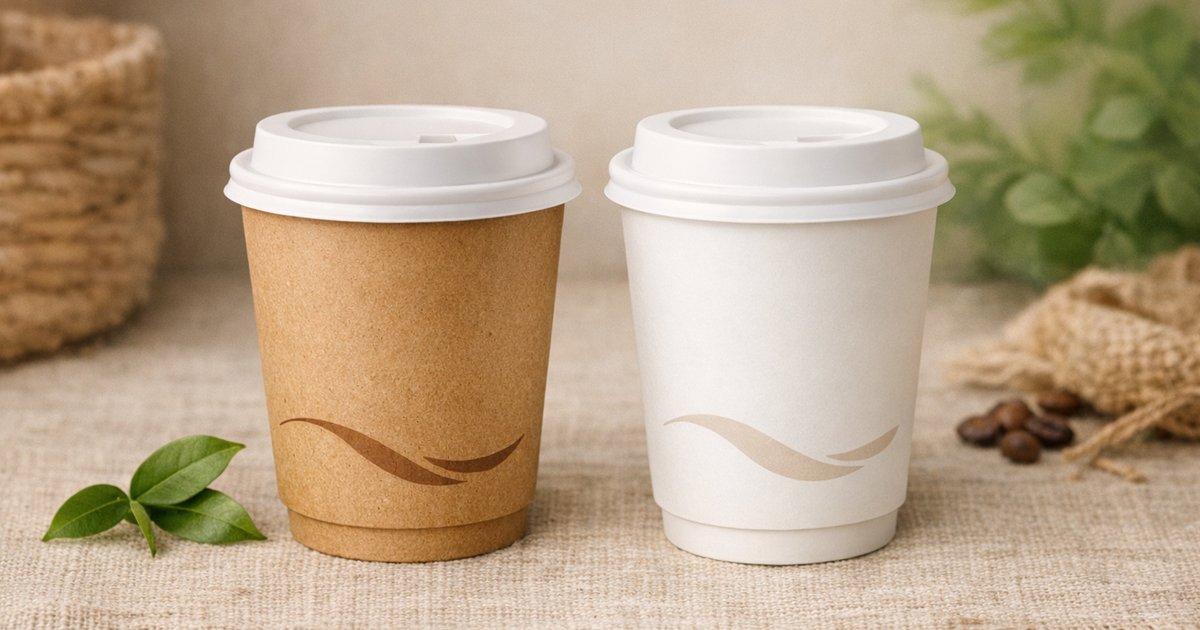
Short answer: not automatically, no. Kraft brown is a board colour, not an environmental property. A brown cup with a standard plastic lining is exactly as recyclable, or as unrecyclable, as a white cup with the same lining. What determines the environmental outcome is the lining and where the cup ends up, not the shade of the paper.
This is one of the most persistent assumptions in takeaway packaging, and it is worth unpicking carefully, because acting on it can lead you to make a claim you cannot support.
What kraft actually is
Kraft refers to a pulping process. Kraft board is typically unbleached or only lightly bleached, which is where the brown colour comes from. White cup board has been bleached to a consistent white.
So the honest environmental difference is the bleaching stage. Skipping or reducing bleaching does avoid some processing, and that is a genuine if modest difference. It is not nothing, and it is also not the thing people imagine when they see a brown cup.
What kraft does not change
Here is the part that matters. A kraft cup still needs a waterproof lining, for exactly the same reason a white cup does: paper alone dissolves under hot liquid.
That lining is what makes cups difficult to recycle, because most paper mills cannot separate a polymer film from board. So a brown cup with a standard PE lining faces precisely the same end-of-life problem as a white one. See are paper coffee cups recyclable in Australia.
The visual cue and the actual property have come apart. Brown looks unprocessed, so it reads as compostable. The colour is telling you nothing about the lining.
The thing that actually matters: the lining
If your goal is a lower-impact cup, the decision that carries real weight is the lining, not the colour:
- PE lining. Fossil-based plastic film. Standard, cheapest, hardest to process at end of life.
- PLA lining. Plant-based, compostable in industrial facilities where accepted.
A white cup with a compostable lining has a better environmental story than a brown cup with a PE lining, even though the brown one looks greener on the counter. The comparison is set out in PLA vs PE cup lining.
And the lining only pays off if the cup reaches the right waste stream. A compostable cup in a general waste bin goes to landfill like anything else. See can compostable cups go in my green bin.
The branding trade-off
There is a practical printing consequence that often gets discovered too late.
Kraft board is brown, so it is not a neutral canvas. Every colour you print sits on a warm brown base and shifts accordingly. Blues dull, whites are not achievable as a printed colour, and bright vivid tones lose their punch. Photographic imagery in particular does not reproduce well.
Designs that work on kraft are the ones that embrace it: one or two colours, bold shapes, strong line work, and the brown itself used as part of the palette. Designs that fight it, like a precise corporate blue or a full-colour photograph, will disappoint you.
We cover this in how to make your brand colours pop on a paper cup. If your brand depends on exact colour matching, white stock gives you a far more predictable result.
The claims risk
This is where the assumption gets expensive. If you choose brown cups and then describe them as eco-friendly, sustainable or recyclable without checking what the lining actually is and where the cup can actually go, you are making an environmental claim you may not be able to substantiate.
The ACCC has published guidance for businesses making environmental claims, and unsubstantiated green claims attract real regulatory attention. We cover what you can and cannot safely say in eco claims on coffee cups.
The blunt version: do not let the colour of your cup write your marketing copy.
So is there any case for kraft?
Yes, an aesthetic one, and that is a perfectly legitimate reason. Kraft communicates warmth, craft and informality, and it suits a lot of brands. Choose it because it looks right for your business, with a clear understanding that the colour itself is a design decision rather than an environmental one.
What to do instead if impact is the goal
- Choose the lining deliberately. This is the decision with actual environmental content.
- Sort out where cups end up. Collection determines outcome more than material does. See cup recycling programs in Australia.
- Serve sit-in customers in ceramic. The highest-impact and cheapest change available.
- Order accurately. Cups you never use are pure waste. See how many cups your cafe needs.
- Make claims you can back. Specific and substantiated beats vague and green.
Where to go from here
If your priority is genuinely lower impact, look at compostable custom coffee cups and read compostable vs standard paper cups. To talk through stock options for your design, get in touch.